Hannah Sage Kay

Hannah Sage Kay is an arts writer and critic based between New York and Los Angeles, who has contributed to ArtforumThe Art NewspaperAutreBOMBFinancial TimesThe GuardianLos Angeles Review of Books, and Nka Journal of Contemporary African Art, among other publications. She studied art history at NYU’s Institute of Fine Arts and Bard College.

It is about as easy to put the work of Fred Sandback into words as it is to capture it in a picture. Using acrylic yarn stretched taut to create various shapes and arrangements between the walls, floor, and ceiling of a given room, Sandback’s “sculptures,” as he terms them—despite their obviation of any physically quantifiable volume—become nearly indistinguishable from the spaces they occupy.
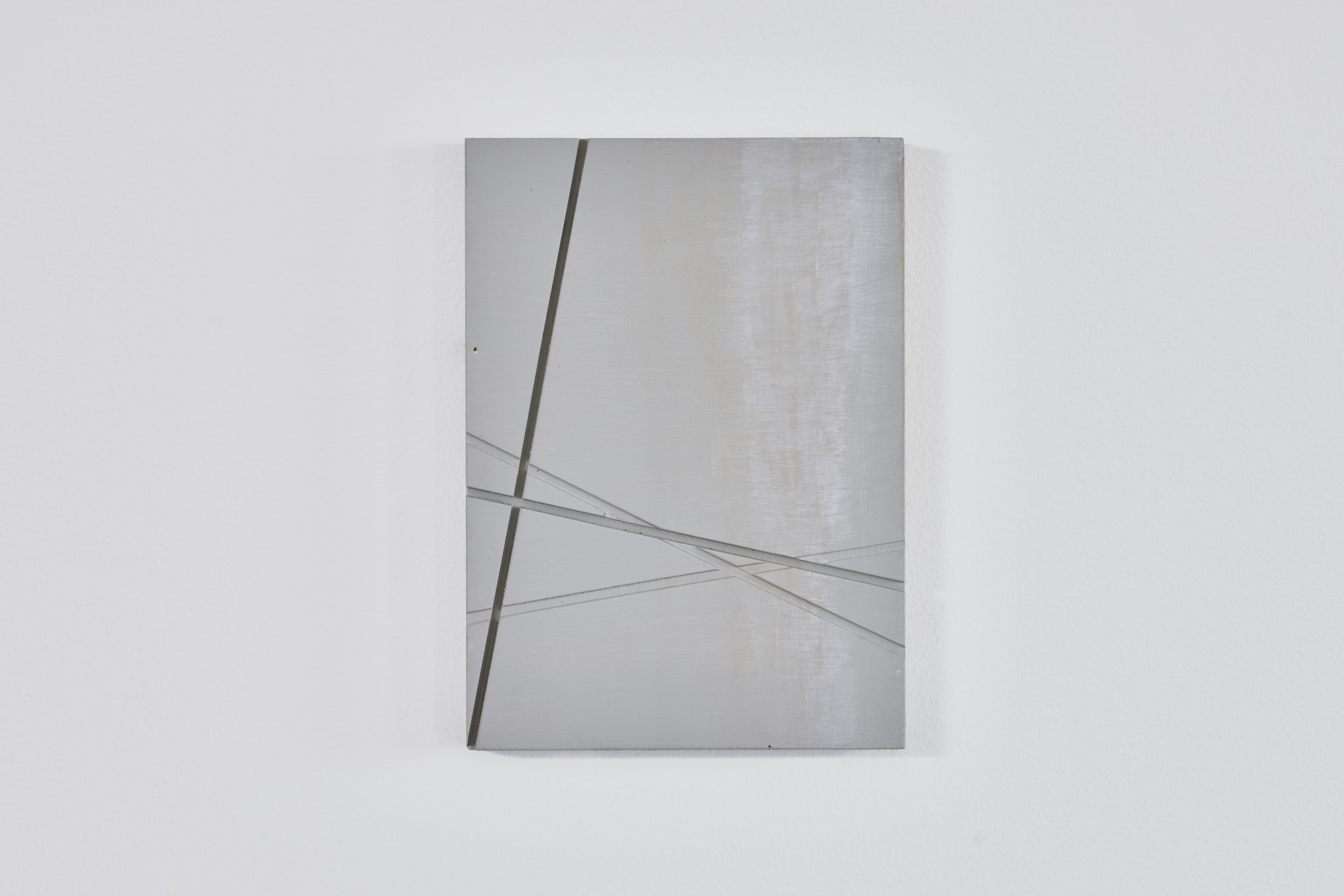
Fred Sandback, Untitled, 1999. Gray housepaint on wood panel. Courtesy Chinati Foundation and Fred Sandback Estate. Photo: Alex Marks.

The portraits hung here, in Glenn Ligon’s exhibition Break it Down at the Aspen Art Museum, tell the story of a single man, and yet many men. Such is the nature, Ligon suggests, of being Black in America.
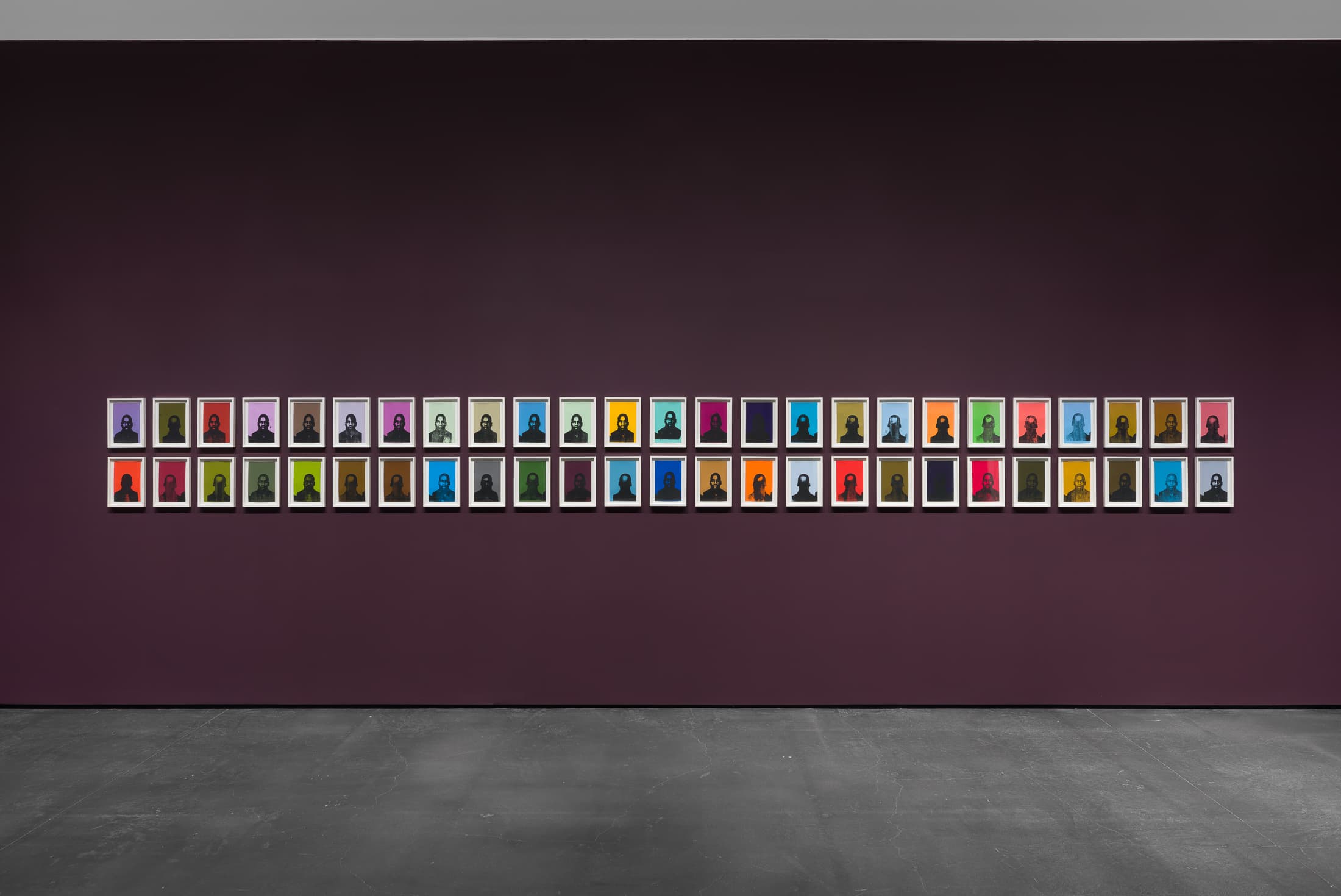
Glenn Ligon: Break it Down

It feels apt that Mire Lee’s current exhibition, Faces, takes the most desiccated parts of our built environment and our bodies to create a presentation that seemingly prizes the last remnants of a tortured existence perennially under threat of annihilation.

Mire Lee, Faces, 2025. Steel frame, polyester fabric, methylcellulose, 14 ⅝ × 11 ⅜ × ⅞ inches. © Mire Lee. Courtesy the artist and Sprüth Magers. Photo: Robert Wedemeyer.

This exhibition is premised largely on the question of what remains legible about identity when the cultural symbols and touchstones that define the presentation of self are stripped away or shuffled.

Alex Da Corte, The Pied Piper, 2019. Neoprene, EPS foam, upholstery foam, staples, thread, polyester fiber, epoxy clay, MDF, plywood, 120 × 120 × 6 ½ inches. © Alex Da Corte. Courtesy the artist and the Modern Art Museum of Fort Worth. Photo: Karma.

What resounds most clearly throughout Carl Cheng's current survey exhibition, Nature Never Loses, at the Contemporary Austin, is the unanticipated resilience of the natural world and our enduring obliviousness to its resolve.

Carl Cheng , Alternative TV #3, 1974. Plastic chassis, acrylic water tank, air pump, LED lighting and controller, electrical cord, aquarium hardware, conglomerated rocks, and plastic plants, 14 1/2 x 11 1/2 x 8 inches. Courtesy the artist and Philip Martin Gallery, Los Angeles. Photo: Ruben Diaz.
Since 1994, Edward Steichen’s landmark exhibition The Family of Man has been on display at Clervaux Castle—an outpost of the Centre national de l'audiovisuel (CNA)—in northern Luxembourg. Between 2011 and 2013, these works underwent a campaign of conservation treatments that Luxembourger photographer Jeff Weber was invited to document.
Jeff Weber, Untitled (Operation Ivy, Mike / 1), 2011-13. Silver gelatin prints, 43 ⅓  x 51 inches. Documentation of the restoration of photographs from the collection The Family of Man at the CNA by Studio Berselli.
For Gary Simmons, who observed the vast disconnect between the political nature of hip hop and the contemporary, predominantly abstract, art of the 1980s, the union of these two modalities engendered an artistic language that could speak simultaneously to multiple publics. Neither didactic nor illustrative, but rather legible and generative, Simmons’s work prompts viewers through subtly affective clues to examine their relationship to those symbols from popular culture that he re-forges into biting social commentary.
Gary Simmons, Step Into the Arena (The Essentialist Trap), 1994. Wood, metal, canvas, Ultrasuede, pigment, ropes, and shoes, 85 × 120 × 120 inches. Whitney Museum of American Art, New York; gift of the Peter Norton Family Foundation. Courtesy Hauser & Wirth. © Gary Simmons.
An exhibition of seven sci-fi assemblages made by Manuel Alejandro Rodríguez-Delgado from repurposed materials which, though undergirded by a general memento-ization of home and family, serve as prototypes for the cultivation and sustainment of life on an inhospitable Earth or extraterrestrial environment.
Manuel Alejandro Rodríguez-Delgado, Jíbaro 2023. Wood, plywood, OSB, HDPE plastic, PVC Plastic, vinyl, rubber, nylon straps,plastic buckles, 2.5 gallon water jug, windshield wiper water pump, hair dryer, power tool batteries, electric wires, bungee cords, duct tape, tarp material, ethafoam, steel, casters, various reclaimed electronics, tropical plant gathered from Puerto Rican rain forest. 98 x 24 x 30 inches. Courtesy the artist and the Canary Test.
Descending the stairs and dirty brown hallway to the two-room Upper East Side basement dwelling that is Meredith Rosen Gallery engenders an air of willing abjection before even entering Anna Uddenberg’s solo exhibition, Continental Breakfast, that features three pseudo-functional contraptions in a white-walled, blue-carpeted, drop ceiling-adorned space with florescent lights that feels like the prelude to a high-class murder.
Installation view, Anna Uddenberg: Continental Breakfast, Meredith Rosen Gallery, New York, 2023. Courtesy the artist and Meredith Rosen Gallery.
Capitalist realism and the many ills it diagnoses are explored in Klammern aus denen Blätter Spriessen (Brackets from which Leaves Sprout), a group show at Hunter Shaw Fine Art in Los Angeles featuring work by Colleen Hargaden, Filip Kostic, Yein Lee, Andrew Rutherdale, Jonas Schoenberg, and a text by Steph Holl-Trieu.
Filip Kostic, Bed PC (Twin), 2022. Custom built water cooled pc, twin sized bed, 49 inch curved monitor, two 27 inch monitors, mounting hardware, split ergonomic keyboard, mouse, and various hardware, dimensions variable. Courtesy Hunter Shaw Fine Art, Los Angeles. Photo: Ruben Diaz.
An homage, a funerary march, a quiet celebration: Louise Lawler’s final exhibition at Metro Pictures, which will permanently shutter its doors in the coming months, resounds with a distinct nostalgia.
Louise Lawler, Untitled (Sfumato), 2021. Dye sublimation print on museum box, 48 x 72 inches. Courtesy the artist and Metro Pictures, New York.
Twisted is the 80-year-old artist’s first ever solo museum exhibition in New York City—despite a career marked by invisibility (whether purposeful or socially enforced), Hershman Leeson has only gained visibility with time.
Lynn Hershman Leeson, The Infinity Engine: Lynn Hershman DNA, 2018. Digital print, 10 1/2 x 7 inches. Courtesy the artist; Bridget Donahue, New York; and Altman Siegel, San Francisco.
By choosing the rather doomed crickets as her subject, Hollander’s Flatwing highlights the enormity of an impact that can be brought about by even the smallest of changes, thus emphasizing the precarity of our present environmental situation and the intensely choreographed nature of the world around us.
Madeline Hollander, Flatwing, 2019. Video, color, sound, 16:25 min. Whitney Museum of American Art, New York. © Madeline Hollander.
Legibility varies greatly in the work of over thirty international artists exhibited in Stories of Almost Everyone at the Hammer Museum in Los Angeles.
Andrea Büttner, HAP Grieshaber / Franz Fühmann: Engel der Geschichte 25: Engel der Behinderten, Claassen Verlag Düsseldorf 1982 (HAP Grieshaber / Franz Fühmann: Angel of History 25: Angel of the Disabled, Claassen Verlag Düsseldorf 1982), 2010. Xerox and clip frames, set of 9. Each: 16 5/8 x 23 3/8 inches. Courtesy the artist, Hollybush Gardens, London and David Kordansky Gallery, Los Angeles. © Andrea Büttner / VG Bild–Kunst, Bonn 2016.
By magnifying the stylistic, architectural, and compositional inconsistencies present within the original comic frames, Kelley highlights the vagaries and mythologies of memory—the tendency to forget and invent a (new) past.
Mike Kelley, Still from ‘Superman Recites Selections from “The Bell Jar” and Other Works by Sylvia Plath’, 1999. Video. Art © Mike Kelley Foundation for the Arts. All Rights Reserved / Licensed by VAGA, New York, NY. Courtesy the Mike Kelley Foundation for the Arts and Hauser & Wirth.
Sounds of life fade away as you, along with four museumgoers and one museum guard, pass through three successive off-white chambers separating the Guggenheim’s rotunda from Doug Wheeler’s PSAD Synthetic Desert in the topmost tower gallery.
Doug Wheeler in the Painted Desert, Arizona, ca. 1970. © Doug Wheeler.
Sounds of life fade away as you, along with four museumgoers and one museum guard, pass through three successive off-white chambers separating the Guggenheim’s rotunda from Doug Wheeler’s PSAD Synthetic Desert III in the topmost tower gallery.
Installation view: Doug Wheeler: PSAD Synthetic Desert III, Solomon R. Guggenheim Museum, New York, March 24 - August 2, 2017. Courtesy Solomon R. Guggenheim Museum.
Take Me (I’m Yours) presents the work of over forty artists, all of whom challenge the time-honored relationship of distance and deference established between art-object and viewer.
Felix Gonzales-Torres, "Untitled" (USA Today), 1990. Candies individually wrapped in red, silver, and blue cellophane, endless supply. The Museum of Modern Art, New York, gi  of the Dannheisser Foundation, 1996. © The Felix Gonzalez-Torres Foundation, courtesy of Andrea Rosen Gallery, New York

Close

Home