Lee Ann Norman

Lee Ann Norman, an Art Editor at the Brooklyn Rail, writes essays and criticism about art, society, and culture.

In the Soloviev Foundation exhibition Between Distance and Desire: African Diasporic Perspectives, curator Tumelo Mosaka asks us to reconsider these structures so that we might know the vastness of African art in the current social, global, and political context.
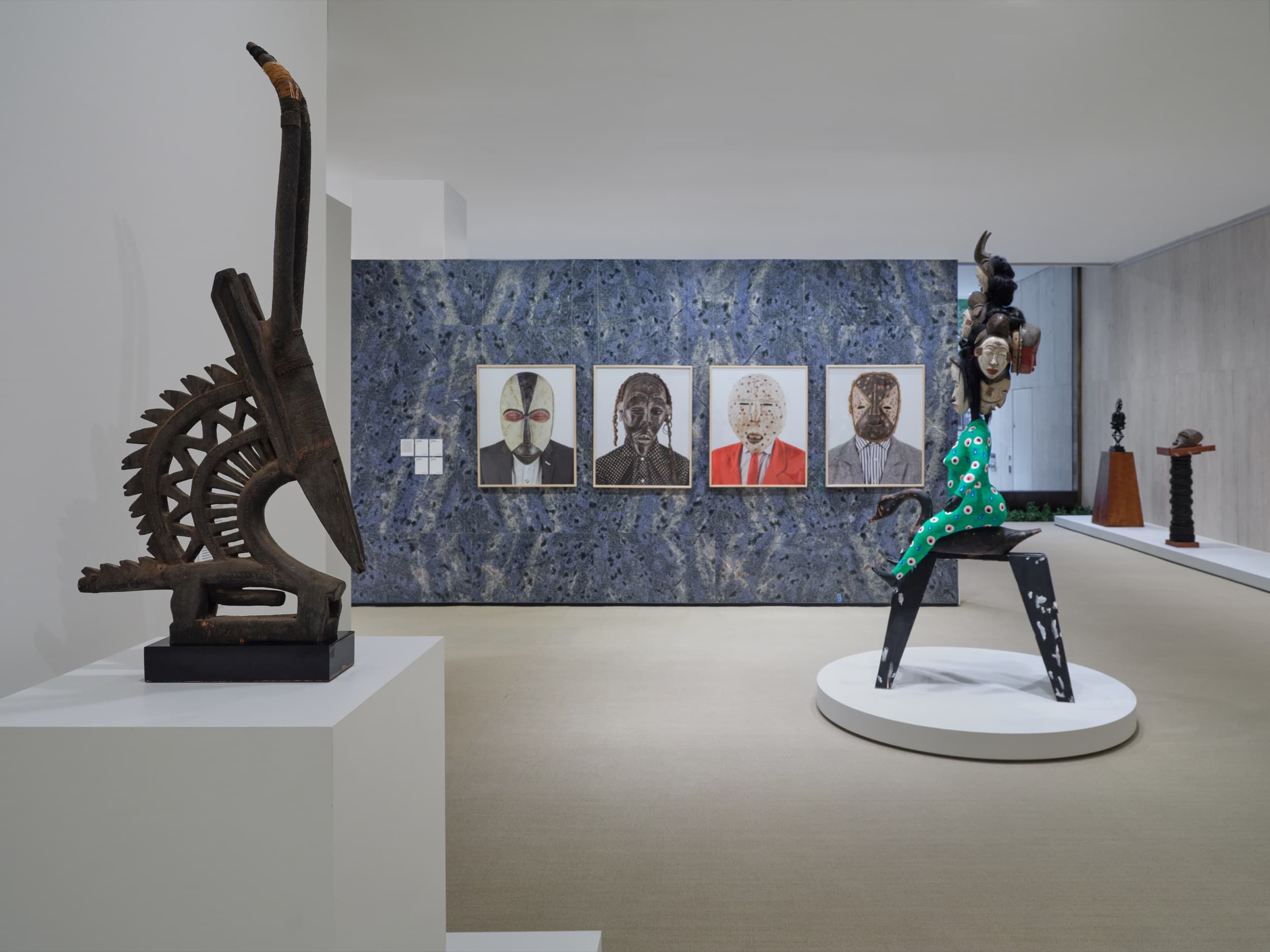
Installation view: Between Distance and Desire: African Diasporic Perspectives, Soloviev Foundation Gallery, New York, 2025. Courtesy Soloviev Foundation Gallery. Photo: Bonnie Morrison.

In Lover’s Knot, Anne Buckwalter reminds us that although there is no place like home, that feeling of bliss often co-exists with complexities, ambiguities, and ambivalences.

Anne Buckwalter, Quilt Study (Spread Eagle), 2025. Gouache on paper, 17 × 19 ¾ inches. Courtesy the artist and Uffner & Liu.

The Messenger does not feel like a standard retrospective, although it is mostly presented like one. But here, chronology takes on new meaning, as it allows us to make connections that reveal how Whitten’s ideas developed, blooming from one foundational form and shifting into another. 

Jack Whitten, Siberian Salt Grinder, 1974. Acrylic on canvas, 80 × 50 inches. © 2025 The Museum of Modern Art, New York. Courtesy The Museum of Modern Art, New York. Photo: John Wronn.

In his first major New York museum exhibition, Ralph Lemon makes an offering of more than sixty works spanning film and video, performance, drawing, installation, text, and sculpture that reveal the depth of a practice rooted in resisting convention. Even after disbanding his dance company thirty years ago, and then going on to create work that traverses and transcends geographies and genres, Lemon continues to poke and push at notions of what it means to make meaning through art.

Installation view: Ceremonies Out the the Air: Ralph Lemon, MoMA PS1, New York, 2024–25. Courtesy MoMA PS1. Photo: Steven Paneccasi.

Pope.L sits on his haunches alongside a building over the course of a few very hot and humid days in July. He is a curious sight—an unambiguously Black man with two jars and plastic spoons set before him. “Warm mayo?” he asks the passerby. “One hundred dollars a dollop,” he adds.

Pope.L, Selling Mayonnaise $100 a Dollop, 1991. Performance. © The Estate of Pope.L. Courtesy the Estate and Mitchell-Innes & Nash, New York. Photo: Jim Pruznik.
What would it mean to disengage from notions of empire? Could we create new structures of knowledge, power, and relation? What conditions must be in place for such a renewal? For Brazilian artist Jaime Lauriano, questions like these are essential to understanding colonial legacies in the Americas, and more specifically, to grasping how they have shaped Brazil in the cultural imagination.
Jaime Lauriano, Meu sangue latino, minh'alma cativa #1, 2023. Acrylic paint, stickers, inkjet printing and prints on MDF. 68.9 x 87 x 2.8 inches. Courtesy the artist and Nara Roesler Gallery.
In Impossible Failures, director Ebony L. Haynes focuses on works by Gordon Matta-Clark and Pope.L that explore the social conditions of space and how creative experimentation might help us to dream of a world that can hold the tension inherent in such social relationships.
Installation view: Gordon Matta-Clark & Pope.L: Impossible Failures, 52 Walker, New York, 2023. Courtesy 52 Walker, New York and Mitchell-Innes & Nash, New York.
Christina Quarles’s work revels in spaces filled with sensuous ambiguity and disorienting complexity. She complicates the figure through abstract gestures and patterns, forcing a longer look when reading her visual language. For Quarles, identity is three-dimensional, comprising what is seen, heard, and felt. Often in her paintings a mess of limbs, torsos, breasts, and buttocks meld and morph into and around each other, resulting in the feeling of stumbling upon someone’s private moments.
Portrait of Christina Quarles, pencil on paper by Phong H. Bui.
The book brings together photographic portraits of people protesting in Zuccotti Park during the Occupy Wall Street movement in Lower Manhattan in 2011 and the racial justice protests across New York City throughout the summer of 2020, filling critical gaps in the narrative around the haves and have-nots.
Accra Shepp’s Radical Justice: Lifting Every Voice
Artists in Residence Gallery (A.I.R.) emerged during a worldwide political and social awakening, when all kinds of people were demanding their rights to equal access to resources. Its seeds were planted in the 1960s, as empires fell and globally, people sought to assert their own values, eschewing those of capitalists, colonizers, and imperialists in nearly every aspect of society, including art and culture.
Founding members of A.I.R. Gallery at 63 Crosby Street. Courtesy A.I.R. Gallery.
Baseera Khan works across media from painting and photography to installation, performance, and sculpture to explore the tensions inherent in living in a capitalist society. Through explorations of material—including their own body—Khan makes plain how notions of economy, labor, goods and services, and art itself often serve as rich sites for exploring our accumulated histories, experiences, and individual and collective traumas. Their current exhibition at the Brooklyn Museum invites us to imagine alternate sites that allow us to refuse empire and resist domination, so we might discover a feeling of liberation instead of exploitation.
Portrait of Baseera Khan, pencil on paper by Phong H. Bui.
A 22-panel accordion book, images of fragmented bodies and reframed scenes ground then disorient us in a past that is elusive yet somehow familiar and within reach. The title references a song by the 1960s girl group the Ronettes, and continues the artist’s exploration of loss, loneliness, theatricality, and queer melancholy.
Pacifico Silano’s I Wish I Never Saw the Sunshine
Lee Ann Norman speaks with Adriana Varejão about her career, artistic influences, and her relationship to the azulejo.
Portrait of Adriana Varejão, pencil on paper by Phong H. Bui.
Made as the AIDS crisis in the United States was at its peak, the photostats—a series of fixed works with white serif text on black fields that are framed behind glass—reflect the contradictions inherent within human beings; a timeless social commentary on the difficult and ongoing work that lies ahead to create a more just world.
Felix Gonzalez-Torres: Photostats
Though a small selection of works, In the Paint aptly demonstrates the foundation for Hendricks’s explorations of aesthetic sensibility and racial identity that would predominate his decades-long career.
Barkley Hendricks, Still Life #5, 1968. Oil on canvas, 51 7/8 x 53 x 1 5/8 inches. © Estate of Barkley L. Hendricks. Courtesy the artist's estate and Jack Shainman Gallery, New York.
In his final days, post-impressionist artist Paul Gauguin undertook one last significant endeavor: to reflect on his life through personal journals, to be published only after his death.
Paul Gauguin's Intimate Journals
In their debut collection of poems, Pinoy writer and visual artist Aldrin Valdez conjures a constellation of identity through the remnants. Memories, photographs, letters, transcriptions, artworks, and pop culture references cleave to reconcile the joy and trauma inherent in a duplicitous, multi-hyphenate world.
Aldrin Valdez’s ESL or You Weren’t Here
From classifying sidewalk stains to the story of a beachcomber finding a bottled message at sea, Ga focuses our attention on the ambiguity and indeterminacy of exploration, and the human desire to rationalize and order the world.
Ellie Ga’s Square Octagon Circle

Close

Home