Jarrett Earnest
Jarrett Earnest is an artist and writer living in New York City. In fall 2019 he curated BREYER P-ORRIDGE: CLOSER AS LOVE: Polaroids 1993-2007 at Nina Johnson, Miami, with companion book published by Matte editions.
Everything Genesis did was dense with layers of intention and association, available to random chance and accumulating coincidence, so that it formed a holograph—one of he/r recurring descriptions of meaningful artifacts.

Fittingly for the name s/he* chose, Genesis Breyer P-Orridge was a protean figure who incalculably influenced the worlds of music, art, performance, literature, and the occult for over half a century.
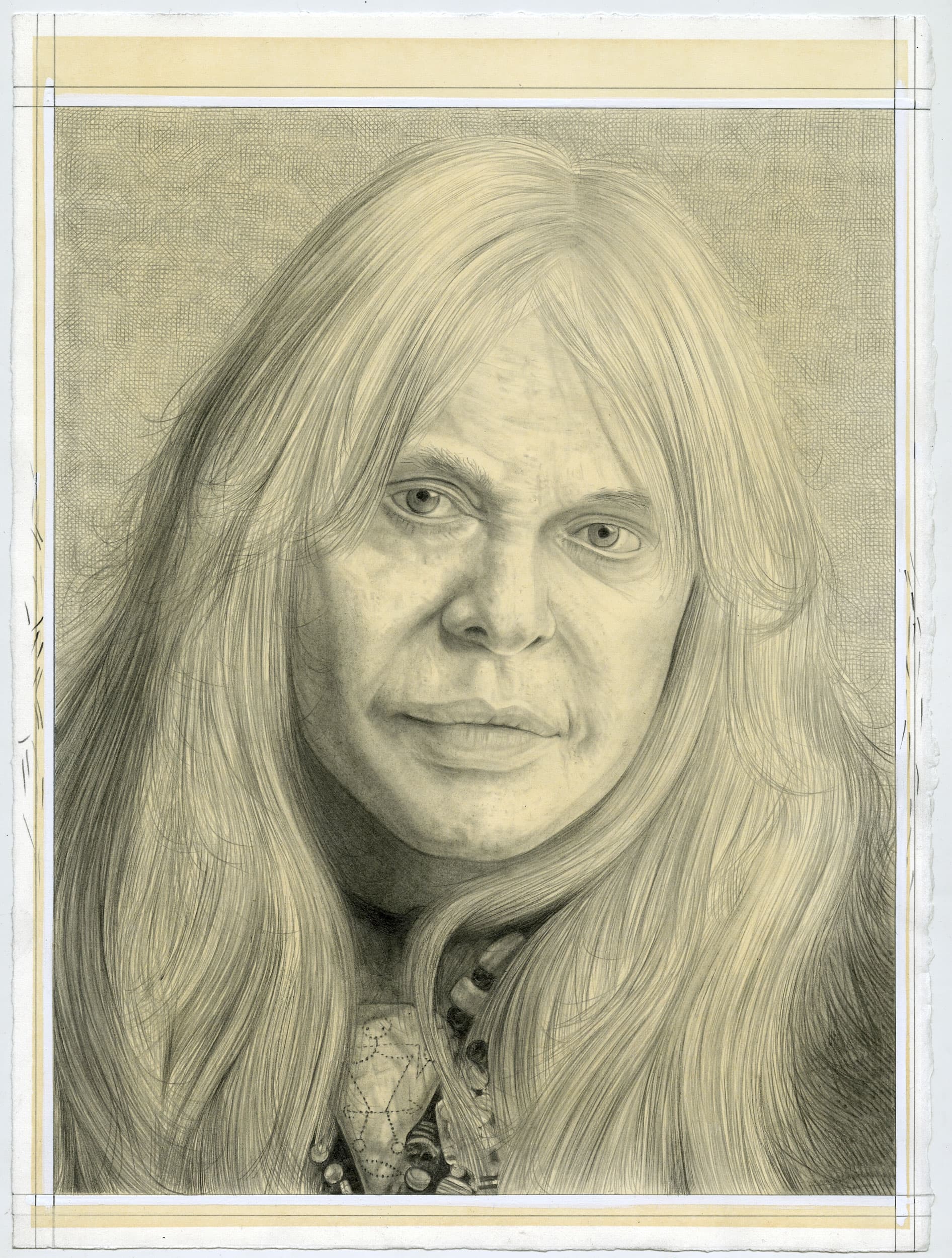
“I think criticism is a fundamental human impulse. Styles of criticism may change, but something essential remains. When people walk out of a movie theater, the first thing they say is, What did you think? Criticism is not some weird esoteric activity. It’s a natural outgrowth of our concern for the world around us.”
I was called an “art critic” but I always just called myself a writer. Now it’s interesting because they call us “art writers”—they don’t say critics as much anymore.
Fred Moten is a poet and literary theorist, whose book In The Break: The Aesthetics of the Black Radical Tradition (University of Minnesota Press, 2003) explored the sonic and aural lineages of the “black radical tradition.” His new book of essays, Black and Blur (Duke, 2017) charts his sustained engagement with contemporary visual art.
I think I hate my show, Andrew Ross told me laconically the morning of his recent opening—Actually, I think I’ve hated most of my shows. This seriousness—hovering between mocking cynicism and desolate sincerity—helps define Ross as one of the major sensibilities of his generation. At 28, he is at the fore of a group of young artists mining the slippages between images and objects—in physical space and online—that effortlessly merge material abstraction with representational form.

Chris Kraus is the author of four novels: I Love Dick (1997), Aliens & Anorexia (2000), Torpor (2006) and Summer of Hate (2012), and two collections of essays, Video Green (2004) and Where Art Belongs (2011).

We met to discuss her new book, her intellectual development, and the future of the academic discipline of art history.

For various reasons, some of which you’re responsible for and some of which you aren’t, you often get talked about as a cartoon character. So I would like to get more of a sense of you as a person. Perhaps we should start with your early life: when did you first become conscious of art and decide that you wanted to be an artist?
The American writer Siri Hustvedt has written non-fiction, poetry, essays, and novels, and holds a Ph.D. in English from Columbia University. Her latest book, A Woman Looking at Men Looking at Women (Simon & Schuster, 2016), brings together her uniquely nuanced, knowledgeable, and sophisticated approach to interdisciplinary readings of science, art, and the humanities.

Barry Schwabsky is art critic for the Nation and co-editor of international reviews at Artforum.

Dore’s house in East Hampton is small and rough, sternly sensual—no nonsense. No air conditioning either. You enter through the kitchen door in the back. The rooms have low plywood ceilings.

Roberta Smith is co-chief art critic at the New York Times. She joined the newspaper’s staff in 1991 after writing for Artforum, Art in America, and the Village Voice. Smith spoke with Jarrett Earnest about Donald Judd, opinionated criticism, and dealing with your own ideas.
In the 1980s David Salle’s achingly cold paintings of layered and collaged images helped define postmodern sensibilities. More recently he’s emerged as an idiosyncratic voice in art criticism, publishing essays in ARTnews, The Paris Review, Artforum, and (from 2013 – 15) in a regular column in Town & Country.

Over the past fifty years Jack Whitten has developed a rigorous personal vocabulary within abstraction, linking ancient mosaics with contemporary process painting. His first solo exhibition with Hauser & Wirth is currently on view.

I was walking on Seventh Ave last spring when I saw something like a limb, but not a limb—it could have been a frond or a vulvic sensation, which is where so much of my work originates. I spent several weeks asking my friends if they’ve seen anybody’s sculpture made up of this kind of unit, multiplied and varied? They said "No, it’s probably your idea."

The novelist, playwright, and critic Sarah Schulman has been chronicling bohemian life in the East Village since the late 1970s. Her work as participant and chronicler of ACT UP is the stuff of queer legend, as is her co-founding of MIX NYC, the NY Queer Experimental Film Festival in 1987 that is going into its thirtieth year.

Novelist and critic Lynne Tillman’s character Madame Realism first appeared in the pages of Art in America in the mid-’80s, reporting on a Renoir symposium. This month, Semiotext(e) brings together all of her misadventures in the volume The Complete Madame Realism and Other Stories. We met to talk about the intricacies of fiction in life, art, and criticism.

In October’s inaugural installment of “Close Encounters,” critic and art historian Douglas Crimp discusses his new book, Before Pictures (Dancing Foxes Press, Co-published with University of Chicago Press, 2016), a hybrid of memoir and cultural history about his life in 1970s New York.

By Jarrett Earnest
Closing my eyes now, I’m trying to remember what Bill Berkson had written on the blackboard—a cloud of disparate names and concepts: UTOPIA; ARCADIA; CHRONOS; AS YOU LIKE IT; KAFKA; OVID.

For decades, Luc Tuymans’s paintings have plumbed the nature of images—charting the limits of their personal and political functions. Before the opening of his latest solo show at David Zwirner Gallery, Tuymans spoke with Jarrett Earnest about temperature in paintings, their instantaneous decay, and the balance between violence and tenderness.

For half a century John Ashbery has remained a solid contender for the title of “greatest living poet.” For much of that time he also wrote art criticism, first for ARTnews, and the Paris edition of the New York Herald-Tribune, New York and Newsweek.

April 2016Art
“I’ll take a picture of you, do you want to hide behind the code?” Michael Riedel and Jarrett Earnest at the American Museum of Natural History
For his current show at David Zwirner, Riedel exhibits appropriated images of dinosaur skeletons blown up, rotated, and draped in vinyl stickers of a Dick Blick Art Supplies bag. The walls are pasted with a texture coaxed from overlays of website texts using information for art material as material for doing art. Riedel admitted that he thought it was a misunderstanding when I asked him to do our interview at the American Museum of Natural History (“My work isn’t about dinosaurs”) but he showed up anyway.

For the next six months Hilton Als is the featured artist at The Artist’s Institute; his exhibition One Man Show: Holly, Candy, Bobbie and the Rest (through April 24, 2016) inaugurates the Institute’s handsome new uptown space (at 132 East 65th Street).

Snowflakes were falling soft and thick on the February morning I met Marie Lorenz in Bushwick, and, à la “My Favorite Things,” it stuck to our noses and eyelashes while we loaded her fiberglass rowboat into a U-Haul van.

It is radical to propose that abstract sculptures have genders, or rather, can evoke them. In his new book, David Getsy goes even further, arguing that non-representational forms can conjure genders unknown, unforeseen, and unshared by their makers.

Lorraine O’Grady crashed into the New York art world as Mademoiselle Bourgeoise Noire in 1980, shouting poems and whipping herself to the distinct displeasure of fellow exhibition-goers. In the subsequent thirty-five years, she’s created an elaborate and tremendously important body of performances, photos, collages, and writing.

Just as artists were collapsing “art” and “life” Ad Reinhardt was mightily prying them back apart.

Justin Vivian Bond is a writer and singer who became famous in the 1990s as Kiki DuRane, half of the cabaret duo Kiki and Herb.

Robert Gober entered the New York art world in 1985 with an exhibition of polysemic sinks that effortlessly slipped between torsos, faces, tombstones, ghosts, and glory holes—animated by the gentle quivering of their handmade surfaces.

By Jarrett Earnest
Why don’t we just accept that art history is one long, looping conversation in a haunted house, with so many vivid voices belonging to currently dead people? Is it weird that we still talk to them?—and to each other?—and about them and each other?

The anthropologist, author, and Columbia University professor Michael Taussig is best known for his book My Cocaine Museum (2004) and his many decades living, on and off, in the Putumayo region of Colombia.

Josiah McElheny is known for his conceptually layered and impeccably constructed artworks made of many materials, but these works almost always involve some use of glass—as a material reality, a symbolic substance, or political device. McElheny’s assemblages and installations emerge from his research into earlier moments of art or design history, finding strange figures and obscure artifacts to hold up to contemporary light, looking for the glimmer of other possible futures.

In the pantheon of art writers Peter Schjeldahl holds a special place near the top as one of our greatest living critics. He entered the New York scene in the ’60s, a poet and college dropout escaping a Lutheran upbringing in Minnesota.

During my brief and disastrous life in an art history PhD program, my professor was finishing a book on an artist who was also a friend of mine. After discussing her ideas I asked what the artist thought of the professor’s interpretations.

I met the legendary poet and critic Bill Berkson as a bratty 19-year-old art student in his final class at the San Francisco Art Institute, where he is professor emeritus after teaching writing and art history for 25 years.

John Giorno has been a New York icon since he stared in Andy Warhol’s Sleep in 1963. Since that time he as explored sound, image, performance, and video collages from a poet’s perspective.

For his solo exhibition Die Hexe, Alex Da Corte transformed Luxemborg & Dayan’s elegant Upper East Side townhouse into a haunted mansion, covering every inch of its three floors. Embedded within his complex tableaux are objects by Mike Kelley, Haim Steinbach, Bjarne Melgaard, and Robert Gober. Da Corte met Jarrett Earnest there to discuss the ways colors create space, memories, and feelings.

Painter Lisa Yuskavage was a guest in my spring 2014 class “Object Lessons” at BHQFU, the experimental free art school in the East Village. Each guest chose a book, film, or work of art for the class to study prior to a group conversation. Y

A multivalent arena, rich and strange—something polyphonic, as Mikhail Bakhtin described Dostoevsky’s work—what art criticism could be.

Under Martha Wilson’s visionary direction, Franklin Furnace has remained a vital force in the New York art world since 1976, holding fast to its mission of “keeping the world safe for avant-garde art.”

Anthony McCall returned to making art in the early 2000s after a 20-year break to further develop his iconic solid light works from the 1970s.

Elizabeth Jaeger is an artist breaking away from the pack of shiny young things with life-sized porcelain and plaster sculptures, equally playful and funereal, coy and confrontational.

“Cookie Mueller is like oxygen and I need all of her writing,” I wrote to my friend Raymond Foye from the beaches of Miami this summer, “can you help me track down those precious little books?”

David Levi Strauss is a writer who looks deeply into the dark realities of our world, providing analysis that is both sensitive and urgent. His newest work, Words Not Spent Today Buy Smaller Images Tomorrow: Essays on the Present and Future of Photography (Aperture, 2014) is a major intervention in contemporary discourse on photography and political representation.

Miguel Gutierrez is a singular force in the performance world, blending dance, drag, poetry, comedy, and song into what he prefers to call “shows.”

Peter Lamborn Wilson, also known as Hakim Bey, is a subcultural monument—authoring countless books, tracts, and slogans that weave political resistance with poetry.

Trevor Winkfield’s idiosyncratic and widely roaming intelligence is evident throughout his career, including publishing projects like Juillard (1968 – 72) and The Sienese Shredder (2006 – 2010), across his distinctive paintings, and within his many art essays.

Keltie Ferris is known for large paintings that lap, layer upon layer, into glimmering pictorial spaces; like her, they are utterly debonair. Last month she debuted Body Prints at Chapter NY, surprising new works which, as the title suggests, are impressions of her body on paper.

Since the 1990s Rebecca Solnit has authored a river of non-fiction at the fertile intersections of environmentalism, political activism, art criticism, and memoir.

Josephine Halvorson is a painter of intimacy, which is as real as anything, but not what people mean when they talk about representing reality.

March 2014Art
IDEALLY THIS INTERVIEW WOULD ANSWER ALL OF YOUR QUESTIONS LAURE PROUVOST with Jarrett Earnest
A charming sphinx, Laure Prouvost plays with being a French artist in her chosen English context, whispering broken riddles in a heavy accent. Her videos seamlessly blend fiction and truth, objects, images, and sound into large, ramshackle Rococo realities.

Performance artist Ann Liv Young emerged as one of the most provocative figures of the 2000s. She often uses fairytales to foreground interactions between audience and performer—producing highly publicized confrontations with everyone from Penny Arcade to Georgia Sagri. Her work evolves a complex mythology centered around a character named Sherry. After traveling extensively in Europe with her family of collaborators, chief among them her partner Michael A. Guerrero, Young is back in New York to perform all four parts of her Sleeping Beauty at MoMA PS1.

Art Historian Cary Levine has just published the first in-depth scholarly analysis of artists Mike Kelley, Paul McCarthy, and Raymond Pettibon, adapted from his dissertation.
Since entering the art world in the early 1980s Roni Horn has produced an ever expanding cosmos of objects, images, and text that are as paradoxically coherent as they are multifaceted. Her exhibition “Everything was sleeping as if the universe was a mistake,” currently at Hauser & Wirth (November 11, 2013 – January 11, 2014) contains two sculpture installations—each made of 10 cast-glass forms.

Chris Burden is an icon—a status that, like most of his work, is no mean feat. One of the most daring performance artists of the 1970s, Burden pioneered a genre now ubiquitous in contemporary art with works like “Shoot” (1971), in which he was shot in the arm at close range.

At the premier of The Gates (2007) at the Tribeca Film Festival, Jeanne-Claude explained, “Between Christo and me there is a love story for each other and for art. Then there is a love story between Christo and Jean-Claude and David and Albert Maysles.”

Third visit to Paul McCarthy’s WS, and everything about it: the cotton candy colored stained glass lighting; the fake noses (Gogol), her’s like a fawn’s and pig’s and upturned cartoon’s; the liquid surfaces—how crystalline it all is regardless of the mess.

Jill Magid’s art includes being hired by the Amsterdam Police Headquarters to bedazzle their security cameras (“System Azure,” 2003), orchestrating a trust game over CCTV with Liverpool police (“Evidence Locker,” 2004), and late-night rendezvous with a policeman surveilling Manhattan (“Lincoln Ocean Victor Eddy,” 2007).

Genesis Breyer P-Orridge pioneered performance art with h/er group COUM Transmissions (1969–1976) and is considered the father of Industrial Music with h/er band Throbbing Gristle (1975– 981). In 1981, P-Orridge formed the influential band Psychic TV, and Thee Temple ov Psychick Youth (T.O.P.Y.) as a magical network to advance alternative social ideas.

Art is about living as variously as possible. If art is, categorically, nothing more specific than whatever an artist does, the question is then “what is an artist?”
Philip Taaffe’s new paintings press your face up against a fence, and, like the first line of The Sound and the Fury, leave you looking “between curling flower spaces.”

In the midst of Paul McCarthy's crazed take-over of New York City, he sat down with Jarrett Earnest amongst his life casts to discuss fluids, mold making, and Disneyland.

Rondinone met with Jarrett Earnest to discuss isolation, the treachery of language, and his new installation in Rockefeller Plaza, Human Nature (April 23 – June 7, 2013, organized by Public Art Fund and Tishman Speyer).

Nayland Blake just completed the large exhibition at the Yerba Buena Center for the Arts and currently has an exhibition of new sculpture at Matthew Marks Gallery (What Wont Wreng, February 2 – April 20). He is also included in the New Museum’s NYC 1993: Experimental Jet Set, Trash and No Star (February 13 – May 26).

If Kant hadn’t been more hardworking than us, would we read him?

Experimental filmmaker Barbara Hammer has made lyrical, confessional, and often deeply erotic films about her life as a lesbian artist since the early 1970s. She performed Witness: Palestine as part of PS1’s Pier Paolo Pasolini: Intellettuale on Sunday, December 16.

The question of making or talking about art is really one of how to engage with the world, to deal with everything from watching sunlight move across a lawn to having sex on the kitchen floor. Given this expansive definition I find it is most useful to understand art as a form of playing: a special kind of social behavior.
By Jarrett Earnest
“Fire lives the death of air, and air lives the death of fire; water lives the death of earth, earth that of water.”

Dear Richard, Phong has been in touch about me doing an email interview with you. I’ve just come from your current show at Pace (Systems VIII-XII September 07 - October 13). I like the idea of compiling an interview-collage-glossary of sorts. I think it will be fun.

“I dreamed of breaking into it at night with a lantern,” wrote André Breton of the Musée Gustave-Moreau, which to this day remains as the Symbolist painter designed it in 1896. Moving up the narrow stair, past the apartment areas preserved with their original decor, one enters a two-storey atelier.

Dana Schutz’s retrospective If the Face Had Wheels opened at the Neuberger Museum at the end of 2011 and a new exhibition of recent work, Piano in the Rain (May 2 – June 16, 2012), opened at Friedrich Petzel Gallery last month. In her freshly empty studio in Brooklyn, Schutz sat down with Jarrett Earnest to talk about her paintings.

Paul Kos, a conceptual artist who has helped create the vocabulary for video, performance, and conceptual art in the San Francisco Bay Area since the late 1960s, walked Jarrett Earnest through the three floors of his exhibit at Nyehaus, Allegories and Metaphors, 1969 – 2012 (March 3 – April 21), and talked about the evolution of his art.

Paintings are, more than anything, physical facts. And it is in this way, in the way that Florine Stettheimer’s paintings disclose themselves to me as surfaces, that I love them.

In the late 1980s Maurizio Cattelan emerged on the international art circuit with sculptures that appeared equal parts sight-gag and natural history diorama. Combining taxidermied animals, wax figures, and the tears of a clown, he has reigned as court jester of the art fair set for the better part of two decades.

November 2011Art Books
CORRESPONDENCE COURSE An Epistolary History of Carolee Schneemann and Her Circle
Dear Bill, Just finished a wonderful book, Carolee Schneemann’s collected letters, with correspondence to and from, which is very nice, endlessly preferable to the single-side such books often give you.

The curators of the exhibition North by New York: New Nordic Art (April 14 – August 19, 2011) have been faced with the problem of how to organize an exhibition around regional identity in the age of globalism?

As Chief Curator of Painting and Sculpture at the Museum of Modern Art from 1958–1965, Selz oversaw many historic exhibitions, including the first major exhibitions of Rothko, Dubuffet, Rodin, Art Nouveau, etc.

June 2011Film
DON'T YOU UNDERSTAND WHAT WE ARE TRYING TO DO HERE? Lynn Hershman Leeson's Meta-Project
We were mad as hell and we weren’t going to take it anymore,” laughs Faith Ringgold, about the lack of women or artists of color in Robert Morris and Carl Andre’s Biennale-in-Exile in 1970.

Anthology Film Archives is a love letter to New York and to the future of our shared intellectual world. So let’s do our part and raise a glass at City Winery this Wednesday.