In a Chromatic Field: Morton Feldman & Jules Olitski
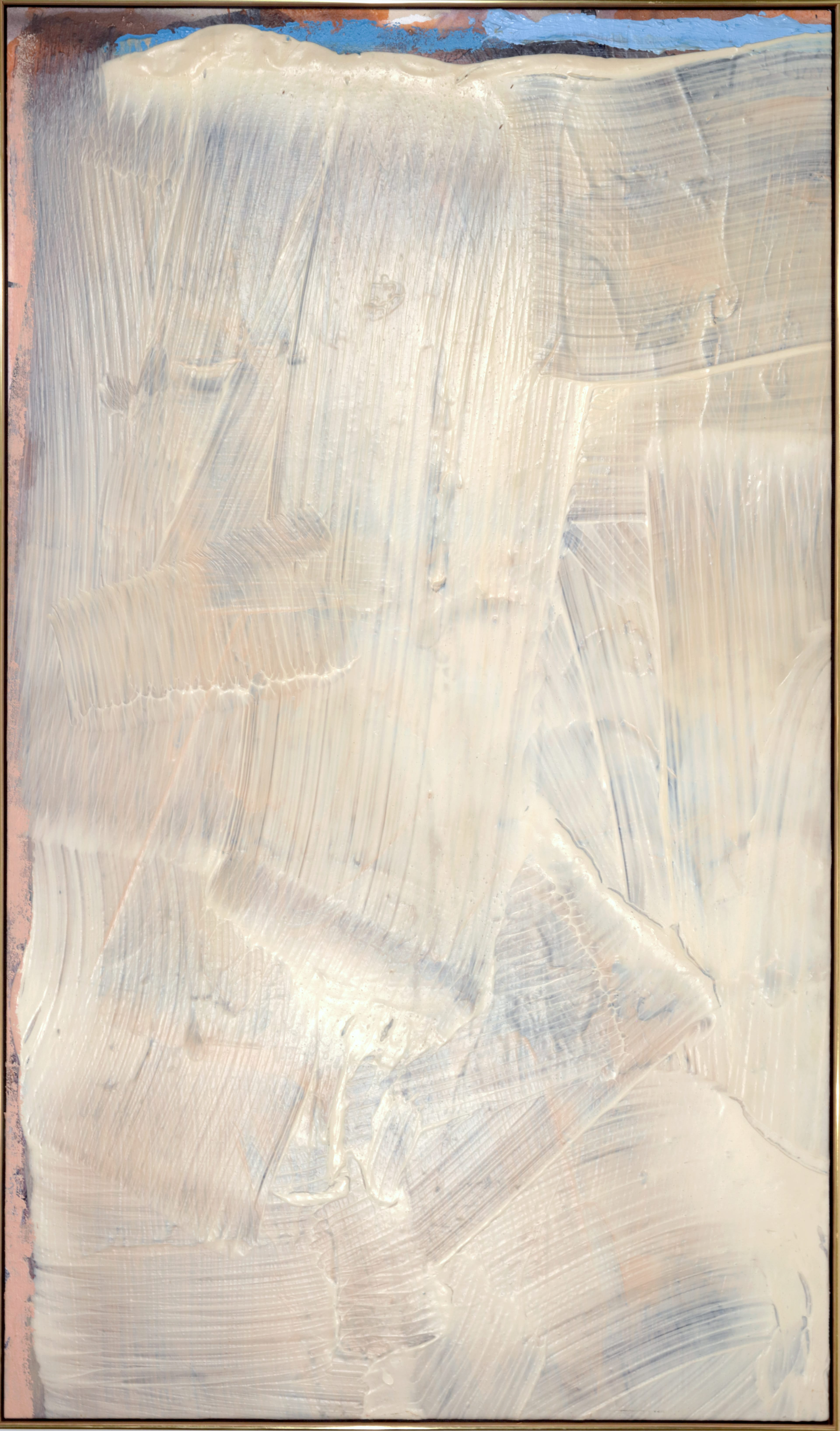
Jules Olitski, Third Manchu, 1974. Acrylic on canvas, 84 x 49 inches. Courtesy Jules Olitski Art Foundation. © 2026 Jules Olitski Art Foundation / Licensed by VAGA at Artists Rights Society (ARS), NY.
Word count: 1127
Paragraphs: 13
Morton Feldman thought like a painter. Through a stream of bluntly stated opinions, comic anecdotes, and philosophical digressions, he spoke in interviews of aesthetic insights gleaned from artists and the role of intuition and exploration in his creative process. Speaking about his music, he often employed metaphors from the visual arts, describing his compositions as “time canvases” with a distinct “aural surface.” While the isolated gestures and flattened continuity of Feldman’s music of the sixties and seventies recall the centralized forms and painterly gestures of Abstract Expressionism, the music of his final decade is concerned with a different order of musical material and aural experience. The expansive durations and immersive quality of Feldman’s late music, his use of the body as a determinant of scale, his method of finding a composition’s proportions rather than beginning with a structure, and ultimately his position as a late modernist working in the pluralistic 1980s, all align his late work with the perceptual and formal priorities of Color Field painting.
Jules Olitski’s practice in particular mirrors Feldman’s in a variety of ways that illuminate a common conception of abstraction. In the mid-sixties, pursuing a pictorial organization determined by color alone, Olitski sought to eliminate drawing from his art. To this end, he painted upon lengths of unsized, un-stretched canvas on his studio floor before “finding” the painting by cropping it out of the larger field. “The development of a color structure ultimately determines its expansion or compression—its outer edge,” he wrote. “The decision as to where the outer edge is, is final, not initial.” In his paintings of the mid-sixties and seventies, Olitski redefined the function of drawing, and made what had been a neutral (or predetermined) aspect of picture making—the size and shape of the canvas—into a site of aesthetic consideration.
Feldman, pondering how his music might change in compositions of extreme length, used an analogy from painting: I think it requires a sense of scale,” he remarked, “which could be a very intuitive thing. I mean, there’s one thing of saying, I’m gonna work on a ten by ten canvas… and [then] trying to fill it up. And another thing, finding that it’s becoming a ten by ten canvas.”
When beginning a composition, Feldman, like Olitski, kept many of its formal dimensions open, gradually “finding” its instrumental colors, its scale, and the boundaries of its duration while working. “I never say to myself, ‘I’m going to write an orchestral piece,’” he explained. “But I’m shrewd enough always to start with twenty line paper!”
In the eighties, to achieve the scale of his expansive compositions, Feldman developed new approaches for establishing and sustaining the continuity of his aural surface, “Up to one hour you think about form,” he explained. “But after an hour and a half it’s scale. Form is easy—just the division of things into parts. But scale is another matter…”
During his last decade, Feldman began to construct his music from modules and patterns ranging from a single measure to several systems in length, subjecting them to prolonged, unsystematic variation and repetition. While in works from the early eighties, such as Triadic Memories (1981) and Crippled Symmetry (1983), he foregrounded variation, later in the decade repetition became central.
The three instrumental voices in Crippled Symmetry are written in different time signatures so that they move through time at varying, unsynchronized paces. The autonomy of these voices resembles the allover linear web of Jackson Pollock’s drip paintings, in which separate skeins of color, though overlapping and intertwined, remain independently legible. In contrast, the broader, ensemble-wide gestures of For Samuel Beckett (1987) recall Olitski’s mid-career paintings like Third Manchu (1974) and First Broom of Joseph (1980), where painterly mark making is more singular, broadly articulated, and expansive.
The role of the body as a unit of measure and a determinant of scale is another factor linking Feldman to Olitski. The gestures in Olitski’s canvases of the seventies and early eighties—broad and generalized—operate at a scale commensurate with the size of the canvas. Third Manchu unfolds at a bodily scale, shaped by the sweep of the artist’s arm across the surface rather than the turn of his wrist atop it. In this sense, the difference between Olitski’s gestures and Pollock’s drips is one of physical reach—Olitski’s expansive gesture covers the canvas while Pollock’s activity is more incremental, as he constructs the surface through successive marks atop it.
In many of Feldman’s late pieces, tempo and repetition similarly align with bodily gestures, particularly the natural pace of breathing. Violin and String Quartet (1985) opens with a languid two-note figure in the solo violin that serves as the harmonic and rhythmic basis for the entire two-hour composition. Although its rhythmic contour changes subtly with each iteration, tempo and time signature remain constant, and the figure’s shape and pace broadly corresponds to that of relaxed inhalation and exhalation, a calming convergence that helps to slow the listener’s perception to the pace of the music. The sense of breathing in For Samuel Beckett is more literal. Together with the strings, the wind and brass instruments articulate static, uninflected sustained tones. As these overlap, they accumulate into larger droning masses, deeper breaths that expand and contract. This kind of bodily synchronization was on the composer’s mind at the time. Lecturing a few weeks after the premiere of the piece, Feldman described the “flexibility of the rhythms” in his music. “I don’t even know if I want to call them rhythms,” he continued. “They’re breathing.”
Throughout the eighties, both Feldman and Olitski understood their art as cutting against the grain of the aesthetic permissiveness then taking hold. Feldman, whose graphic notation and indeterminate music contributed to the liberation of the performer, returned to conventional notation and traditional ensembles in the late seventies and eighties. Like Olitski, he remained a steadfast modernist, committed to intuition, abstraction, and experimentation within the medium-specific conventions of his discipline. Both artists created works of sensuous beauty during a period in which the practice of abstraction came under scrutiny by socially and ideologically oriented artists working across disciplines and using a seemingly inexhaustible range of new media.
Olitski welcomed this station: “Creative energy can thrive,” he wrote, “when there is a culture to go up against.” Compelled toward innovation yet committed to the perpetuation of tradition, they were what art critic Clement Greenberg described as “reluctant revolutionaries.” In this late modernist period, Greenberg wrote, “What is authentically and importantly new…comes in softly as it were, surreptitiously—in the guises, seemingly, of the old.”
Feldman echoed this sentiment. Lecturing to an international group of students in the early eighties, he cautioned: “The people who you think are radicals might really be conservatives, [and] the people who you think are conservative might really be radical.”
Alex Grimley is an independent art historian specializing in postwar and contemporary art, particularly Color Field painting. His writing addresses intersections of visual art, criticism, and experimental music.