The Devil in the White City
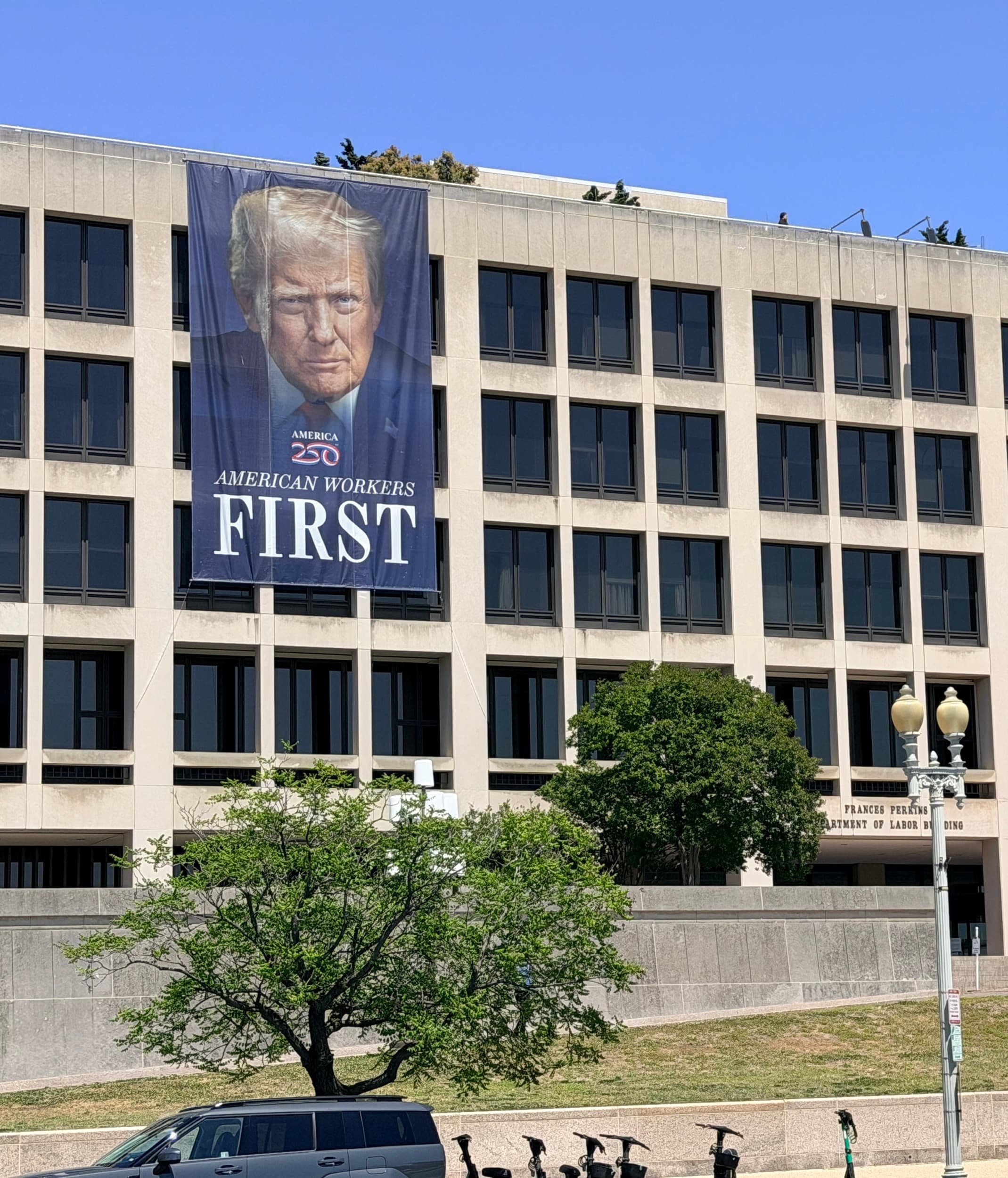
A Portrait of Trump Hung on the Department of Labor. Courtesy the author.
Word count: 1472
Paragraphs: 12
In April, the Trump administration released an AI rendering of the upcoming Great American State Fair, which will be held in Washington, DC, on the occasion of the 250th anniversary of the American Revolution. In the image, a 110-foot Ferris wheel looms above the National Mall, casting its shadow over a scattering of onlookers—far fewer than one would expect at what has been billed by its organizers as a “the biggest, boldest, state fair in the country.” In the background, what are apparently “semi-permanent ‘Beaux-arts’ structures” crisscross the green space. Inexplicably, the AI has also placed a small triumphal arch among the pavilions; a copy in miniature of the super-sized one planned for a plot of land adjacent to the Arlington Memorial Bridge.1
If the AI (or whoever has been writing its prompts) were better at its job, it would have surely found a way to include some of the other spectacles that Freedom 250—the controversial quasi-nonprofit arm of the commemorative machine—is planning for this semiquincentennial summer. These include a sports contest for high-school athletes that is already being compared to The Hunger Games, a cage match on the lawn of the White House, and an auto race around the Mall; all sponsored by a dizzying array of corporate entities with close ties to the current administration.2 In an AI-generated video released by Freedom 250, racecars whirl around the monumental core, flying by the Smithsonian museums (except for the National Museum of African American History of Culture, which has been totally erased from the landscape) and other buildings which—in the proliferating style that is favored by both generative AI and the President himself—are decorated with an abundance of American flags. Ironically, the AI doesn’t seem to share Freedom 250’s enthusiasm for the event: the stands are sparsely filled, and other spectators wander the sidewalks seemingly oblivious to the race.3
If you know The Devil In the White City, Erik Larson’s enormously popular 2003 book about the World Columbian Exposition of 1893, or if you’ve ever seen Meet Me in St. Louis, this all might seem more than a little familiar: in effect, it’s a World’s Fair.4 For the semiquincentennial, the National Mall will be transformed into a midway filled with amusements and concessions; around it, a gleaming new “White City”—all order, control, and might. Historians like Robert Rydell have long connected the Gilded Age World’s Fairs with America’s turn towards global imperialism at the end of Reconstruction: in their organization and exhibitions, the international expositions were meant to stage, for Americans, the supremacy of white, western civilization. Fittingly, the first of these fairs, the Centennial Exposition in Philadelphia, marked the nation’s centenary in 1876, and was quickly followed by fairs in St. Louis, Buffalo, and Chicago—many which featured the live displays of colonized people from America’s new territories.5 The nation’s most recent return to militarized occupation, mounting obsessions with nativism and race science, and policing of its own internal colonies have combined with Trump’s own gaudy Victorian sensibilities, carnival hucksterism, and coterie of robber barons—the revival of the International Exposition is a natural outcome. Or maybe it’s just like all the other AI slop: a crude regurgitation devoid of context or meaning, slotted in simply because it fits the prompt.
Given this slapdash execution, it’s helpful, for the organizers of this new World’s Fair, that Washington, DC, a city that embodies the contradictions of American democracy, provides a built environment itself inspired by the White City. The same cadre of architects that designed Chicago’s much-vaunted Exposition helped create Washington’s McMillan Plan, the 1902 document that laid the groundwork for DC’s Federal Triangle: those expansive neoclassical buildings—the National Archives, the National Gallery of Art, the Lincoln Memorial—that, in the Freedom 250 videos, appear swathed with flags; the wide avenues that the Indycars will careen around.6 For visitors who venture further afield, the monumental core even boasts its own colonized village on display: Washington, DC itself. Like other US territories, its residents do not have representation and it is occupied, on a seemingly permanent basis, by the National Guard.
The additions and changes planned by the Trump administration follow the McMillan Plan, sort of: the giant neoclassical triumphal arch; a giant neoclassical ballroom; a neoclassical sculpture garden of white statues of various American “heroes,” and a proposal to whitewash the giant Old Executive Building, so that it looks more neoclassical. The emphasis on this particular style of architecture is, of course, not a coincidence: scholars and commentators have long underscored the connections between the neoclassical—a colonial approximation of ancient Greek and Roman architecture—with white supremacist ideology.

Plywood walls and white tents help approximate the “Beaux Arts Pavilions” promised by Freedom250. Courtesy the author.
Downtown, the White House and Lafayette Square have been fenced off, as are portions of the Mall where workers are putting up plywood walls that will eventually become AI-illustrated facades for the “Beaux Arts Pavilions.” The actual structures behind them appear to be white rental tents—an apropos metaphor for the gap between reality and ChatGPT’s fever dream, and really for Freedom250’s entire plan. Tourists hover around the perimeters, trying to see behind the chain links and construction trailers blocking many of the city’s signature photo opportunities. Federal buildings have already been hung with American flags and Big Brotheresque banners featuring the President. On the face of the Department of Agriculture, the State Fair is advertised with a tableau of George Washington and Abraham Lincoln standing in a wheat field. In the background, a frontier vista complete with covered wagons, farmhouses, and a train—a haphazard AI recombination of John Gast’s 1872 painting American Progress, with the allegorical Columbia figure replaced by the two presidents, each with the same glowering expression that Trump wears in his own banners.

The Department of Agriculture, With An AI-generated banner reminiscent of John Gast’s American Progress. Courtesy the author.
*
In its shadowy conception and haphazard implementation, this World’s Fair is totally absent the very human creativity and enterprise that it is supposed to be celebrating. The generic AI renderings and the makeshift structures are also signs of what is perhaps the central contradiction in all of this: the foundation of a democratic, participatory nation-state will be staged without significant democratic participation or input. Commemorations—especially national ones—can only be meaningful when they reflect the ideas and interests of their citizenry. This one reflects the interests of corporations and the sloppy plagiarism and fascistic undertones of artificial intelligence algorithms: a commemoration that is neither of, nor by—not even for—the people.

Counterexhibit at The President’s House Site at Independence National Historical Park. Courtesy the author.
Walking around the Mall, I am reminded of a very different scene at a site no less sacred in our pantheon of civil religion: the President’s House at Independence Mall in Philadelphia. In January, following Trump’s executive order against historical interpretation that does not “focus on the greatness of the achievements and progress of the American people,” exhibition panels concerning slavery were removed from the President’s House at Independence Mall in Philadelphia.7 In response, visitors to the site have been putting up copies of original panels, handwritten signs, collages of news coverage, and other ephemera; in effect making a new exhibit, a wholly analogue and handmade antithesis to Freedom 250’s LLM-designed commemoration. When I visited last month I saw school groups, tourists, and young and old Philadelphians engaging with this grassroots signage and with each other. They are like many other Americans, who, for the last several years have seized the reins of a nuanced, inclusive, and accessible history. They have been doing this by protesting monuments and museums; launching research, preservation, and collecting initiatives; and taking to social media with their observations, questions, and affirmations. They see themselves as active stakeholders and partners in our shared history, a role fundamentally connected to the self-determination and participation inherent in the promise of the American Revolution.

Still from “Trump Gaza” AI Video Circulated By President Donald Trump. Screenshot via Instagram.
What will be the ultimate legacy of the 250th? Will the semiquincentennial, like the centennial before it, usher in a wave of International Expositions to accompany the dystopian new era of imperialism and inequality? Will we see similar ventures in Palm Beach, Starbase, Texas, or in “Trump Gaza?”8 A new White City of gleaming data centers in Northern Virginia or the suburbs of Atlanta? Or will the World’s Fair of 2026 meet a fate similar to the mostly unsuccessful 1964 World’s Fair in Trump’s own borough of Queens, the abandoned remnants of which litter the landscape? Will the giant arch, in 2076, loom over a monumental core overwhelmed with floodwater and occupied by mercenaries?
The answer is up to us: we, the Americans who have pulled down monuments, who have protested occupation, and who recognize the promise of the American Revolution while acknowledging that it is unfinished. We should take a note not only from Philadelphians, but also from the myriad ways that Americans have insisted on being active partners in the making of history, and strive to find ways to participate, to make this commemoration for us and by us.
- Freedom 250 website, https://freedom250.org/celebration/the-great-american-state-fair.
- Dan Diamond, Cat Zakrzewski, and Emily Davies, “Trump allies expand role in planning America’s 250th anniversary,” Washington Post, March 5, 2026.
- Freedom 250 Grand Prix, https://www.freedom250gp.com/.
- Erik Larson, The Devil in the White City: Murder, Magic, and Madness at the Fair that Changed America (Crown, 2003).
- Robert Rydell, All the World’s a Fair: Visions of Empire at American International Expositions, 1876–1916 (University of Chicago Press, 1985).
- Howard Gillette Jr., Between Justice and Beauty: Race, Planning, and the Failure of Urban Policy in Washington, D.C. (University of Pennsylvania Press, 2006).
- Maxine Joselow and Jennifer Schuessler, “How the National Park Service Is Deleting American History,” New York Times, January 23, 2026.
- Guardian News, “Donald Trump shares bizarre AI-generated video of ‘Trump Gaza’” February 26, 2025, https://www.youtube.com/watch?v=PslOp883rfI.
M.J. Rymsza-Pawlowska is an interdisciplinary cultural historian of the nineteenth- and twentieth-century United States and an associate professor of history and public history at American University. Her research interests include public history, historiography, visual and material culture, and media history and theory. She lives and works in Washington, DC.