Let Freedom Ring
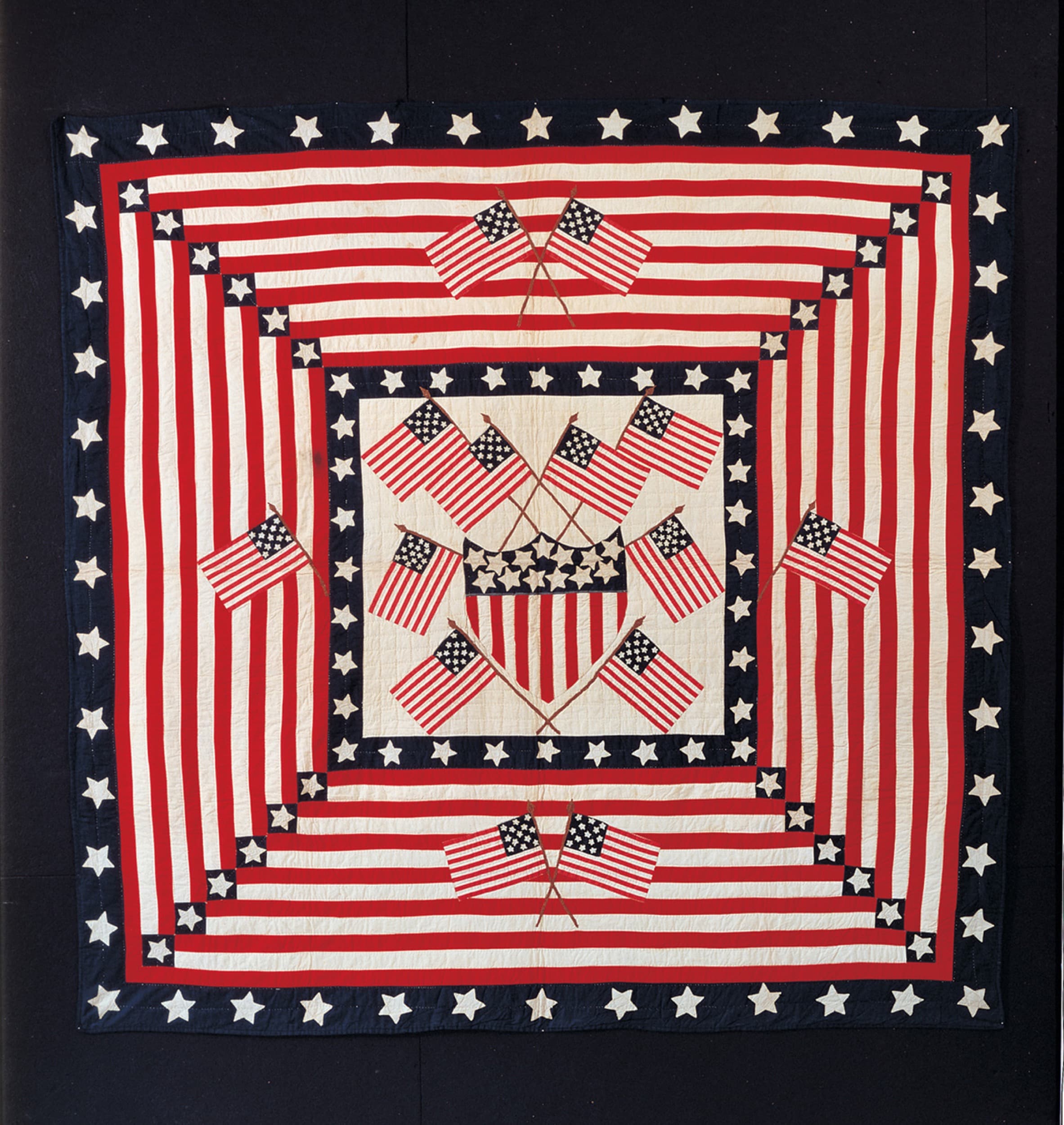
Mary C. Baxter, Flag Quilt, 1898–1910. Cotton with cotton embroidery, 77 ¼ × 78 ¾ inches. Courtesy the American Folk Art Museum.
Word count: 1014
Paragraphs: 7
When you think of folk art and American politics, what comes to mind? Most likely, something bearing the stars and stripes, such as the extravaganza of a quilt shown here, made by Mary E. Baxter in New Jersey at the turn of the century, now in the American Folk Art Museum (AFAM). It features no fewer than fourteen flags, frantically disposed across a field of red, white, and blue. To call it political may seem like a stretch; it’s too “naïve” (a word often applied to artists like Baxter) to be taken as anything but straightforward patriotism. This is one uncrazy quilt. All the same, there is something potent about it. The sheer enthusiasm that it manifests, unencumbered by nuance, strikes a chord as resonant as any in “The Star-Spangled Banner.” It has the ring of authenticity, that scarcest (and potentially scariest) of all political qualities. Not for nothing has a Smithsonian Folklife Festival been hosted on the National Mall annually since 1967—until this 250th anniversary year, when, at the Trump Administration’s behest, it will be replaced by a “Great American State Fair.” The huge festival of flag-waving will doubtless make Baxter’s quilt look subtle by comparison. The powers-that-be always want to claim the folk, in all their honest simplicity, for their side.
All of which may imply that folk art is apolitical at best, and at worst, a domain of false consciousness, easily recruited by forces beyond its ken. The thing about folks, though, is that while they may sometimes be honest, they’re never that simple. Take, for example, another “naïve” artwork from the turn of the century: a 1905 lithograph by one Sherman Schofield Furr. This “Ethiopian Likeness of Jesus,” as it was described in one period advertisement, would be all but lost to history today, but for Gordon Parks’s iconic 1952 photo Soapbox Orator, Harlem, New York which shows a Harlem rabble-rouser clasping a reproduction of Furr’s half-century-old image. The man’s hand echoes that of the newsprint Messiah, while a procession of arched windows tilting behind his head makes it look as if he is declaiming in the Colosseum. “BLACK PICTURE OF CHRIST,” states the title at the top, while a legend below recommends that the print “SHOULD BE IN ALL NEGRO HOMES, CHURCHES, SCHOOLROOMS, LODGE HALLS AND PLACES OF BUSINESS.”
A little research reveals that Sherman S. Furr was president of a training school in Newport News, Virginia, and something of a rabble-rouser himself. In a letter he wrote to Woodrow Wilson, which is preserved in the Library of Congress, he implored the new president to “take up the perplexing Negro Problem in this country,” expressing the fervent hope that “the lynching and burning of negro men and women in America, and their homes, churches and school houses will soon end.” Another of his prints apparently depicted an all-Black Last Supper—with the exception of Judas, who was shown as white. Furr’s image of Christ might be taken as just a humble expression of faith—as placid as the flock of straight-faced sheep, which could have ambled over from a “Peaceable Kingdom” painting by Edward Hicks—until you recall that to show Jesus as a Black man, notwithstanding that the real Jesus of Nazareth was doubtless dark-skinned, was long an explosive political act.

Gordon Parks, Soapbox Orator, Harlem, New York, 1952, gelatin silver print. © 2026 The Gordon Parks Foundation.
Parks’s ferocious framing of Furr’s image recognizes this provocation, drawing an implicit comparison between the folk artist and the street preacher. The orators who used to gather at “The Campus”—as the area around 135th street and Lenox Avenue in Harlem was then known—had no mandate to speak beyond the one they granted themselves; no resources to make themselves heard, beyond a box or a stepladder; only their own individual viewpoint and the conviction to express it. In folk art, we experience this same unauthorized yet undeniable rhetoric. Many works by Black self-taught artists, in particular—the story quilts of Harriet Powers are one famous example—have this quality of powerful self-possession.
Other works in the folk canon are more literally scripted, offering alternative perspectives on the world in chapter and verse. “From sad experience I now have been unlawfully confined and otherwise barbacued [sic] by the Government going on twenty-three years while I am yet uncondemned by any witness of either friend or foe….” So begins the inscription on A Political Explanation, one of a pair of pencil-and-ink drawings also in the AFAM collection, which Franklin Wilder made between 1878 and 1892 while confined in Northampton Lunatic Hospital in Massachusetts. In a neat hand below a quasi-Masonic abstract emblem, he rails against the sinister forces he saw abroad in America, including the racist “Know Nothing Hypocrisy” and “the Ku Klux of Hell.”

Franklin Wilder, The Messiah's Crown, late nineteenth to early twentieth century. Ink and pencil on paper, 15 ½ × 16 ¾ inches. Courtesy the American Folk Art Museum.
Wilder (who was probably white) may have been mentally ill, but he also had legitimate grievances: after his family farm failed, it had been appropriated by a local textile industrialist, and he was then imprisoned over a property dispute. To be sure, he outlines no cogent political stance in his writings. Even so, like countless other politically-oriented folk artists, he gives us things to think about that may be far more meaningful: news that would never be printed in the paper, creeds at variance with those of the organized church, conceptions of right and wrong that transcend the law. Self-taught creativity, in all its dizzying variety, reminds us that individual consciousness cannot be contained by any ideology, populist or otherwise.
This should hardly need pointing out, but it’s a truth easily lost when politics are defined in partisan terms, as they are at present—a zero-sum game. Even Mary Baxter, who may seem in retrospect like the ancestor of today’s “Quilters for Trump” (a Facebook group “for people who love to sew and don’t like being shamed for having conservative values”), transmuted the emblem of national identity into a pattern of her own devising. Across the whole range of human opinion, which is not a linear spectrum from red to blue, but a vast, mostly wild terrain, we find folk art speaking its truths—not just to power, but in all the other directions too.
Glenn Adamson is a curator and writer based in New York and London. His most recent book is A Century of Tomorrows (Bloomsbury, 2024).