Cherokee250+
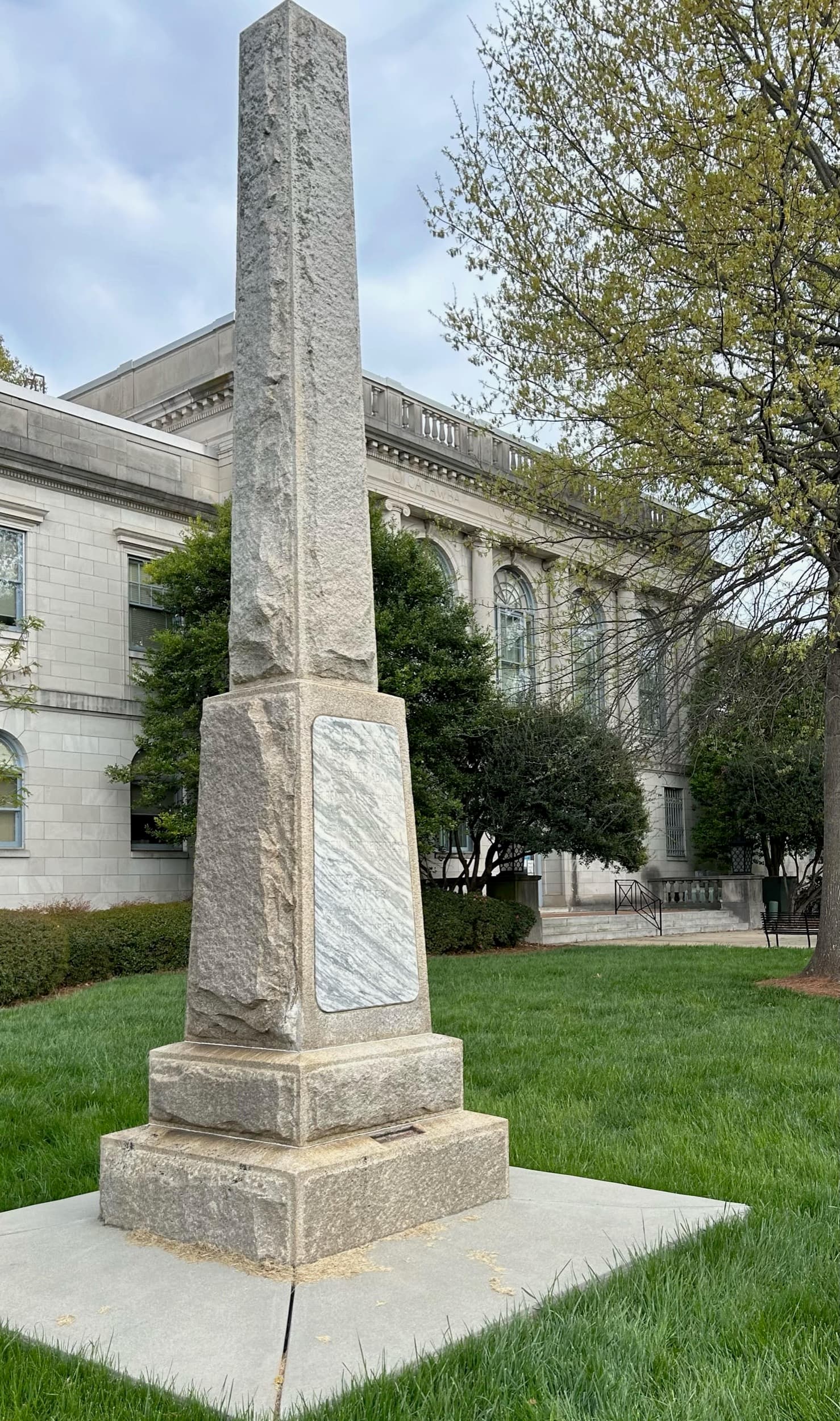
Monument “To Men Massacred on General Rutherford's Forced March, Newton” at the 1924 Catawba Courthouse, now the site of the Catawba County Museum of History, in Newton, North Carolina. Courtesy the author.
Word count: 925
Paragraphs: 11
In July 1776, when Thomas Jefferson was revising the draft of the Declaration of Independence in a town house in Philadelphia, a violent conflict was erupting five hundred miles away on the Appalachian frontier—a war between the Cherokee people and the white settlers invading their land under the banner of independence. Jefferson’s declaration is the beating heart of America250 and is celebrated in monuments spread across the US. The war in Cherokee country, by contrast, has largely disappeared from mainstream memory.
The only monument that even obliquely commemorates this founding conflict is a modest obelisk standing on the courthouse green of a small town in western North Carolina. On the shaft, a marble plaque names a half dozen white men supposedly “massacred” by the Cherokees in that fateful summer. Erected in the town of Newton over a century after the war, it stands near a Confederate soldier monument built a few years later.
A throughline connects all these events: independence, the Cherokee war, and the Confederacy. Here, in a nutshell, are the foundational paradoxes of American history.
When Jefferson wrote the Declaration, he included only one line about the continent’s Indigenous people, who controlled a huge stretch of territory bordering the thirteen colonies. He accused King George of deliberately inciting “merciless Indian savages” to prey upon the white inhabitants of the frontier. At the time, he based this accusation on the thinnest of rumors and inflated them into an existential threat, just as Trump has done in our own time with immigrants. Jefferson, too, did it for political reasons, to appeal to the backcountry whites the Revolutionaries desperately needed in their coalition. The playbook was essentially the same—to de-civilize and dehumanize the people you want to get rid of.
Ironically, Jefferson had no idea that a real war was breaking out at that very moment, incited not by the King but by those very backcountry whites, who for years had been breaking treaty obligations and moving across the boundary that was made to separate Indigenous territory from white settlement. Fed up with systematic white intrusion on their land, the Cherokees became the first Native tribe to go to war against the Revolutionaries in defense of their own territory. Cherokee warriors proceeded to attack white settlements on their side of the boundary line and drive large numbers of settlers in a panic back to white territory in Virginia and the Carolinas.
None of this history intrudes on the pristine surface of the obelisk in Newton. The “massacre” is unexplained, leaving it simply one isolated episode in the long, ultimately triumphant struggle between American civilization and Native savagery. A stroke of luck in old land records helped me reconstruct the actual train of events. The men named on the obelisk were not innocent victims. They were armed combatants who died inside Cherokee territory when they marched up a creek into an ambush. It was a military defeat, not a massacre, with the Cherokees on their own land rightfully defending it.
While Jefferson’s Declaration helped create a new nation, the Cherokee-American war of 1776 caused the destruction of much of the Cherokee world. In reprisal for the Cherokee attacks that summer, thousands of local militiamen launched ferocious raids deep into Cherokee territory. The troops burned dozens of Cherokee towns to the ground and destroyed thousands of acres of fields and orchards, causing mass starvation and displacement. Jefferson himself wrote that “I would never cease pursuing them while [even] one of them remained on this side of the Mississippi.”
It is no coincidence that settler independence would go hand in glove with Cherokee genocide and removal, and that both of these historical developments would prepare the way for plantation slavery to spread across the southern US. A straight line of white self-justification connects Newton’s massacre memorial to its Confederate monument, which claims grandiloquently, “No braver blood / For brighter land.”
If America250 were doing its job, it would put this story at the center of national reflection and reckoning about 1776. We would see it and talk about it in Philadelphia and Washington, Charleston and Colonial Williamsburg. Maybe even New York, where Cherokee-supplied pelts and skins once fueled the production of hats, shoes, and coats. The problem is not simply Trump; it’s baked into the world the founders made and the rest of us have inherited.

Laura Walkingstick (Eastern Band of Cherokee Indians), Then and Now: Wrapped in Survival, 2026. Courtesy the Museum of the Cherokee People.
To begin to reckon with this story, the place to go is Cherokee, North Carolina, the home of the Eastern Band of Cherokee Indians (EBCI). Its 16,000 enrolled tribal members are the descendants of a thousand-strong band who, against all odds, managed to elude multiple removals and become the only Cherokee community to remain on their ancestral homeland. There, the Museum of the Cherokee People is running its own America250 exhibition, Unrelenting: Cherokee People and the American Revolution, the first Cherokee-curated exhibition specifically about the ramifications of the founding moment. Curators Dakota Brown (EBCI), Brandon Dillard (Cherokee Nation), and Evan Mathis have created a show that decenters settler patriotism and puts Cherokee artists and voices up front, allowing the submerged story of 1776 to resurface. One might call it “Cherokee250+,” recognizing that the Cherokee world was created long before “America” ever was. In Laura Walkingstick’s piece, Then and Now: Wrapped in Survival (2026), a torn Revolutionary flag lies at the feet of a corn husk doll depicting a Cherokee woman. The doll stands erect, framed by corn stalks, the crop traditionally planted by women. It is a small but powerful antidote to America250—a miniature monument of protest and resilience.
Kirk Savage has been writing on public monuments and racial justice for decades. He is currently co-authoring a book with Elizabeth Thomas about her ancestor William Holland Thomas, his adopted father Yonaguska, and their extraordinary effort to keep a Cherokee community on their ancestral homeland.