Bicentennial Women: Feminism, Antifeminism, and Craft
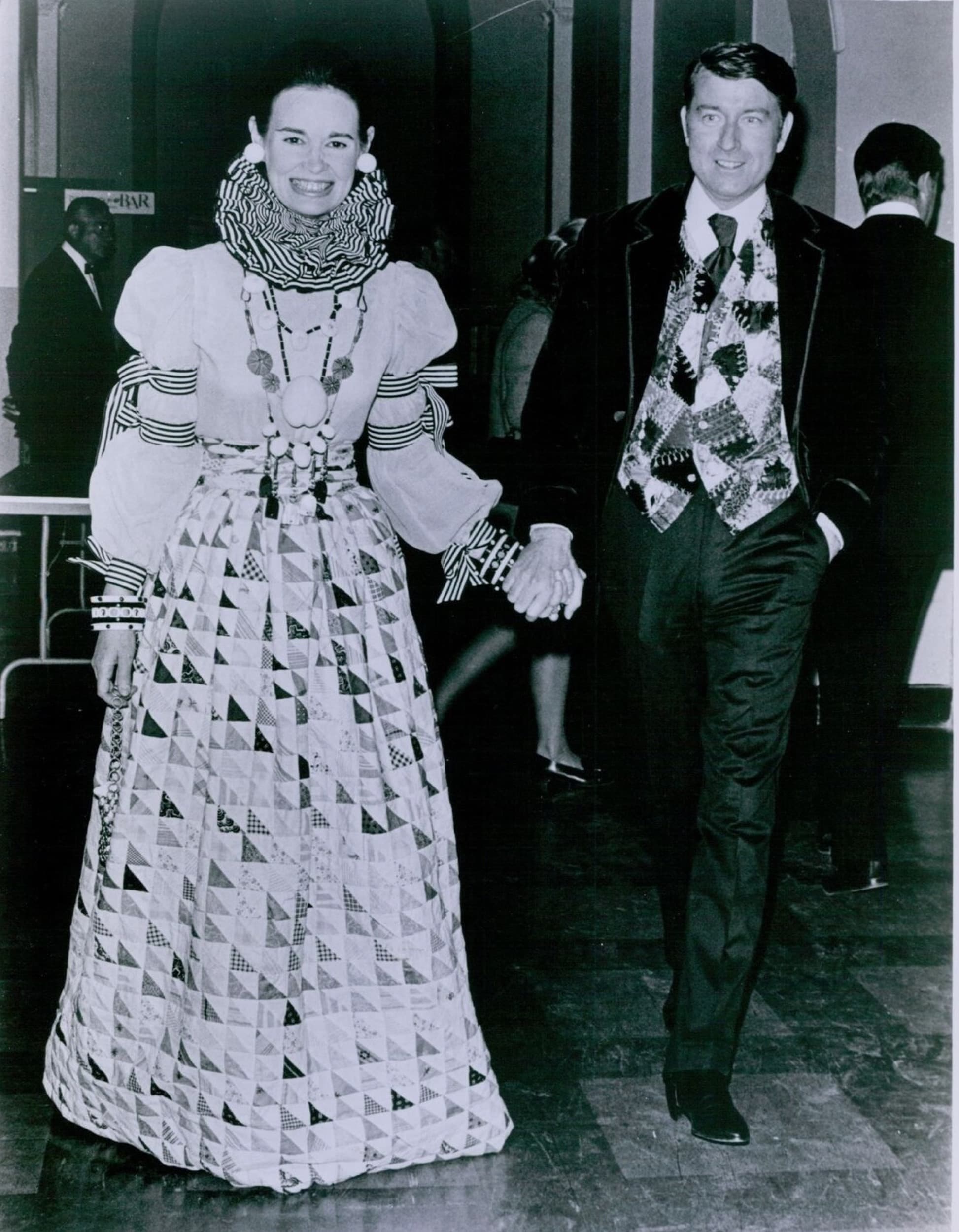
Gloria Vanderbilt Cooper and her husband, Wyatt Emory Cooper, in 1970. Gloria is wearing an outfit made from an antique patchwork quilt by the designer Adolfo in 1967 (now in the V&A Museum) and her husband is wearing a waistcoat also made from an antique quilt. Public domain, via Wikimedia Commons.
Word count: 789
Paragraphs: 17
A Partial Timeline
1969: Jessica McClintock buys Gunne Sax
1970: “Gloria the Great’s Patchwork Bedroom” February 1970 issue of Vogue
1971: Erica Wilson’s needlepoint show premieres on public television
1973: Roe v. Wade; Betty Friedan debates Phyllis Schlafly
1974: “Little House on the Prairie” premieres on NBC
1975: The Stepford Wives film premieres;“Wonder Woman” premieres on ABC
1976: Bicentennial celebrations; Martha Stewart launches catering business
*
The visual scene of the Bicentennial was deeply influenced by crafts, thanks both to its origin story in the preindustrial age and a certain romantic attachment to well-loved but apocryphal stories like that of Betsy Ross. Rather than gazing ahead at the computer age, style-setters in the 1970s seemed to look backwards to the colonial era and frontier life. It’s no accident that this occurred at precisely the moment when enthusiasm for the Equal Rights Amendment was building nationwide, and progressive women were declaring their independence from American patriarchy. In this way, the commercial face of the commemoration expressed profound uncertainties about the role of women and the related conflict between science and tradition, as well as roiling politics and media at the time and still today.
Fast forwarding to the present, tradwives too take the long way home, making food from scratch and resting their family’s health and wellbeing on the strict avoidance of modern conveniences, including synthetic fabrics, disposable diapers, and increasingly, vaccines.
We can’t begin to make sense of the contemporary web of wellness culture, femininity, patriotism, domesticity, and pseudoscience without understanding its prehistory.
The postwar American housewife had at her command devices and household conveniences that her own mother could scarcely have imagined, all available at affordable prices and styled for an optimistic future. She could be (and was) judged materially on her ability to produce nutritious family meals, and to keep her house sanitary and healthy. This housewife was also the mistress of a private sanctuary in which the raising of children—patriotic, Christian, and law-abiding future citizens—was her primary responsibility, just as it had been the duty of Victorian wives and mothers a century earlier. Here, her success would be measured affectively, rather than quantitatively. These two sets of responsibilities symbolize the powerful forces that pull American women between technological innovation, representing productivity and progress, and an idealized past case as simpler, more wholesome, less industrial, more natural.
The bent towards tradition saw a wide range of expression in the Bicentennial era. Suburban homes of the 1970s were designed around nostalgic nods to an idealized, preindustrial past in the form of colonial revival furniture and duck decoys. Colonial revival had been popular since the 1930s but really hit its groovy stride in the 1970s, when manufacturers like Ethan Allen and Frigidaire marshaled a color palette of red, white, and blue along with patriotic motifs of drums, eagles, flags, and Windsor chairs. At the same time, a countercultural version of domesticity popularized natural childbirth, and evinced a strong skepticism of newer technologies like plastic toys and the synthetic dyes, artificial sweeteners, and preservatives of processed foods. And craft projects, like quilting, stood in for a complex set of values and beliefs that, taken together, didn’t align with either of America's major political parties: craft was traditional women’s labor, and yet also anti-establishment and anti-consumerist, a rejection of postwar suburban norms.

Ethan Allen Inc., The Treasury of Ethan Allen: American Traditional Interiors (77th Edition) 1976. Courtesy Ethan Allen Inc.
The Bicentennial coincided with the height of the feminist movement: American women were pursuing opportunities in higher education and professional life in ever greater numbers. The working world was transformed by their presence up to a point, but nothing in domestic culture shifted to ease their burdens, so the home became a site of shift work, where relaxation and labor had to be negotiated. American family homes, still packed with the labor-saving devices that signaled solid middle-class status in the middle decades of the twentieth century, were increasingly the domain of moms who worked outside the home during the day.
In the wake of the counterculture movements of the 1970s, the strain of rustic romanticism was transformed by the traditional-values conservatism of the Reagan era. The domestic footprint of this era is shot through with conflict and tension; arguments about whether moms should work, anxiety about latchkey kids, and the pursuit of luxury and status in an economy that boomed only for a few. Ralph Lauren mapped out a preppy idyll for the privileged as politicians were busy demonizing supposedly crime-ridden cities. And perhaps most strikingly, in a new synthesis of tradition and liberation, Martha Stewart approached labor intensive home-keeping with the drive and seriousness that a 1980’s working woman might apply to her white collar, salaried job. Far from being a neutral form of opting out, the pastoral—then as now—was political.
Sarah Archer is a design journalist and independent scholar based in Philadelphia.