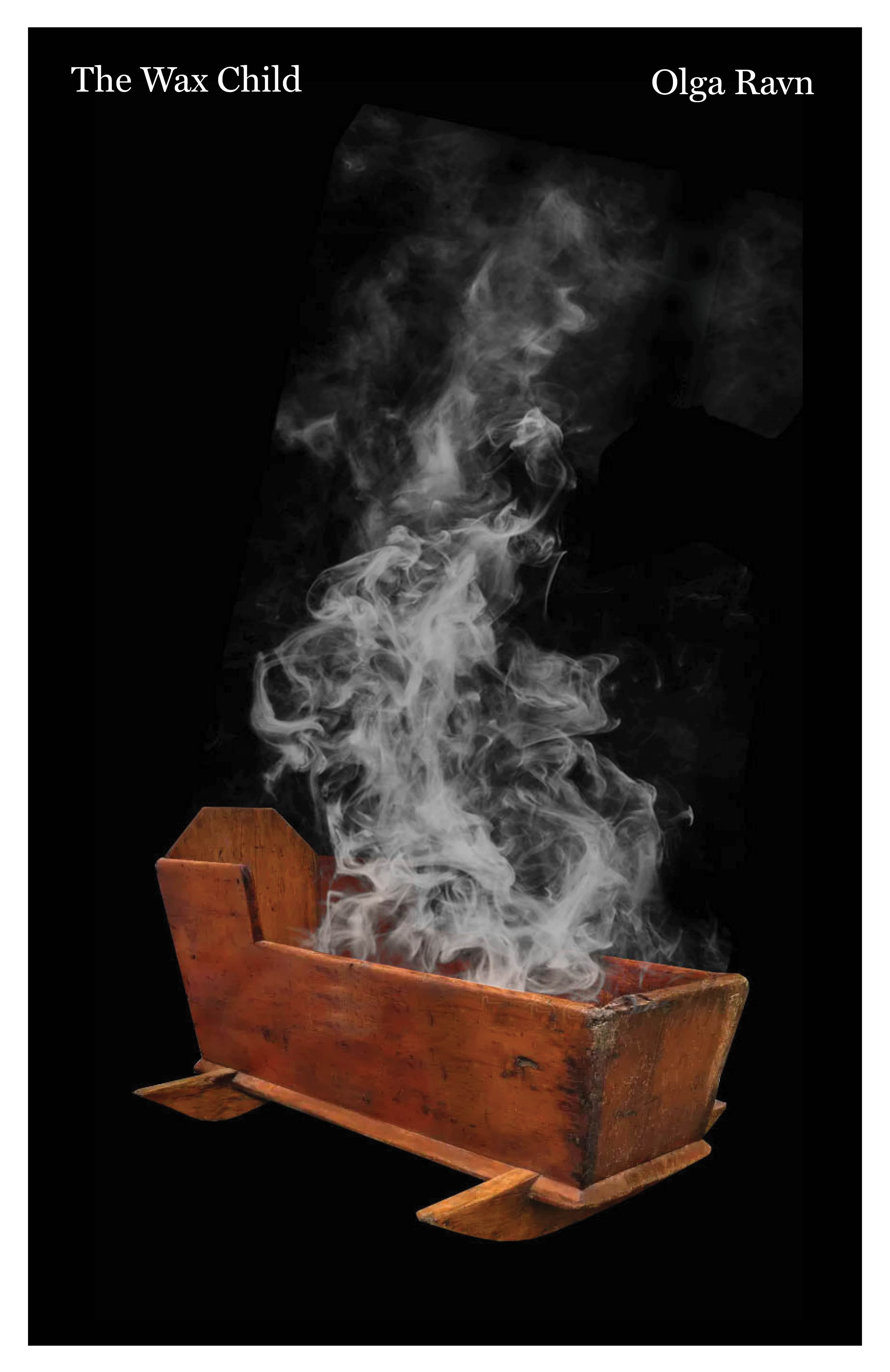
Olga Ravn’s The Wax Child
Word count: 684
Paragraphs: 10
The Wax Child
Translated from the Danish by Martin Aitken
New Directions, 2025
The Wax Child opens underground. “I lay in the ground and saw it all. Insects and worms approached, to retreat on sensing my poison.” The narrator is a wax child, made object, toxic to the natural world in its dissolution. By the last page it is still there, continuing: “every evening I tell the same story, and I speak to the soil.” Olga Ravn frames her novel with earth as much as wax as witness, soil as a carrier of knowing and seeing.
The wax child functions less as a conventional narrator than as an emotional, but not emotive, presence that observes, smells, inhabits, tends. Its “I” carries the precarious weight of a collective, recalling obliquely the plural consciousness of Olga Tokarczuk’s The Empusium’s “we,” without ever fully becoming one. It escapes the confessional lyric tradition and remains instead a slippery, assembled figure, made of unstable wax and spell and other women’s mouths and arms. It is an “it,” happily unresolved, neither fully subject nor object, neither alive nor inert. Not quite a doll (though at times it is wished to be one).
It belongs to Christenze Kruckow, orbits her, tends to her with a care that exceeds what it is capable of, watches over a woman it loves, cannot save and cannot leave. While it orbits Christenze, “my mistress,” the primary protagonist, the wax child lives materially buried in the dirt, carried in the arms of daughters, rests in Christenze’s friends’ kitchen drawers, and self-describes as inhabiting the murderous King Christian IV, “in the bone of his buckles” or “in his breath.”
Christenze Kruckow was beheaded as a witch in Copenhagen on June 26, 1621. The wax child outlives her to tell her story.
In the best way, The Wax Child functions as a historical research project via incantation. The spells that interrupt the narrative are not invented but adapted from so-called black books, grimoires spanning 1400 to 1900, some bearing the name Cyprianus, drawn from handwritten originals held at the Royal Danish Library in Copenhagen and the Trolldomsarkivet at the University of Oslo. To feel nothing during torture: “write these Latin words on paper and swallow them.” To see what would otherwise be unseeable: “wet your eyes with water taken from a stallion not yet led to a mare, three mornings in succession.” What feels absurdist is, in large part, documented. The back matter lists real execution dates: Dorte Kjaerulf, burned 1620. Maren Kneppis, burned 1612. Elle Nielsdatter, burned late summer 1620. Some women disappear from the court records mid-trial, deaths unrecorded, the archives reflect the narrative ambiguity. The book insists on their particularity. The soil remembers what the archive couldn’t.
The women who populate the text are spoken to with ambivalence. They are intimate and communal; they tell stories, slice fish for husbands, shield one another from abusive husbands, drink sheep’s milk, suck blood from one another’s fingertips, and also betray and accuse. Pettiness, malice, and class distinction prevail as much as care.
Voices often bleed into one another without quotation, a formal enactment of a world in which parsing voice becomes difficult, testimony and authority aren’t stable, in which a woman’s speech could become evidence against her. For all its eeriness the book moves quickly, scenes arrive and dissolve with little warning. The result is a reading experience that feels less like following a story than like being passed through a series of states, sensory, historical, affective. It—Olga, the wax child, the spells, the soul—asks what it means to tell a story when the conditions of telling are themselves unstable, when who speaks, who is believed, and what counts as evidence have always been questions of accepted ritual and power. The Wax Child carries these tensions by inhabiting them fully.
Like wax, the novel holds its shape only provisionally. Press against it and it gives and reshapes. Christenze Kruckow’s head is tossed and kicked into the gutter. The wax child watches, cannot move its hands, and goes on speaking without uttering a word.
Chimera Singer is a gender researcher, photographer, and multidisciplinary artist based in New York City. Their work moves between academic theory and visual practice, exploring how body and flesh collide with image and sound, revealing the limits of bodies codification.