Maggie O’Farrell’s Land
Word count: 1079
Paragraphs: 14
Land
Knopf, 2026
To casual readers, Maggie O’Farrell may be known solely as the author of Hamnet, her devastating portrait of William and Agnes Shakespeare published in 2020 and made into a celebrated film last year. Hamnet (the movie) is a deeply-emotional exploration of love, marriage, and death—standard ingredients of fiction that the great Bard himself deployed to great effect more than four hundred years ago. The irony here is that, over the course of ten novels now, Maggie O’Farrell has been consistently inventive and formally ambitious, experimenting with jumbled chronologies and shifting perspectives across a vast expanse of time periods.
O’Farrell’s debut, After You’d Gone (2000), was a multi-generational, multi-perspectival portrait of an English-Scottish family amidst social tensions exemplified by the 1990s Northern Irish “Troubles,” and a real-life IRA bombing. O’Farrell’s second novel, My Lover’s Lover (2002), brought readers to contemporary Australia and dabbled in ghost story tropes; The Vanishing Act of Esme Lennox (2006) spiraled back to 1930s India, while The Hand That First Held Mine (2010), was set in swinging 1950s London.
Even readers of Hamnet (the novel) will recall that—amidst all the drama and trauma, the passion and tears—O’Farrell penned an extended sequence from the point of view of a cat and a flea, to illustrate the disease transmission that eventually killed William and Agnes’s young son. After Hamnet—set in in the 1580s and 1590s, on the eve of Shakespeare’s literary fame—O’Farrell remained in the sixteenth century, with the hefty Marriage Portrait (2023), a breathless Italian melodrama (“The day that everything changed was damp and thunderous…”) chronicling a young girl’s traumatizing marriage into the mighty Medici family.
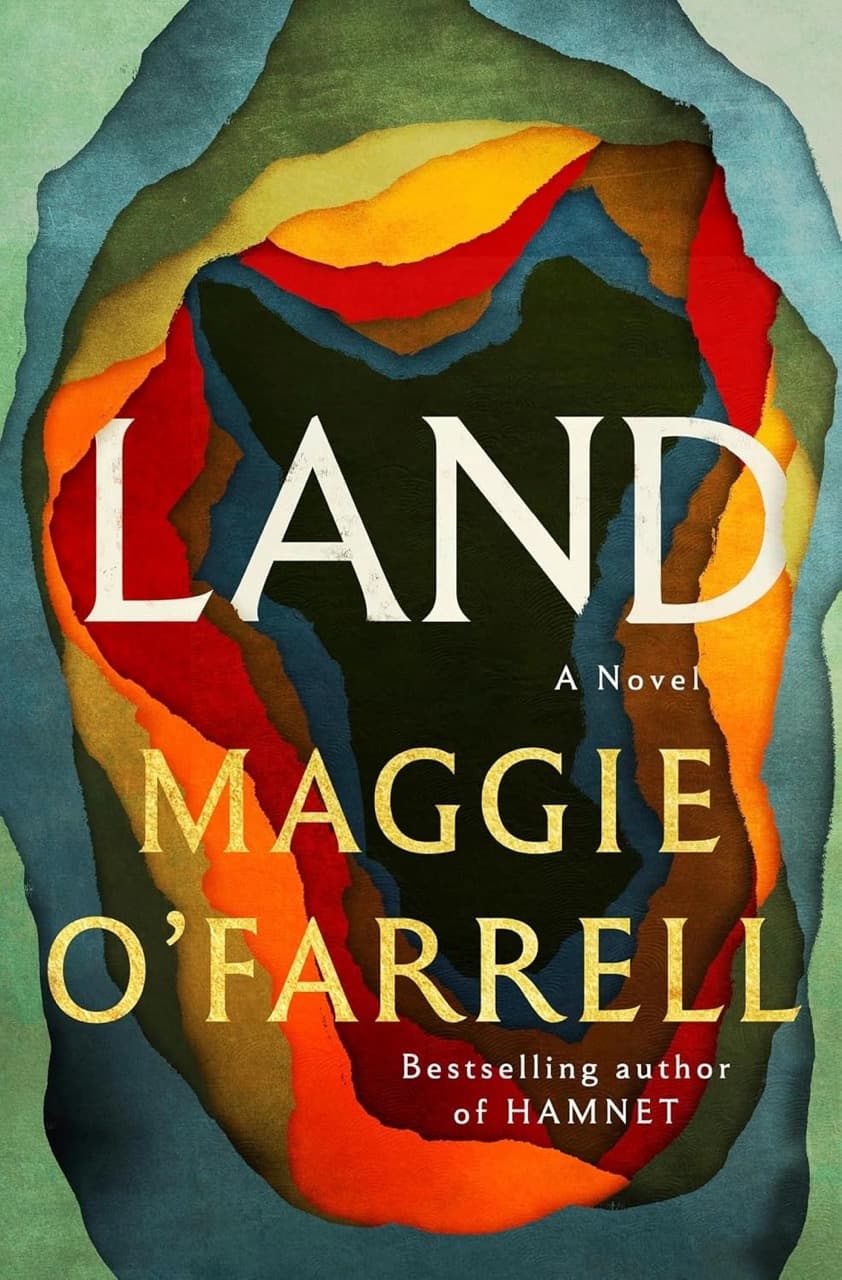
Now we have what may be O’Farrell’s most ambitious novel. Land is set almost entirely in mid-nineteenth-century Ireland—except, that is, for a section that takes place a thousand years earlier, featuring generous portions of magical realism, Irish-style. Land opens on “a peninsula, stretching out into the Atlantic, like an imploring hand, the westernmost scrap of Europe, before it surrenders to icy cross-currents of a vast ocean.” Much of Ireland is still recovering from what O’Farrell calls “The Great Hunger,” a disastrous potato crop failure that was exacerbated by colonial British bigotry and indifference. “Her life has seen too many endings,” O’Farrell writes of one scarred peninsula resident, “too many leavings, more than can be borne by one woman.” Land’s central characters are Tomás, Phina and their three children, all of whom come to exemplify different aspects of Irish diaspora experiences.
O'Farrell’s own biography illustrates the breadth and complexity of Irish identity. She was born in the partitioned province of Northern Ireland, in the contested county of Derry—or Londonderry, as it’s known to those who prefer to maintain British cultural ties. Young Maggie’s family followed her academic father to Wales, though she spent summers with family in Ireland, and was later educated in Scottish, Welsh, and English schools, before embarking on a journalism career in Hong Kong. No wonder O’Farrell once said: “In Britain I felt Irish, and in Ireland I felt British.”
Which only makes it more interesting that Land is a big, bold statement about her tiny island nation. A front-matter note even defines the Irish Gaelic word “seanchaí” as a “custodian of tradition,” or “reciter of ancient lore.”
Land opens with Tomás and Liam, father and son, working as land surveyors to create maps of the Irish landscape. They are accompanied by British “redcoats,” though O’Farrell largely avoids two-dimensional renderings of colonial persecution, in part because she’s more interested in strategies the Indigenous Irish use to persevere. Tomás, we learn, “is useful to” the British mainly because he “can also speak to the locals in their own language.” After a mysterious experience in a (magical?) forest, Tomás has a revelation.
What follows is a rollicking family portrait that veers from mythical to sitcom-ish: Dad goes a bit daft, while sensible Mom worries “the landlord might turn them all out onto the street.” And it works, in part because O’Farrell generally avoids lapsing into overwrought prose, allowing readers to feel “pulled along by events like a boat on a current.” We flashback to the grueling conditions under which Tomás and Phina met, and encounter an “atrocious creature” with “wide … fanged jaws” that Tomás wants to grab “by the neck and throttle … with his bare hands.” When a Jesuit priest arrives, with his own ideas about why Tomás has changed, O’Farrell not only upends this family unit, but also raises thorny questions about centuries of spiritual matters on the island of Ireland.
These narrative proceedings then come to a screeching halt. We return to that magical forest, just a “milennia” earlier, to meet a girl and her dog—a “monstrous, shaggy beast” with “fangs gleaming white in the sun.” This flashback is lengthy and playful, with some gorgeous writing about nature. If it’s not entirely necessary, it does fill in some important historical gaps, compelling readers to reconsider any ideas they may have about “ancient Ireland,” which is too often reduced to trinkets or vibes peddled on “Celtic” web sites.
By the time we return to the 1860s, emigration commences. O’Farrell sends characters to Québec, and India, then back to the Irish peninsula. All the while, English viscounts and their ladies arrive looking to buy up estates of Irish land. In The Marriage Portrait, O’Farrell presented a “tongueless” character—a “mute” artist—who played a small but important role. She builds such a characterization into something more important in Land, with a highly circumspect Irishman who “could tell you about the history” of his home, but only “should he wish to do so.” It’s a new spin on that old Irish adage: Whatever you say, say nothing.
Right before Land was released, it so happens that St. Ann’s Warehouse in Brooklyn presented another Irish epic about violence, memory, and real estate—a new adaptation of John B. Keane’s 1965 play The Field, directed by Luke Murphy. Entitled Scorched Earth, Murphy incorporates dance, prose, crime, history, and more. O’Farrell’s Land, in its own way, is also a multimedia work. Music, religion, dueling languages and education systems, and all those “ancient” memories flow into and out of O’Farrell’s characters, who compel us to look at old conflicts with new eyes—to see our present in their past.
Which is another way of saying that, with this big, exuberant book, Maggie O’Farrell shows herself to be an artful custodian of tradition, and skilled reciter of ancient lore—a twenty-first century “seanchaí.”
Tom Deignan is a columnist for Irish America magazine, and has written about books for the Irish Independent, New York Times, and Washington Post. He teaches at CUNY and is working on a book about religious violence in the 1920s.