Albert Mobilio’s Readings Against Type
Word count: 1616
Paragraphs: 11
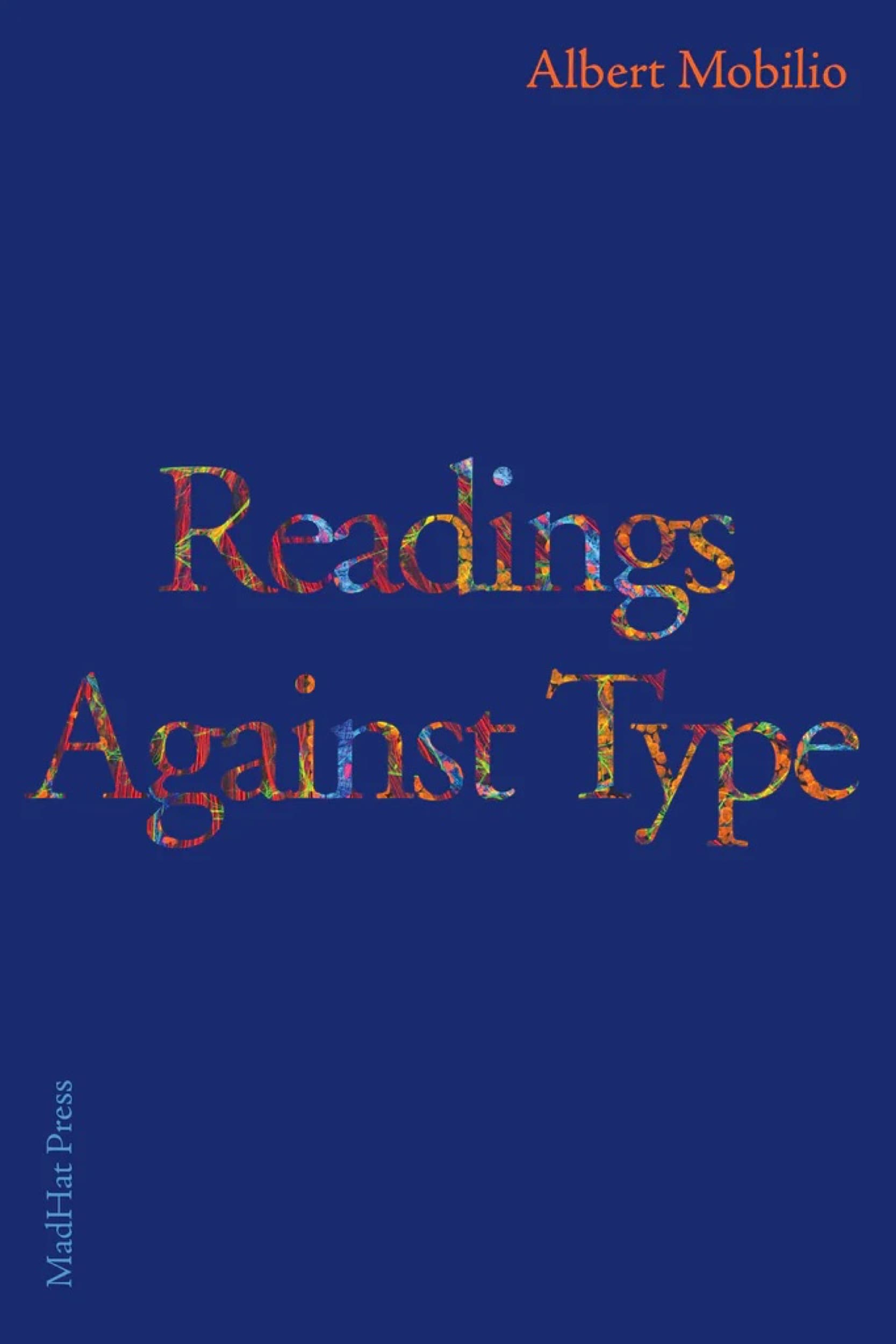
Readings Against Type
MadHat Press, 2025
The strangeness—the thrill—I wrote, while reading Albert Mobilio’s Readings Against Type, of writing a literary review on a book of literary reviews. Though isn’t criticism indebted to exactly this interactivity and self-reflexive connectivity, the potential of a reading that is so up close that it pushes inwards, aiming, like a reverse-angle camera, on the body of work that now necessarily includes the reader’s, this iterative aerobics of reading? And to open up analysis, to treat our lives with/in the texts that pass through us—often in the very moment of interpenetration—is also to change what it means to read. Mobilio’s Readings Against Type, like its title signals, demonstrates how one might undergo the task, the invitation, of recalibrating not only how to read but what can be read, a hermeneutic intervention that questions the literary system itself.
Readings Against Type is as eclectic as it is extensive, gathering work from a thirty-seven-year period beginning in 1988 from a range of literary venues—The Village Voice, Hyperallergic, Tin House, Harper’s, Bookforum, the Paris Review—including a recent talk delivered at the Louisville Conference on Literature and Culture. In order to accommodate a reading against type, Mobilio introduces an organizational framework that smuggles in a novel typology of literature that feels especially relevant for an age of data aggregation, transmediation, and hyper visibility: “Collectors,” “Unreadables,” and “On Camera.” The text’s thoughtful arrangement intimates Mobilio’s actual prose, which rims the borders of experiential and intellectual in order to dissolve any line separating the two. Remember, this is a book that doubles as instructions on how readers might engage the genre of literary criticism anew, but far from being didactic or clinically diagnostic, Mobilio explores and explodes his subjects through keen observations and personal ruminations, harnessing intimacy and vulnerability alongside philosophical insight. Examples abound in the collection’s very first essay, “For Keeps: The Christian C. Sanderson Museum,” which, in fleshing out the provocative thesis that to save is not to stave off loss but to welcome it, as memorial, into our lives—to make loss more bearable in its retroactive apprehension—could serve as a leitmotif for the essays to follow and, more broadly, for the act of writing reading that nurtured them. “For Keeps” also employs Mobilio’s swift shift from analysis to theory, the fluid movement of subjects and positions that implicates both “we” and “I.” We see this critical-creative progression play out on the page as Mobilio’s gaze restores his potentially unfamiliar subjects to the private sphere of everyday ritual.
But Sanderson wasn’t pathological; the tenor of his collecting mania was domestic and pedagogical, not rabid.
Every day, we make dozens of decisions about what things we want to keep and what things should be discarded. We sit in judgment over our material domain: the postcard from an old friend that’s been on the kitchen counter for a month, toss it; the set of unidentifiable keys, keep them just in case; assorted Post-its with various numbers and illegible names, keep for now; a coffee mug given by office mates, goodbye. It’s an unending and often perplexing chore. Most decisions we make automatically, appraising the relative utility of things—does it work? do I need it?—but other decisions are more fraught. I have a birthday card signed by my mother. Generally, I would keep these cards for what I believed to be a respectful period of about a month and then consign them to the trash (with a small but nonetheless manageable pang). There’s nothing special about the inscription on the card I have kept for several years, except that she wrote the words “Your loving mother and father” two weeks before she died. I keep the card, for what reason, I’m not sure. It’s standard-issue Hallmark, individuated only by a dash of her penmanship, but I cannot bring myself to throw it away; the pang is not manageable. Sanderson, it’s clear, couldn’t endure even the hint of such a pang.
Mobilio, who has published four collections of poetry—most recently, 2020’s Same Faces (Black Square Editions)—imbues his analyses with lyrical interiority and compression but also the plenitude of displacement, mobilizing the wandering fascination of a flâneur without their characteristic detachment. Reciting a line by John Ashbery (“Art House: On ‘John Ashbery Collects’”) indulges the conditions for absolute absorption, the giddy fantasy in which reader becomes writer becomes subject: “and I remember that night in Hudson years ago: among these things, amid their thingness, I realize that I’m standing inside one of Ashbery’s poems.” Antecedents of Readings Against Type’s commodious architecture and malleable lens include the essay collections My 1980s & Other Essays (2013) and Figure It Out (2020) by Wayne Koestenbaum, another cross-genre polymath whose work reprocesses the essay through its affinity with poetry, a commingling that destabilizes the assumed authority of the former with the open-minded density of the latter; both of these writers, perhaps taking a cue from Theodor W. Adorno in “The Essay as Form” (1958), show us that to write an essay is to treat its form and scope as nothing less than a zone of pleasure, of chance and play, occasioning the childlike conditions to “make the transitory eternal.” Likewise, each of these essays seem to offer Mobilio the occasion, not necessarily to extract but rather intensify and expand his subject’s “meaning” with sensitivity, wit, diversion, and lucidity.
Like many effective literary reviews, these essays are not necessarily about their intended subjects but the ways in which such subjects encourage broader conceptualizations of related phenomena or the ephemera of a previously hidden history. In “Past Forward: Joe Brainard Made His Memories Yours,” Mobilio parses the meticulous construction of naturalness; in “Soon There Was Nothing Left: A posthumous volume from John Ashbery troubles the line between finished and incomplete,” he reanimates the notion of the intentionally unfinished work by attending to the variable temperatures of “done”; in “The Lost Generator: Gertrude Stein Builds a Better Reader,” he mobilizes Stein’s writing to theorize the blurred distinction between reader and writer as a mode of translation: “She had pushed past telling into a new arrangement with the reader, one in which the reader felt the text become itself.” And earlier: “The writer uncovers what’s already penned.”
In “The Bookness of Not-Books,” Mobilio continues his decades-long investigation into the un/readable by configuring his elastic purview to artist’s books, whose pages elicit a reaction that he describes as moving “along the continuum between seeing and reading,” an assessment that returns us to the project of reassessing not just criticism but what it means to read, particularly in relation to a multimodal experience, which, Mobilio seems to suggest here, is not a contemporary product of digital media, but intrinsic to the act of reading, in which material, sensorial, and semiotic processes entangle to shape the text.
I like the “bookness” of Mobilio’s book, the aforementioned discernment with which he’s assembled a life in books as a kind of artist/reader retrospective. The review of the Christian C. Sanderson Museum that opens the collection provides the ideal entry point for Mobilio’s examination of documentation, death, memory, grief, and il/legibility, which achieves its logical culmination in the book’s finale: “Exquisite Corpses: Lifestyles of the Dead and Buried in Funeral Photography.” Like so many of Mobilio’s reviews, “Exquisite Corpses” also begins on the personal and anecdotal: his childhood role as altar boy: “Stoic child amid others’ pain, I earnestly played my bit part in a pageant of last things, sensing how ancient rites sought to transcend not only the drama of a single loss, but that of death itself.” Such early lessons instigate others, years and pages later, as Mobilio unearths the acknowledgment: “The dead do not require transcendence, whereas the living crave it,” before turning his attention, yet again, from the past to the present, from cultural text to cultural study: “If our sense of ending has been banished to an unacknowledged, shadowy realm by technology’s bright promise, these artifacts and rites of death allow our mortality some frank and necessary survival in the daylight world.”
Elsewhere, Mobilio’s measured curation links an essay on Ray Johnson’s mail art with “Correspondence School: The Changing Face of Letter-Writing Manuals,” in which he explores the rhetoric of letter writing throughout the twentieth century by reading a host of letter-writing manuals. The reviews, originally published a decade apart, are separated in Readings Against Type by a single page, allowing readers the means to locate latent connections in post-publication by coinciding the so-called “New York Correspondance School” (Johnson’s spelling) fostered by the avant-garde collage artist and the urtexts of junk mail traceable, not to America Online’s cheerful start-up announcement, but the death knell of intimacy provoked by an industry of impersonal personal communication. When Mobilio writes, in 1994—“The art of polite correspondence hardly needs a manual now; our letters read the way we speak—blunt, pissed-off, and loud. … We are now free to sling our plainly put sentiments at will, although bothering to write them down risks making us look like dandies. To look at a book on how to do it would make us frauds”—I can’t help but conjure visions of the now ubiquitous infiltration of ChatGPT and Claude into our everyday lives, chatbots that have replaced the message but also its writers and recipients. The opportunity for readers to be able to track these essays alongside their original publication dates and venues permits yet more fertile waypoints towards a reading between the lines and against the type. I can’t help but consider that this, too, was Mobilio’s point, in the endeavor to remap the horizon of criticism through the middle-distance bridging seeing and reading, recording and reconstruction.
Chris Campanioni was born in Manhattan and grew up in New Jersey. His research connecting migration and media studies has been recognized with the Calder Prize and two Mellon Foundation fellowships, and his writing has received the Pushcart Prize, International Latino Book Award, and Academy of American Poets College Prize. His essays, poetry, and fiction have been translated into Spanish and Portuguese and have found a home in several venues, including Best American Essays and Latin American Literature Today. Recent books include the novel VHS (CLASH Books, 2025), a creative nonfiction called north by north/west (West Virginia University Press, 2025), a monograph on works of art born in translation called Drift Net (Lever Press, 2025), and the poetry collections Windows 85 (Roof Books, 2024) and Rolling Windows (Roof Books, 2026).