Lucy Mullican: Encounter
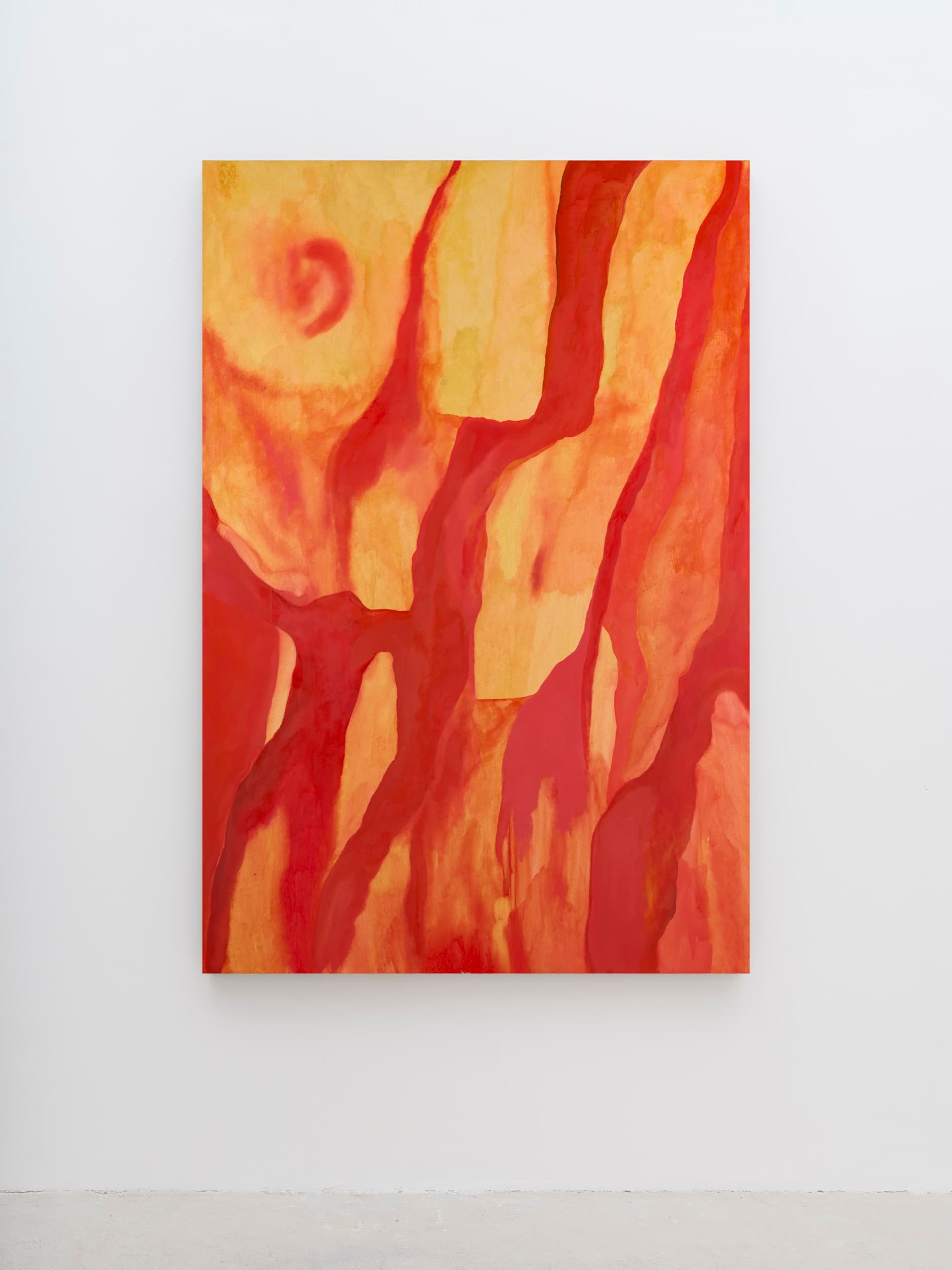
Lucy Mullican, Limbs, 2026. Watercolor on wood panel, 70 × 47 × 2 inches. © Lucy Mullican. Courtesy the artist and Villa Magdalena. Photo: Pablo Gómez-Ogando.
Word count: 649
Paragraphs: 7
Villa Magdalena
May 22 – July 22, 2026
Madrid
Lucy Mullican’s Encounter begins with ghosts from the past. Three framed found objects: a child’s shoe from the early 1800s, a photograph of an unknown woman in 1920s Glasgow, and a German decorative wall plate. Each carries its histories and silences. The instinct is to decipher, position, and contextualize. Yet, the harder you look for their stories, the more you realize you can only find your own.
Encountering these objects is a way to prepare for the artworks that follow. Mullican’s works play on our instinct to hunt for legibility, offering glimpses of a figure, a symbol, a name, yet never quite enough to reach a definitive understanding. You are left in a state of uncertainty, forced to let go. It is precisely within this condition that the work begins to reveal its full depth. By withholding a fixed narrative, it sustains a space in which multiple interpretations can coexist, drawing the viewer into a more personal and visceral experience. Within this framework, a review on this exhibition may seem contradictory, if not beside the point. My aim, then, is not to explain or resolve the work, but to offer a way of looking that shifts attention from the artist to the viewer—where the work becomes a site for recognition rather than explanation, and a means of encountering oneself.

Installation view: Lucy Mullican: Encounter, Villa Magdalena, Madrid, 2026. Photo: Pablo Gómez-Ogando.
It is no coincidence that the watercolors on paper in the exhibition function as a vocabulary, a lexicon of Mullican’s visual world. These small works on paper made with mineral pigments introduce a glossary of forms and motifs, including pockets and portals, strata and layered structures that recur throughout the paintings in shifting scales, colors, and configurations. Yet across the shifting imagery, one constant holds: the pair. Each work carries two forms in dialogue, at once in symbiosis and in tension, working with and against each other like a grammatical rule underlying the whole visual language. While they might initially read as preparatory, the watercolors’ relationship to the paintings is not one of hierarchy but of scale, unfolding through a reciprocal process of translation. Counterintuitively, it is the small drawings that offer the macro, almost aerial view of Mullican’s visual landscape, while the large paintings operate at the level of the micro, magnifying a single detail until it becomes its own territory.
Beyond their role as a visual lexicon, the watercolors are also key to understanding Mullican’s approach to color, surface, and paint in her wood paintings. What lives freely in the watercolors—that watery, light, ephemeral quality—is pursued in the paintings on a surface that seems to resist it. Yet, she achieves it through an inverse process: not through fluidity, but through control, layering thin veils of paint to produce a sense of translucency.

Installation view: Lucy Mullican: Encounter, Villa Magdalena, Madrid, 2026. Photo: Pablo Gómez-Ogando.
The painted veils are not only material, they also function as portals, entry points into the pictorial realm for both artist and viewer. At once revealing and obscuring, they become less barriers than thresholds, shaping and deepening the act of looking. Thin and delicate, these veils both protect and contend with the dense, anthropomorphic forms beneath and across them, shapes that immediately trigger recognition—a limb, a foot, a profile—yet never fully take form. This tension is sharpened by the literal titles, such as Old Man (2023), Limbs (2026), Monster (2023), which direct the viewer toward recognition while withholding its fulfillment. This dynamic becomes a form of calculated misdirection. Mullican stages the conditions of legibility only to suspend them, offering the illusion of resolution without release. The paintings resist immediate recognition, demanding instead more time, more questions, more thinking to reach a more sustained form of looking. The works confront you with a simple truth: not everything can be decoded. But then, what ever really can? Perhaps all images are, in the end, illusions we agree to believe in.
Ginevra de Blasio is a Rome-born curator and writer, currently based in New York City. Her practice bridges institutional and independent projects, with professional experience at the Drawing Center, Performa, Fondazione Corsini, 99 Canal, and Paula Cooper Gallery. She collaborates with professionals, including Adam Weinberg, Director Emeritus of the Whitney Museum of American Art, and Joachim Pissarro, founding member of the Global Museum Strategy Group. She was recently awarded a grant from the Italian Council to support her curatorial research on textile art, a project that includes lectures and public programs at leading museums internationally. In parallel, she serves as curatorial assistant for the forthcoming retrospective of Isabella Ducrot, travelling from MADRE (Naples), to Astrup Fearnley (Oslo), and MoMA PS1 (New York).