Leonora Carrington: Shape of Dreams
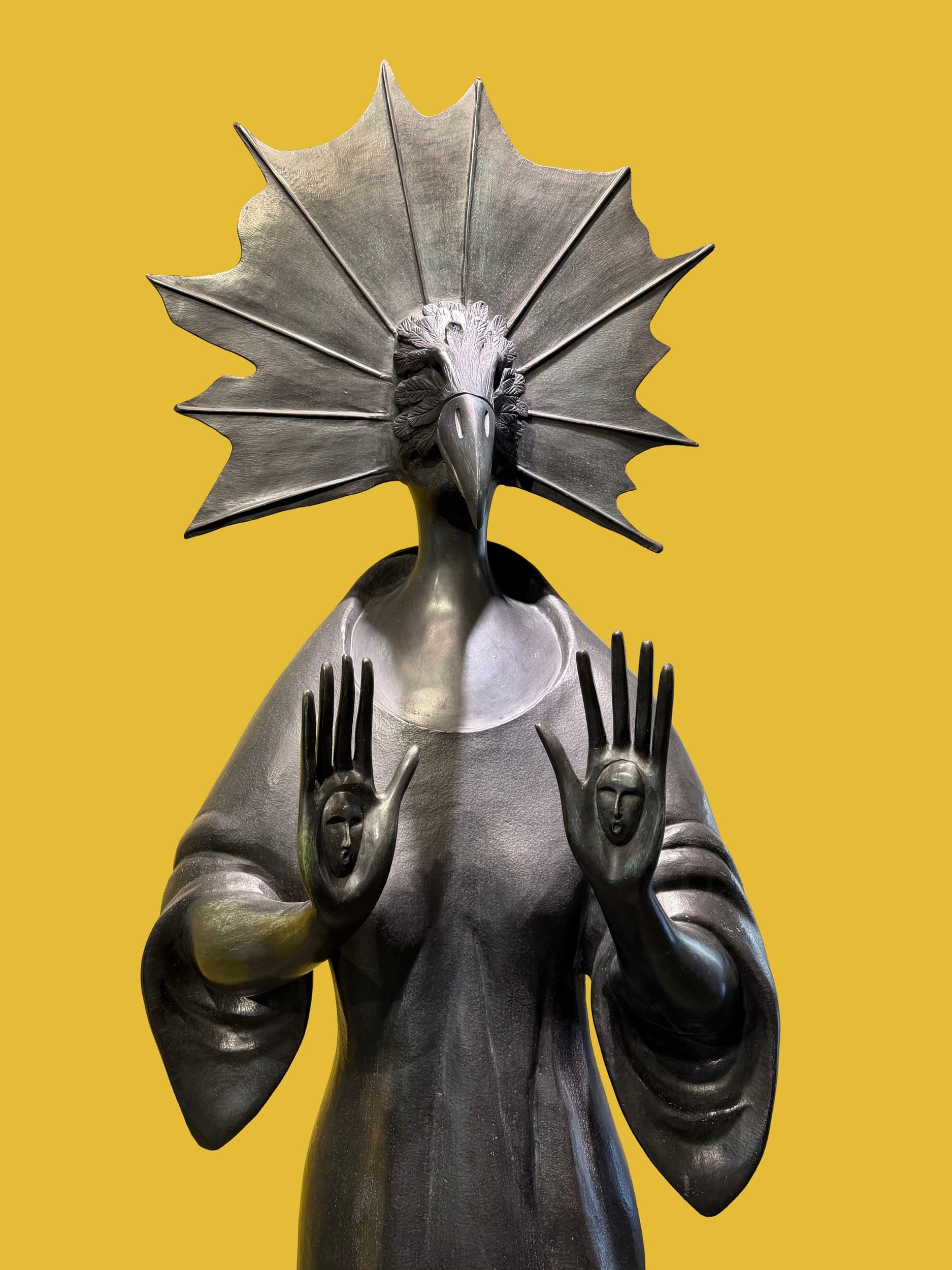
Leonora Carrington, The Palmist (detail), 2011. Lost-wax bronze casting, 103 × 50 × 33 inches. Courtesy L’Space.
Word count: 1226
Paragraphs: 9
L’Space
May 14–July 25, 2026
New York
L’Space’s Shape of Dreams, sculptures by Leonora Carrington, is an ambitious exhibition of eighteen of the artist’s reputed “last sculptures” that, given the thoroughgoing authorial controversy surrounding the reception of this set of works—executed by the artist, her sons, and several collaborators at a time when the artist’s health prevented her from painting—and the considerable debate they have generated among art critics and historians alike, is inevitably mired in several prefatory debates. Perhaps the most controversial and looming of these issues concerns the works’ authorial attribution. By way of thematic, documentational, and art-historical bolstering, the show seeks to emphasize the thoroughgoing threads of esotericism undergirding Carrington’s oeuvre, and thereby evinces that these late works are by no means peripheral to or separate from Carrington’s veritable art practice.
The lost-wax bronze sculptures, of which eleven are editions, were conceived between 1999 and 2011, correctly hew toward the soteriological and esoteric facets that buoyed Carrington’s art practice in general and informed her late Mesoamerican sculptural practice in particular. Many of Carrington’s preferred occult composite-creatures, which she returned to throughout her art practice, are culled into towering figurines. Carrington's sumptuous and moon-faced “giantess,” flanked by geese, was introduced in her painting, The Giantess (The Guardian of the Egg) (ca. 1947), and is one of the earliest such hybrid figures. Carrington continued developing her set of humanoid-animal celestial hybrids in And Then We Saw the Daughter of the Minotaur (1953), in which an antlered female bovine priestess sits beside an orb-punctuated table. This exhibition also features La hija del Minotauro [Daughter of the Minotaur] (2010), a sculptural adaptation of the seated priestess-doe, her neck and antlers now significantly elongated.

Installation view: Leonora Carrington: Shape of Dreams, L’Space, New York, 2026. Courtesy L’Space.
Readers familiar with Viktor Wynd’s infamous 2024 review of the recent Newlands House Gallery show Leonora Carrington: Rebel Visionary, in which several related “last sculptures” were exhibited, will know that these works have been the subject of significant recent critical dispute. Although the late artist’s son, Pablo Weisz Carrington, has avouched their authenticity with a photograph of Carrington flanked by a number of these works, Wynd has averred that, having spoken to “most of the experts on her work—museum curators, art historians, dealers and collectors … they are unanimous in their dislike of these late sculptures and in their feeling that she can have been only minimally involved at best.” According to Isaac Masri, Carrington’s friend and dentist, a number of these late works were based on plasticine models, with the material transfiguration and scale-based shifts accounting for aesthetic attenuation. It is often thought that Carrington, whose exacerbating arthritis prohibited her from painting and carving wood, began sculpting in bronze out of circumstance, contracting the support of her oldest son, Gabriel Weisz Carrington, alongside her colleagues José Sacal and Raquel Chamlati.
Admittedly, one of the means by which the exhibition seeks to achieve its art-historical aims is resuscitating the image of the artist from beyond the grave by way of Artificial Intelligence reconstruction. This galvanizes a set of nebulous biographical, if not moral, questions. A tarot card reading booth is installed wherein visitors are encouraged to pick a card from the major arcana suite (inspired by the Tarot of Marseille and the Rider-Waite deck) that Carrington designed and Tere Arcq rediscovered during a 2017 research trip to Mexico City. Here, Carrington’s speech—which traipses through tin-toned Spanish, English, and French poetic fragments—is recreated, rather than quoted. In some sense, this only compounds the inaugural authorial controversy, if not creating a host of new ones. As questionable as the manner of this presentation is, the inclusion of these optically enthralling tarot cards is most welcome. Carrington’s interest in cartomancy was informed by authors like P. D. Ouspensky, whose Tertium Organum (1912) was influential to both her and her Surrealist fellow-traveler Roberto Matta. Together they attempted to create a novel system of divination and to develop a strain of automatism informed by occultism.

Installation view: Leonora Carrington: Shape of Dreams, L’Space, New York, 2026. Courtesy L’Space.
Carrington began sculpting at Saint-Martin-d’Ardèche under Max Ernst and, early on, executed sculptures such as Head Horse (1938), which, much like the host of late works in this exhibition, similarly isolate Carrington’s motifs. The artist spent the subsequent decades moving from towering painted wooden guardian figures, like La Grande Dame (The Cat Woman) (1951)—its chest pocked by variegated anamorphic and hieroglyphic apotropaic marks—to silver casting before she began work with bronze in the 1980s. It should be admitted that there is a discernible difference between many of the early bronzes and the thumping majority of her late ones—a gulf that consists in the smoothing-out of ridges, buffed textural arcs, and, most significantly, the abdication of limned elements. Consider the totemic La Vieja Magdalena [Old Magdalene] (1988), where the wrinkle-rimmed visage of the owl-faced creature endows it with formal complexity. The cragged surface texture allowed for the artist’s appropriation of the alabaster-sheathed figure from The Ancestor (1968) to impress itself upon the percipient as a weary, ritualistic talisman of sorts—not the reductive remnants of a mere medium-based (viz., painting-to-sculpture) conversion or painterly plucking. Viewing Catwoman (2011), one is caught in the mimetic grips of Carrington’s La Grande Dame, but emptied of its quondam gradient shifts. Where the sculptures technically falter, the stumbling is partially due to the edition-based sculptural process. With generational removal, second (and subsequent) plasters often involve softened edges and the loss of surface information. This dilution of fine transitions is exacerbated when the foundry process involves enlargement. The absence of painting is highly significant. Collaborator José Horna carved the work (following Carrington’s instruction) after which Carrington added the painterly skeins.
Carrington’s painting, How Doth the Little Crocodile (1998), titled after the poem by Lewis Carroll—whose Alice’s Adventures in Wonderland, Aberth tells us, Carrington could recite “word for word”—inspired the eponymous 1998 sculpture on view here is one of the art-historical treasures in the show. La Inventora del Atole [The Inventor of Atole] (2011) and The Palmist (2011) are also captivating in their own right. The former benefits from the folds of silver-pearled cloth that lusters over a horned astral figure—the progenitor of the titular Mexican sweet drink. Compared to the other editions, this rendering of The Palmist’s beaked hybrid, with its stipules, flowered crown, and outcast webbing, is much more detailed. In La Cantante Muda [Mute Singer] (2010) and Cat Without Boots (2011), however, the ethereal motifs are simplified into soft forms stripped of such textural shifts. The same issue plagues the three sculptural works contributed by Carrington’s son Pablo: PAX ETERNA,, Untitled, and Posedon [Poseidon], all made in 2022 and all issued as editions of ten.
That some of the works are appropriations of the recurrent fantastical beasts that punctuate many of Carrington’s best-known paintings, such as the alabaster-sheathed figure from The Ancestor (1968) or the Stygian huddled triumvirate in the center of Tribeckoning (1983), is by no means a fault. For Carrington, these sculptural figures were at once informed by the indigenous symbols that the artist became familiar with during the 1950s while she collaborated with the Rosales family. However, they are also highly idiosyncratic and luxuriate in personalized, even psychographic, meaning. Thus, there is, at minimum, art-historical significance to be espied in the show. In addition, there are some works that are fine-grained in their detailing, periphrastically succeeding in demonstrating the value of “late sculptures” like The Palmist.
Ekin Erkan is a writer, curator, and researcher whose writing has appeared in the Journal of Value Inquiry, the International Journal of Philosophical Studies, and Hyperallergic, among others.