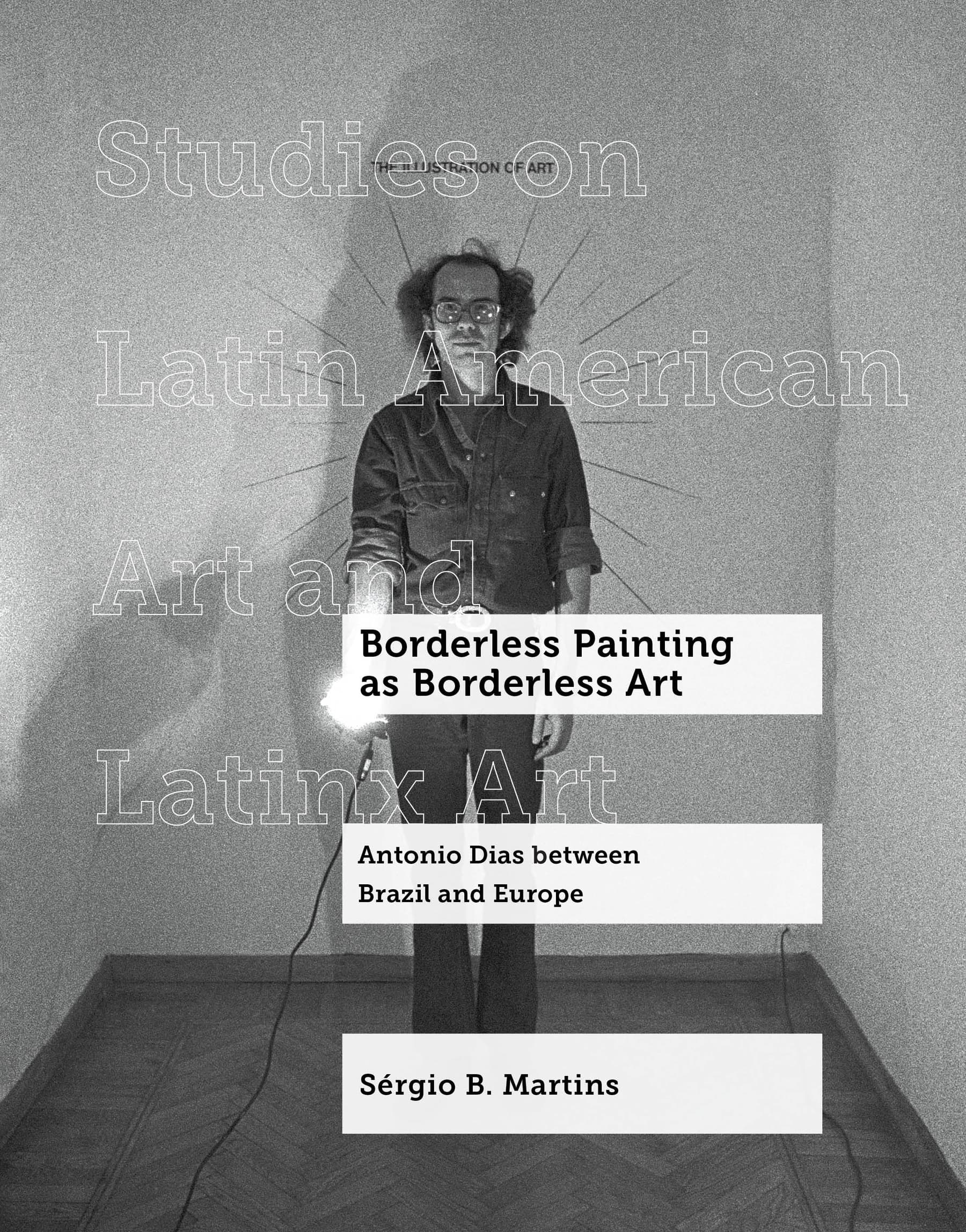
Borderless Painting as Borderless Art: Antonio Dias between Brazil and Europe
Experimenting with materials like plaster and laminate, Dias carved out a zone between painting and sculpture, de-bordering the work of art.
Word count: 816
Paragraphs: 6
Sérgio B. Martins
University of California Press, 2026
The reception of Brazilian artist Antonio Dias tends to be filtered through catch-all categories like “global pop” or “Latin American conceptualism,” neither of which captures his talent for positioning himself in between some of the most important art movements of his time. Initially trained as a printmaker and graphic designer, Dias’s first forays into artmaking were figurative paintings that combined images from pop culture and advertising with influences from European Art Informel. He made his name in landmark exhibitions alongside figures like Hélio Oiticica and Lygia Clark, before the hardening of the military dictatorship in Brazil forced him to flee the country. After a brief stint in Paris, he took up permanent residence in Milan, where he participated in happenings inspired by Fluxus and the Situationists, engaged with North American Conceptual art, and collaborated with the forerunners of Arte Povera. Refusing to find an optimal point between the different strands of his research, Dias preferred to extract creative implications from the interstices between them. As Sérgio B. Martins argues in Borderless Painting as Borderless Art, this negative dialectical approach is intimately related to the experience of geographical displacement, and to the market constraints placed upon peripheral artists in exile.
The title of the book is borrowed from a line in one of Dias’s notebooks, originally written in English shortly after his arrival in Italy. Although recursive, the sentence is not a tautology, unless the art status of painting is taken for granted. But after the historical dissolution of the medium-based system of the arts, learning how to paint was no longer enough to become an artist, for by that point art had transformed into something else. As Martins shows, Dias’s early figurative style mediated the crisis of modernism by combining graphic representation with three-dimensional objecthood. Experimenting with materials like plaster and laminate, Dias carved out a zone between painting and sculpture, de-bordering the work of art. Yet the full ramifications of this attack on the institution of painting would only emerge during his political exile in Europe, where he supplemented his repertoire with conceptual techniques and pivoted to a more pared-down graphic vocabulary. The “borderlessness” of the title is in this sense double-coded, referring both to a kind of painting that overspills the limits of the frame, and to the dislocation of the artist across national frontiers.
The bulk of Martins’s book explores the significance of this hinge point in Dias’s trajectory, which was shaped by the necessity of making connections with dealers and galleries within an emergent contemporary art market. Alive to the irony of the situation, Dias negotiated these demands by playfully adopting the mythology of cosmopolitan artistry, fully aware that “both his life and the reception of his work would always be determined, to a considerable extent, by his South American origin.” In Anywhere Is My Land (1968), one of his best-known pieces from the period, a white grid partitions a galaxy of stars like locations on a terrestrial map, putting outer space in the crosshairs. The English-language caption evokes the empty clichés of gambling and aviation (“the sky’s the limit!”), while also thematically introducing the ideology of free movement. As Martins demonstrates, Dias actively sought out indeterminate spaces like these, trading on the instability of the binary oppositions through which he was received: universal and particular, national and global, core and periphery. If his art embraced positive universality, it was in order to expose it as a form of exclusion, as becomes clear from another line in his notebooks, almost a manifesto: “NEGATIVE ART FOR A NEGATIVE COUNTRY.”
In his previous book, Constructing an Avant-Garde: Art in Brazil, 1949–1979, Martins argued that Brazil’s postwar avant-garde hijacked the strategies of modernism in a way that troubles dominant Euro-American narratives about how art history develops. Borderless Painting as Borderless Art traces the same contrapuntal movement along a different latitude, revealing how Dias’s adoption of conceptual techniques in Europe negatively indexed his peripheral formation as an artist. While the most up-to-date works of the era were laying claim to a generic concept of art that superseded the narrowness of national borders, Dias’s own works seemed unable to shrug off the contingency of geographical origin, throwing into relief the asymmetrical structure of the world art market. The problem, as Martins puts it, was that “Brazil could not be figured without his painting registering as provincial, or worse, exotic.” The artist’s solution was to enroll himself as the citizen of a negative country, one that manifested through his engagement with a range of art-critical categories, which he dialogued with but never totally adhered to. Although limited to the career of a Brazilian artist, Martins’s book succeeds in disclosing a more general system of marginal inclusion that still determines the circulation of artworks today.
Thomas Waller is a writer based in London. His writing has appeared in Parapraxis, e-flux Notes, Brooklyn Rail, and Los Angeles Review of Books, as well as in academic journals like Textual Practice, Qui Parle, Paragraph, and Rethinking Marxism. He is the author of Genres of Transition (2024), the editor of Roberto Schwarz and World Literature (2024), and the co-editor of Understanding Lacan, Understanding Modernism (2025).