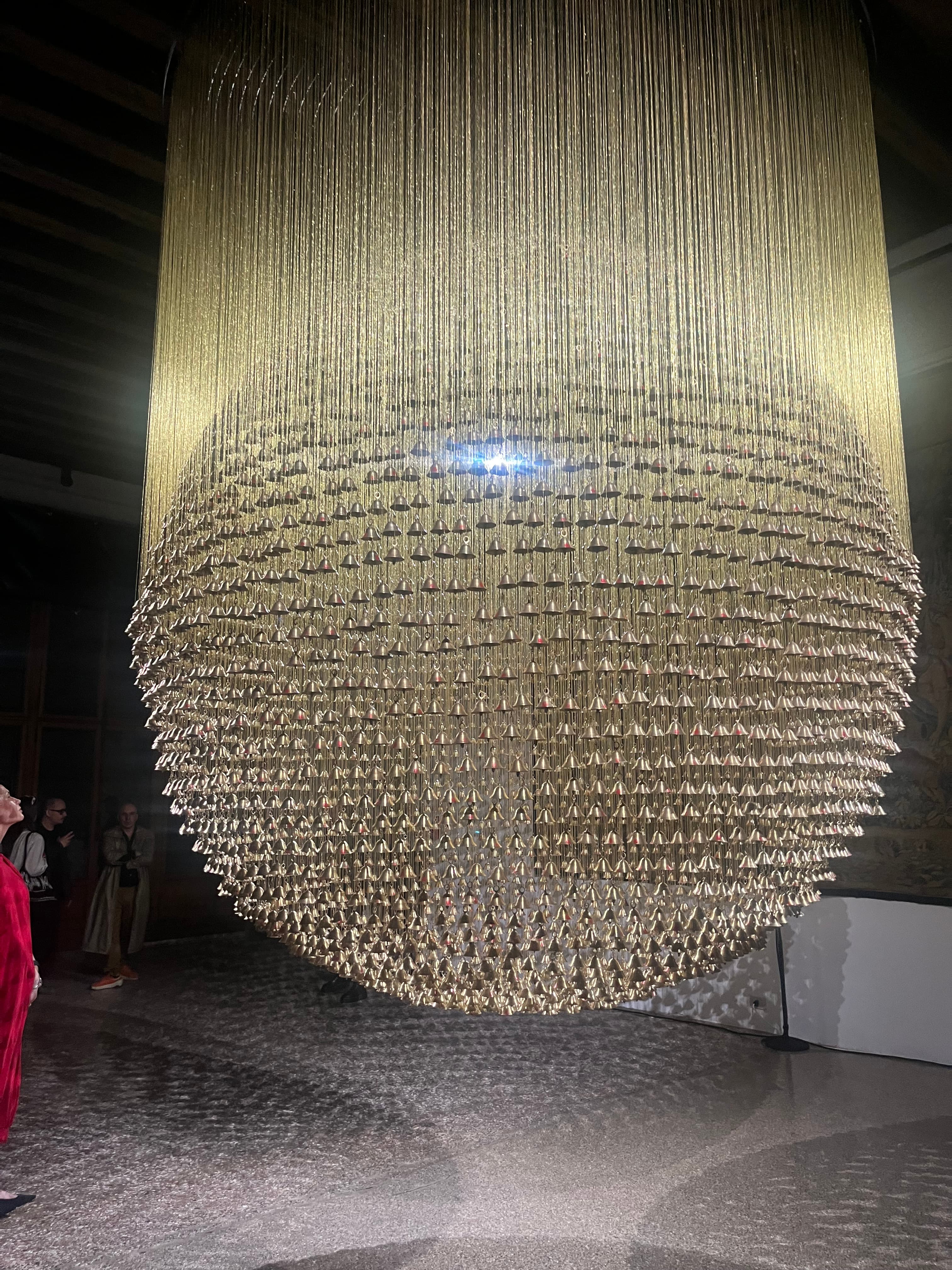
Ashfika Rahman, Than Para — No Land Without Us, 2025– . Installation with 4,849 temple bells (brass) bearing collected thumbprints from the community, golden silk threads, and metal frame. Courtesy the artist, in collaboration with the community of Than Para and the Chittagong Hill Tracts, Bangladesh. Photo: Monika Fabjinska.
Word count: 1589
Paragraphs: 17
PinchukArtCentre & Victor Pinchuk Foundation
Palazzo Contarini-Polignac
May 9–August 8, 2026
Venice
Belarus Free Theatre
Church of San Giovanni Evangelista
May 9–November 22, 2026
Venice
The postulate to separate art from politics has often been voiced in the context of the 2026 Venice Biennial as a result of globally heard protests against the participation of Russia and Israel. Even some curators and writers seem to have forgotten that most art is inherently political and that the Venice Biennale was designed as a soft power tool of national states—like the Olympic Games and world’s fairs. In its 131-year long history, many artists tried to outsmart the commissioning bodies, while states used their efforts to present themselves as more liberal. The relationship between art and state is the core of the Venice Biennale. That’s why it is such an important stage for nations without states, unrecognized states, and those under war or occupation.
Both protests attracted more immediate attention than the exhibitions of artists from Ukraine and Gaza. Rather than comparing geopolitical apples and oranges, it is more apt to read the Ukrainian exhibition organized by the PinchukArtCentre in the context of the first independent exhibition of Belarusian art at the Venice Biennale organized by the Belarus Free Theatre from London (both official collateral events of the 2026 Biennale).
Ukrainians masterminded an important weapon: their narrative. Still Joy – from Ukraine into the World, featuring works by fourteen Ukrainian and ten international artists, tells a clear story. And its joy is infectious. Above all, it is a thought-provoking exhibition that makes great use of the beautiful Palazzo Contarini Polignac. In the fifth year of the full-scale war and the twelfth since Russia annexed the Crimea, Ukraine still stands. Its people live a reality of alarms, shellings, excruciating cold in winter, civilian deaths, family separation, children kidnapping, seeing no end to the war. Ukraine lost some 350 of its artists—three times as many as the number of artists shown in the Biennale exhibition. How does one live under circumstances like these, when it becomes clear that normal life or happiness cannot be postponed and lived sometime later? How does one live in the moment? The exhibition shows that each manifestation of life becomes an act of war.

Roman Khimei & Yarema Malashchuk, Open World, 2025. Two-channel video with 5.1 sound, 236 inches. Courtesy the artists.
Two large screens in the entranceway show two massive crowds partying at music concerts, one in 2019—when the war in Donbas wasn’t news anymore and the sense of greater danger was fading, and one in 2023—a year into the full-scale war, when partying became both resistance and a celebration of life. In Dedicated to the Youth of the World II and III (2019 and 2023 respectively), the camera of Yarema Malashchuk and Roman Khimei shows the hypnotic trance of the packed crowd, the frenzy of the music, lights, and bodies, to then follow the participants into their daily lives.
An installation by Zhanna Kadyrova features plants she saved from bombed apartments and large-scale lightboxes with their photographs taken among rubble. While Kadyrova’s uncanny ability to play with materials that encode Ukrainian post-Soviet architectural landscape, like concrete and mosaic, were considered her hallmark, something else is at the core of her war works: she is busy saving and moving. There is a Sisyphean effort in her moving stones from the river, transporting them, and transforming into bread (Palianytsia [2022]); there is utopian care in saving her concrete sculpture Origami Deer (2019) from bombarded Pokrovsk and hauling it across Ukraine and Europe to the 2026 Ukrainian Pavilion in Venice—hanging from a crane at the entrance to the Giardini, the deer greets the Biennale visitors. The installation of rescued plants (Refugees [2023]), living creatures , suddenly makes obvious the scale of Kadyrova’s moving things around, saving metaphors from under bombs, performing woman’s endless care for the world. Watching the rave, we looked at the war. Here, we appreciate the loving care and resilience coded in every gesture, and yet one wants to ask: what if the war ends, but it has already entered Ukrainians’ bloodstream?
Curators Björn Geldhof and Oleksandra Pogrebnyak set Ukrainians in dialogue with international artists, bringing together joy and sadness, the prayer of hope and the prayer of grief showing that there is no other life, a war just offers an intensified version of it. Next to Kadyrova’s flowers, Ashfika Rahman’s stunning installation of 4,849 Hindu temple bells draws attention to other refugees: displaced Indigenous communities of a conflict-affected border region of Bangladesh (Than Para — No Land Without Us [2025]).
Alevtina Kakhidze, who could be called a conceptual cartoonist of this war, offering herself and society a pinch of humor as self-therapy, set a tattoo studio (Joy [2026]) where viewers can get a tattoo of her sarcastically captioned drawings (limited edition, complete with an artwork originality certificate), among them various symbols of resilience such as a tardigrade—a micro-animal that can survive almost anything.
The top floor hides a true gem: Yarema Malashchuk’s and Roman Khimei’s video installation Open World (2025). They offered a military robot that resembles a toy dog to a teenager from Zaporizha, Yaroslav, living in exile as a tool to visit his hometown. When the electronic dog, seeing for Yaroslav and speaking in the boy’s voice, enters his former school or chats with a little girl, we watch the boy’s face lighting with various emotions on a separate screen. The robot takes him home to his mom and cat. “Pet him for me,” Yaroslav says. When the mother asks her son whether he misses home, he smiles charmingly and with disarming honesty replies “Actually… no.” No one watching the film leaves. Glued to the screens, we partake in an intimate journey to the land of war where we see no explosions, only exploded emotions.
The state of Belarus presented a national pavilion sporadically, the last time in 2019. After a brutal crackdown on mass protests following the fraudulent 2020 presidential election in which Aleksandr Lukashenko claimed his sixth term, Belarus was absent from Venice. This year, the Belarus Free Theatre (BFT)—the most established Belarusian cultural organization in exile, in London since 2011 and critically acclaimed for their physical theater—organized an independent exhibition.

Installation view: Official. Unofficial. Belarus., Belarus Free Theatre, Church of San Giovanni Evangelista, Venice, 2026. Collateral Event of the 61st International Art Exhibition – La Biennale di Venezia. Courtesy Belarus Free Theatre. Photo: Dasha Trofimova.
Official. Unofficial. Belarus. at the Church of San Giovanni Evangelista blurs boundaries among art forms—some elements of its immersive environment are authored by visual artists, others by the theater group, verging on a multimedia set design. One enters a dark space to stand in front of what encapsulates the pain of exile for Eastern Europeans: a field of golden grain. It grows straight out of the dark pit of a cold, damp crypt, with folk spiders hanging above. Vladimir Tsesler’s iron welded sculptures (Straw Spiders [2026]) pay homage to delicate straw hangings traditionally believed to absorb tension and maintain balance at home. The space is filled with voices narrating stories of political prisoners. During the 2020 protests, over 30,000 people were arrested, some of whom were later released to the West. One account describes the moment when a prisoner realized she would never see her home again or return to her country, that there would never be a farewell to her family. Another describes tortures. Edges of the space disappear into darkness from which voices emerge, filtered through the experience of exile and contributing to the dramatic rift in terrorized nations’ cultural elites—between those who left and speak for their nation in the West, and those who stayed, muted for the world and often silenced inside the country.
Inside the church, the BFT morphed their metaphors even further with the function of the building: a large cross made of surveillance cameras and railway tracks refers to the arrests, persecution of clergy, and the partisan sabotage of railways used to move artillery towards the Ukrainian border in 2022 (Surveillance Crucifix [2026]); in Confessional of the System, a visitor approaching a confessional sees their image captured on closed-circuit TV monitors.
An enormous sphere of books banned in Belarus was originally designed by Nicolai Khalezin for the BFT stage production, Dogs of Europe (2022). A quick look reveals a massive volume of classical literature and even fairy tales. The environment is completed by Olga Podgayskaya’s soundscape and a scent created with Ukrainian studio ol.factory—The Smell of Dictatorship surreptitiously permeates the space. Several paintings by Sergey Grinevich add heavier religious iconography to these conceptual installations, directly using the figure of the crucified Christ to refer to the suffering of the nation. Replacing Venetian paintings undergoing renovation, they immediately recall the so-called church art in 1980s Poland, in which direct patriotic and religious metaphors often merged, and where protestors also hid from the brutality of state police in churches. The religious landscape is more complicated in the former Soviet republic where religion was banned, and where Christian denominations today are strictly aligned with political powers in and around Belarus.
Ukrainians perfected storytelling techniques as a tool of war. The Belarusian exhibition offers an encounter with a society whose silent voices can only reach us mediated by the Belarus Free Theatre whose founders have lived in exile for fifteen years. The environment they created makes the muted existence of an imprisoned nation, and especially the absence in Venice of the younger generation of artists, scream.
Ukrainians have agency; Belarusians almost nothing, for their dreams no hope is on the horizon. That’s why taking the time in Venice to hear the voices of the exiled and witness the silence of a nation is so important.
Monika Fabijanska is a contributor to the Brooklyn Rail.