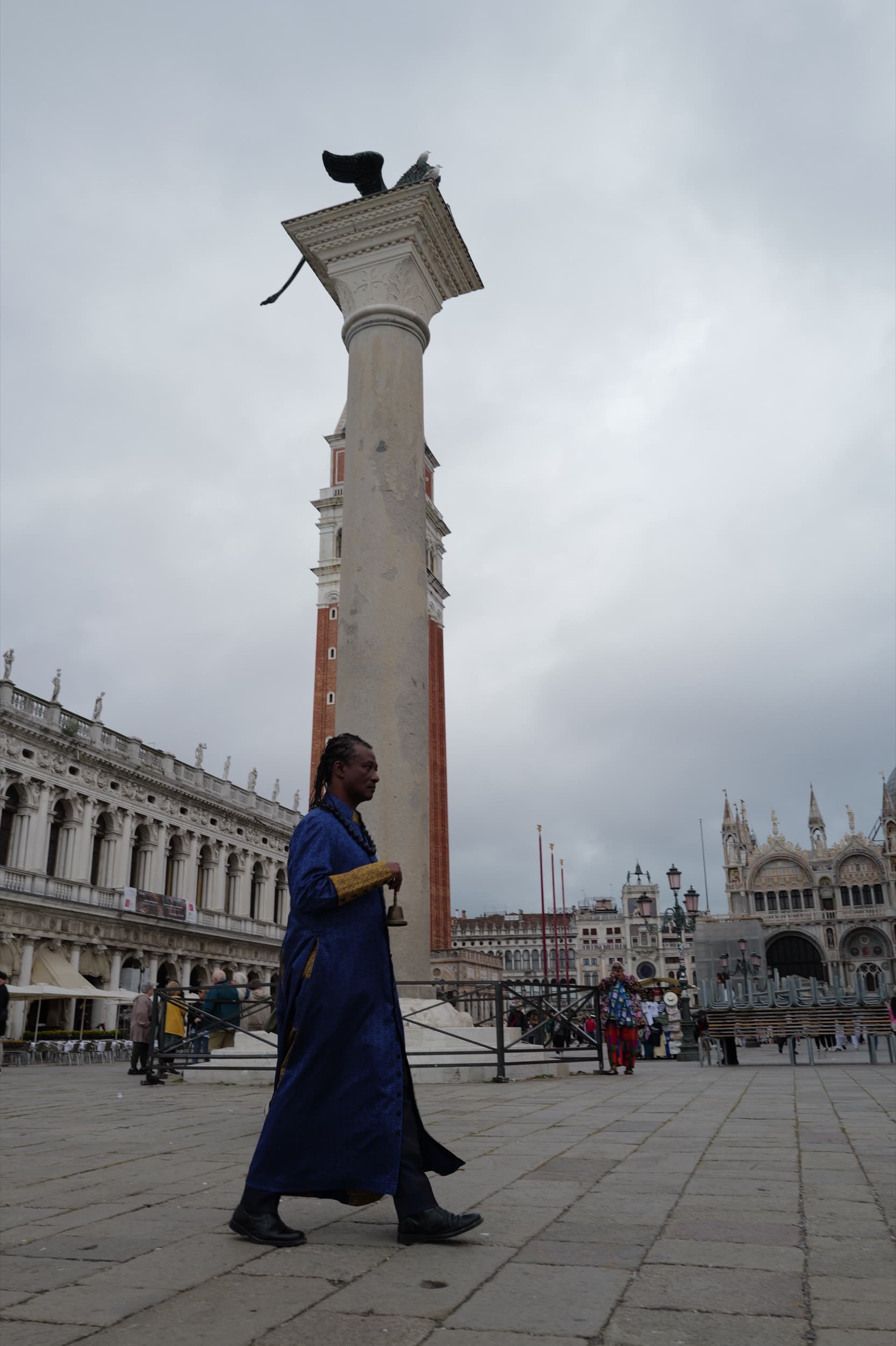
Bernard Akoi-Jackson, Performance of “Openings and Meanderings: Supplications for More Accessible Futures” for Jelili Atiku, @thirdspaceartfoundation, San Marco, Venice. Photo courtesy of author.
Word count: 2283
Paragraphs: 16
May 9–November 11, 2026
Venice
The 61st Venice Biennale, In Minor Keys, is not a collection of separate artworks but, like all groundbreaking curatorial projects, invents a place for artists and participants to live in a new aesthetic world for a time. Experiencing the show is disorienting—its architecture/scenography throws its denizens carefully and productively off-balance. Koyo Kouoh, as the first woman of African descent to curate the Venice Biennale, did not assemble a set of African and Global South star artists as was perhaps expected. She did not include African and diasporic artists that the art establishment might have expected, especially as she curated a major show on Black figuration. Instead, she has done something revolutionary. Kouoh focused on form, moving the center and curating from a critical African stance. She convened an eclectic group of co-creators who constructed a show around an African-centered philosophy built on cosmopolitan mobility and an ontology of eclectic, multivocal creativity. The artists neither focus on craft nor conceptualism, nor do they constitute a literal political or identity-based project. The show is not a celebration of art as commodity nor a simplistic critique of it. It is not an orgy of presentist pleasure or pain. Instead, it is about process and embodiment, archiving and reimagining. It imagines art practice as a dialogue about aesthetics and power; art is not something made and contemplated but an ontology, an attitude, a mode of discernment, a way of moving in the world. The show asks: how do we look, listen, and act if we do not take the stance of most curators and critics but curate from the perspective of a critical cosmopolitan Africanity?
The show features 110 artists and collectives spread across two sprawling installations at the Giardini and the Arsenale. The show revolves around shrines to Beverly Buchanan and Issa Samb alongside Marcel Duchamp, and six schools and collectives—blaxTARLINES KUMASI, Guest Artists Space Foundation, lugar a dudas, Nairobi Contemporary Art Institute, RAW Material Company—that establish a tone favoring collective art practice as way-of-life and pedagogy as method for archiving and accessing the bridges between human, spirit, and material world.
The show’s sharp edges and humor, its flows and movements take time to discern. It frustrates viewers intent on contemplating each work in isolation and positing each artist as a singularly productive potential genius. But the show has a story to tell if you listen. At Giardini, viewers entering are greeted by Big Chief Demond Melancon’s Amistad Takeover (2026), a suit sewn of beads, rhinestones, and feathers. Melancon led a procession to officially open the show, and his work stands at its entrance adorned with images from the Black masquerade tradition of New Orleans built upon West African performance forms. Entering the Arsenale space, Khaled Sabsabi’s meditative immersive eight-channel installation film khalil [close friend] (2026) with its low frequency meditative sound design establishes a tone of intimacy and collective dignity-in-contemplation.
blaxTARLINES KUMASI calls itself an art-labor movement and exemplifies how radical artistic practice challenges formal relations between artist and curator. This art collective formalized in 2015 by a group of teachers and students dissatisfied with the colonial legacy of the art curriculum at the Kwame Nkrumah University of Science and Technology in Kumasi, Ghana. They formed a critical art pedagogy that crucially blurred the lines between art-making, scholarly research, and curating. In the Arsenale, their collective installation SLOW DOWN: CATTLE BATTLE AHEAD (2026) is conceived as a space of immanent critique. It revolves around their “UNDERGROUND RAILROAD,” a giant topographic wall map of a geography of imaginary coastlines and archipelagos of islands. Tracy Naa Koshie Thompson takes microscopic images of bioplastics and cellulose foods and blows them up into a new cartography. On the map are names of radical movements and African and African diasporic thinkers, artists, and schools like Wole Soyinka and Ama Ata Aidoo, posited as escorts and conductors to navigate a path through a hostile landscape. During the opening week, artist Pious Fiifi Davies used a custom wooden loom to weave Kente cloth, calling it an “indigenous imaging machine.” Around the map are blaxxRADIO broadcasting a series of conversations, blaxxMEDIA with videos of past events and collaborations, and blaxxLIBRARY: On Ghosts, Resurrections, and Debris from by-passed Futures with books and archives, as well as haptic archives like the weaving performance that show knowledge held in bodies. The installation is not static, with programming changing twice a month.

Pious Fiifi Davies of blaxTARLINES KUMASI, Weaving Kente for “SLOW DOWN: CATTLE BATTLE AHEAD,” Arsenale, 61st Venice Biennale. Photo courtesy of author.
The collective draws inspiration from Harriet Tubman and the way Underground Railroad stations were used by African Americans to navigate to freedom in the pre-Civil War American South. blaxTARLINES KUMASI plots imaginary islands and celestial bodies as means for navigating ongoing depravities of racial orders of power. Standing in front of the map, artist Adjo Daiki Apodey Kisser explained to me, “We map safe houses and persons and places and groups that create new thought and convivial encounters all over the world.” The collective, whose members include multimedia sculptor Ibrahim Mahama and performance artist Bernard Akoi-Jackson, draws inspiration and its name from Ghana’s first independence leader Kwame Nkrumah, who used Marcus Garvey’s conceptualization of the Black Star to conceptualize post-imperial Black political-economic and spiritual freedom. For Kisser, blaxTARLINES KUMASI is a “condition for arts practice” that “suggests a new way of being.” It is a flexible and diffuse mode of discernment that can deploy any media and be channeled through an evolving cast of members each evolving their own creative practice while maintaining a grounding in the collective vision of care and action. For this collective, provocations become dialogic stories that chart new paths to freedom.
The biennale’s title, In Minor Keys, asks participants to “tune in to the frequencies of minor keys.” It calls for remapping time and space, listening for the less heard sonic-musical registers, in time, and looking for small islands in an archipelago to chart networks and movements rather than dwelling on vast monoliths and discontinuities, in space. As with blaxTARLINES, this aesthetic theory of time-space is rooted in 1950s–60s struggles against colonial rule across the globe and the pragmatic idealism of the independence-era as former colonial peoples imagined new political futures. This project rebuilds these philosophies for the post-independence era, as we struggle with new violences as well as possibilities.
Senzeni Marasela’s installation focuses on archiving as living process and embodied dialogue between past and present, living and dead, built and natural environments. Her main piece comprises seven mixed fabric blankets each stitched with an explosion of red wool thread. They are suspended high up, so the red cascades flow down towards the ground while remaining frozen above the floor. Details are woven into the back and front of the pieces, challenging viewers to move up and down and strain to discern complex stories in the flowing nuances of the fabric. Each piece is named for a specific mining disaster in South Africa in which Black miners died. Their bodies remain buried underground, their stories unresolved. Written archives and oral stories the artist collected are stitched into the work. It is a memorial and discussion of mining and mine tragedies and how the families of those still buried underground struggle to find rituals and means for connecting with the dead. The red thread represents the blood of death and rebirth as well as “red dust,” a reference to ecological disasters and political turmoil in South Africa. The piece embodies how women witness and record the past and rebirth the future. It is both an archive of the past and a method for imagining new modes of communication.

Senzeni Marasela, 2025 Installation of six pieces each named for South African mining disaster, year, and miners killed. Red wool hand-stitched on mixed-fabric ceremonial blankets. Arsenale, 61st Venice Biennale. Photo courtesy of author.
Standing under her work, Marasela explained to me that she is interested in “ecological grief” and in excavating Johannesburg, a city whose vast wealth was built on mining and the violent exploitation of Black labor. Born under Apartheid and experiencing the struggle for freedom, she said, “there is the South Africa before Nelson Mandela and after,” and that—in the seismic shifts that shape the evolving South Africa—“Johannesburg is new to many of us.” Digging in the city reveals its layers. Exploring archives allows her to excavate Johannesburg and discover it as a space of death, struggle, and possibility. Her installation draws together a set of works at the center of the Arsenale focused on extractive economies and relationships between minerals and people, labor, and sustainability. She pulls viewers into a set of specific conversations about Johannesburg, the racial violence of Apartheid, and post-freedom sustainable life that requires being in dialogue with the past while living in the present. Through archives and their aesthetic sensibilities presented in this work, we are trying to discover ourselves. In this work, South African life in its layered archives of racialized labor and structural violence and its always-emergent creativity becomes an aesthetic guide and ontology that makes sense of this seemingly chaotic contemporary moment.
Viewers moving through exhibition spaces encounter multiple shrine-like works by Carolina Caycedo, Sandra Knecht, Edouard Duval-Carrié, Guadalupe Maravilla, Ebony G. Patterson, and Dawn DeDeaux plotting links between humans and spirits, past and future selves. Similarly, paintings and images by Werewere Liking, Sawangwongse Yawnghwe, Pio Abad, Kaloki Nyamai, and Godfried Donkor and multimedia sculptures of Wangechi Mutu and Nick Cave invoke multivocal archival memory, eluding the representational instinct to make or disassemble subjects in favor of more diffuse, raw, and multiplanar compositions.
Kader Attia’s multimedia installation Whisper of Traces creates a shrine-like film-viewing space for contemplating the relationship between technology and ghosts. It occupies a room divided from the rest of the exhibition that viewers must pass through. The entrance is adorned with images of twentieth-century European modernist art woven together with pictures of non-Western sculptures that they copied. The dual images appear as haunted ambivalent invocations of the spiritual in art. The main space is filled with thick ropes hung from the ceiling and adorned with fragments of broken mirrors that refract images from five irregular video projections on the walls of the room. It is impossible to see all the screens at once, so viewers are compelled to roam and perch around the pillars as they listen and watch. Images move from Vietnam to Senegal to France. The central story that inspired this work starts with a Vietnamese shaman who told Attia that the world of spirits knew about digital technology long before people invented it. This sets him off on a journey to explore artificial intelligence and the digital realm through the realm of the occult. As Attia told me, he is concerned with “an ontology of ghosts” and exploring post-religious spirituality in an era when enchantment is increasingly located in the technological. For him, ghosts appear as external but are inside of us. The juxtaposed images of shrines and technology, rituals and media show how frequencies are spirits that haunt technology from within. Digital paths that lead us to the seemingly scientific are, in fact, already haunted by collective and personal ghosts.

Kader Attia, 2026, Whisper of Traces. Installation with broken mirrors, rope, woven images, paper, and dried flowers, sound, and video projections. Arsenale, 61st Venice Biennale. Photo courtesy of author.
Some of Attia’s moving images are styled documentary and some experimental. It is all experienced partially filtered through the thick black ropes and violently shattered mirrors. This is both playful and a warning about singular meaning. The space becomes a shrine to the spirits of technology and those of image-making. The work presents an ontology of knowledge, projecting signs and ideas as always fragmented and filtered. The work creates a time-space for experiencing the relationship between the spirit world and the technologized present and future. The space of installation is a deterritorialized one in which art frees the artists and consumer from the strictures of formal French modernism on the one hand, and archival and ethnographic knowledge-production on the other. Attia is concerned with dreams and collective memory and using art to provoke them. For the artist, ghosts are not external free spirits but are already inside of us, signs and agents of collective histories—aesthetic clues to where we are going.
The show posits an African curation as cosmopolitan, critical, inclusive, mobile, and de-territorialized. The curator and her team, which took over after Kouoh’s sudden passing, and the architects who did the scenography focus on complex juxtapositions amongst works inviting audiences to think not with individual artists or pieces but in a multivocal symphony—not held in place by nation states or identities—while remaining grounded in specific contexts, histories, silences, desires.
In the water behind the Arsenale, Alice Maher recreated her 1996 work Les Filles d’Ouranos composed of a set of orange resin heads emerging from the water. They present the birth of Aphrodite not as a singular figure of beauty for contemplation as many disembodied heads. Half visible, submerged their eyes watch, their mouths just below the surface. Always emergent they are just silenced or preparing to speak. These female subjects are partially hidden, multiple and observant. Rising from the water behind the main show, the female figures are forever reborn—satiric, biting, and violent critics refusing to reveal themselves for masculinized observation. If archipelagic thinking coming from Caribbean theorists like Édouard Glissant is central to this African critical curatorial project, Maher’s work becomes an unexpectedly central node for magnifying this concept into a fragmented yet singular subject of the mythic realm. The water is the medium of nature and spirit and the site of emergence of what it means to be human. The waters of Venice contain traces of ancient trade routes that birthed extractive imperial economies as well as new mobilities. Aphrodite’s heads become an archipelago, extending from this artists’ enclave into the world.
The uniqueness of this Venice Biennale is in positing African curation as an ontological stance from which to watch, listen, apprehend, adapt, connect fragments of the world, and forge new embodied modes of communication.
Jesse Weaver Shipley is an artist, filmmaker, and scholar.