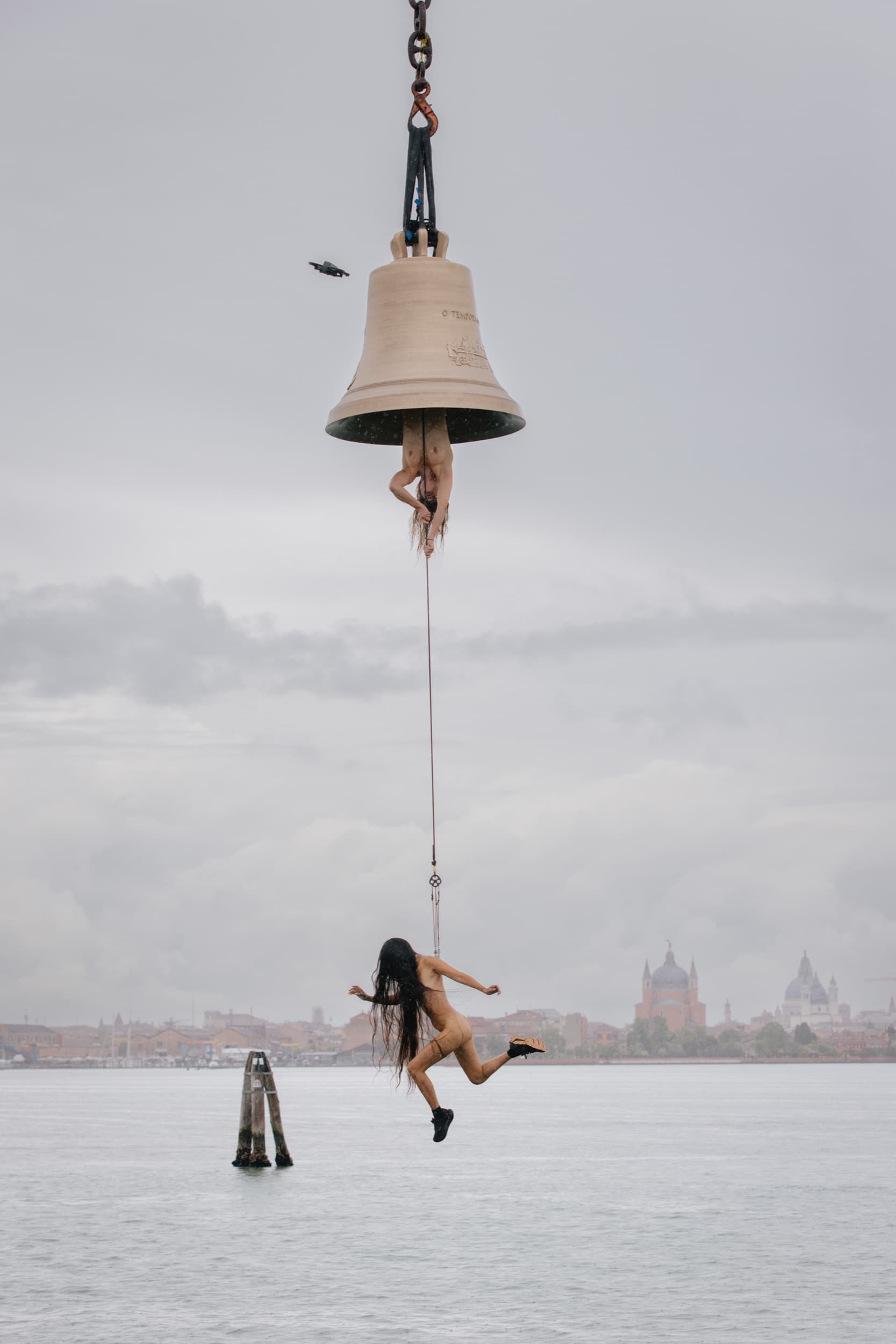
Florentina Holzinger, Opening Étude, SEAWORLD VENICE, 2026. © Helena Manhartsberger. Courtesy the artist and La Biennale di Venezia. Photo: Helena Manhartsberger.
Word count: 1287
Paragraphs: 20
Austrian Pavilion
May 5–November 22, 2026
Venice Biennale 2026
In her curatorial text for the Biennale catalog, Koyo Kouoh drew inspiration—and a title—from James Baldwin: “The minor key, in music, alludes both to the structure of a song and to its emotional effects. It is a rich idea, so rich that it quickly overflows its technical definition and spills with metaphor.” Kouoh, the first African woman to curate the Venice Art Biennale, passed away on May 10, 2025; “In Minor Keys” was realized posthumously by her team. Kouoh’s Biennale reveres the sacred, illuminating rituals both contemporary and diasporic, seeking transport for the ritually deprived.
Florentina Holzinger’s SEAWORLD VENICE transformed the Austrian Pavilion through ascendant movement and sonic force—mirroring Kouoh’s theme—launched by performances that repurpose the bell, freshly drawn from the lagoon in an Étude, reframing its canonical function as a radical feminist Maenad’s call to action.
On the morning of the pre-opening, I rushed to catch a ferry into the lagoon for SEAWORLD’s invitational Étude. As we launched, a ship of art world figures broke into applause as curator Nora-Swantje Almes introduced Florentina. She greeted us with a grin: “No one knows where we’re going. You’re the lucky ones… We’re going to try to get something out of the water today.” We learn that her original intention was to dump Josef Hoffmann’s rationalist “Temple of Art” into Venice’s dark, polluted waters that will one day flood the city entirely, but instead she chose to flood the pavilion first—creating SEAWORLD’s origin story.

Florentina Holzinger, Opening Étude, SEAWORLD VENICE, 2026. © Helena Manhartsberger. Courtesy the artist and La Biennale di Venezia. Photo: Helena Manhartsberger.
We disembarked onto a small platform in the lagoon, the cluster of artworld VIP’s dwarfed by the vast seascape. Around forty meters directly across, the “stage” is set on a similar platform, supporting a giant crane. Holzinger’s nude, all-female performers loitered at its base, sizing us up—musicians, dancers, gymnasts, acrobats, sex workers, contortionists—Holzinger’s “family,” a living collage of pop-cultural warrior women. The band, nude except for boots, improvised a droning, mantra-like ode, conjuring up forces both seen and unseen in the sea. A guitarist, axe strapped across her back, climbed the crane and began shredding, followed by a Chinese vocalist who screamed in rage. The sound system was ear-splitting, evoking and subverting the myth of sirens. Holzinger, ever the aerialist, as the bell rises became the bell’s clapper: inverted, hair like seaweed, body stretched by gravity, ribs fitted with something hard, sounding the bell with a force that evoked symphonic tsunamis—Gustav Mahler and Richard Wagner drowned out by Betty Davis, Yoko Ono, or Pussy Riot.
If the human clapper was not enough, the crane raised another performer, pierced beneath her shoulder blades, suspended by Florentina. With Venice behind, the musicians vamped on a suspended chord, as the bell sounded, Holzinger inverted and holding the rope: the dancer rose by hooks, skin stretched, appearing to walk on air. Clearly painful, but magical and gravity-defying. As it began to pour rain, the scene became a dissident beauty, oddly harmonious. Where there was nothing, Holzinger and her performers did the impossible: built an open-air temple in the lagoon. Awed by her vision, I witnessed a moment of axis mundi.
Reflecting, I recall Kouoh reciting Baldwin: “The minor keys are also the small islands, worlds amid oceans with distinct and endlessly rich ecosystems … the other worlds that artists make, the intimate and convivial universes that refresh and sustain even in terrible times; indeed, especially in terrible times.”
Back at the entrance of the Austrian Pavilion, the bell hung again from a crane. The crowd swelled. Florentina appeared, deftly climbed the rope, and began oscillating upside-down, transcending the human clapper of Hieronymus Bosch’s Hell-scape like a high priestess to kick off SEAWORLD VENICE.

Florentina Holzinger, SEAWORLD VENICE, 2026. © Nicole Marianna Wytyczak. Courtesy the artist and La Biennale di Venezia. Photo: Nicole Marianna Wytyczak.
SEAWORLD VENICE invokes nearly-forgotten goddess worship and sounds an urgent alarm about environmental and ideological disaster. Its waveform signals also echo a Berlin dancefloor, with the refrain “I LIVE IN YOUR PISS” emblazoned across the Austrian Pavilion.
Some may call Holzinger’s theme tasteless, but it’s grounded in fact. Overtourism overwhelms Venice’s sanitation: during the Biennale, the city’s fifty thousand visitors can generate twenty-five thousand liters of urine and ten metric tons of feces daily, leading to untreated sewage in the canals and contaminating the water supply and marine life, which also includes one’s spaghetti alle vongole.
Like a strophic song with a meta-lyric—“It goes like this: the fourth, the fifth / The minor fall, the major lift,” from Leonard Cohen’s “Hallelujah”—or the solfège phrase “Doe, a deer,” the form names its own structure as it unfolds. Similarly, Florentina Holzinger’s productions use meta-lyrical and behaviorist twists, break the fourth wall, and leave a burning impression.
The shock of trigger warnings or the contortionist’s gaze as she spins in a pavilion wading pool, head between her thighs, is disconcerting, but it’s the continual reframing that keeps viewers in heightened, real-time awareness and moving to the choreographer’s time.
The Austrian Pavilion, constructed in 1934 as a temple of art, now features a repurposed nave with an altar-like, life-sized aquarium tank filled by filtered public urine—sourced from two working portable toilets. Like the sea itself, this apparatus ensures the performer’s “baptism” never runs dry. Other flooded stations included an aquarium tank where two uniformed cleaning women struggled over a high-pressure hose, endlessly trying to wash away film-set feces. My favourite was the undetected “toilet training” of the art world, with a crew of cleaning women tending to plastic toilets—the only outfits assigned to Holzinger’s costume designer.
Debate around SEAWORLD VENICE erupted instantly: is it a turning point for Holzinger’s radical feminist oeuvre, or just an attention-grabbing provocation? Within minutes, social media posts—especially of the bell—flattened the work into a meme, while attacks on nudity ranged from ageist digs at an octogenarian knitter at the totem’s base, to jaded veterans accusing any performance art using female nudity as a cheat or stunt.

Installation view: Florentina Holzinger: SEAWORLD VENICE, La Biennale di Venezia: In Minor Keys, 2026. Courtesy the artist and La Biennale di Venezia. Photo: Andrea Avezzù.
Holzinger’s work centers on the female body, navigating a tug-of-war between class and gender. Her nuanced messages challenge perceptions of nakedness with a bold “so what?”—showcasing gravity-defying athletics, piloting jet-skis and monster trucks away from the domain of men, while cleaning toilets in stealth. This self-sustaining ecosystem resonates with a demanding art audience, drawing parallels between SEAWORLD VENICE and Venice itself—a living museum and a sewage treatment plant. Like the Situationists, whose punk spirit unsettled critics, negative reactions simply add fuel, like the urine sustaining Holzinger’s SEAWORLD VENICE as the Biennale’s most profound yet unsettling success.
Flipping through the “In Minor Keys” catalogue, Pietrangelo Buttafuoco, President of the Venice Biennale, recalls inviting Kouoh to Venice and meeting her beside a weeping fig tree; she reciprocates, alluding to their disputable shared African heritage (Buttafuoco is Sicilian). His omission of Kouoh’s predecessor, Adriano Pedrosa, as architect of her nomination, is part of his euphemistic signalling: the reinstatement of the Russian Pavilion, declaring his Biennale the “UN of art.” If Kouoh had lived, one imagines her, after hearing such statements, asking for the way back to the weeping fig tree.
If, as Austrian tabloids claimed, Holzinger is a debauched agent of chaos, the focus should be on examining how the current unrest in Venice has less to do with Kouoh’s Biennale than with President Buttafuoco. The reopening of the Russian Pavilion resulted in the loss of €2 million in EU funding, the resignation of all judges, demonstrations, and a one-day strike.
On May 15, it was reported that the Russian state added Pussy Riot to its list of “terrorist and extremist” organizations, leaving them on the sacrificial altar. As Holzinger rightly says: “The first thing compromised in our contemporary world is basic women’s rights.”
“And that will bring us back to doe, but you don't really care for music, do ya?”