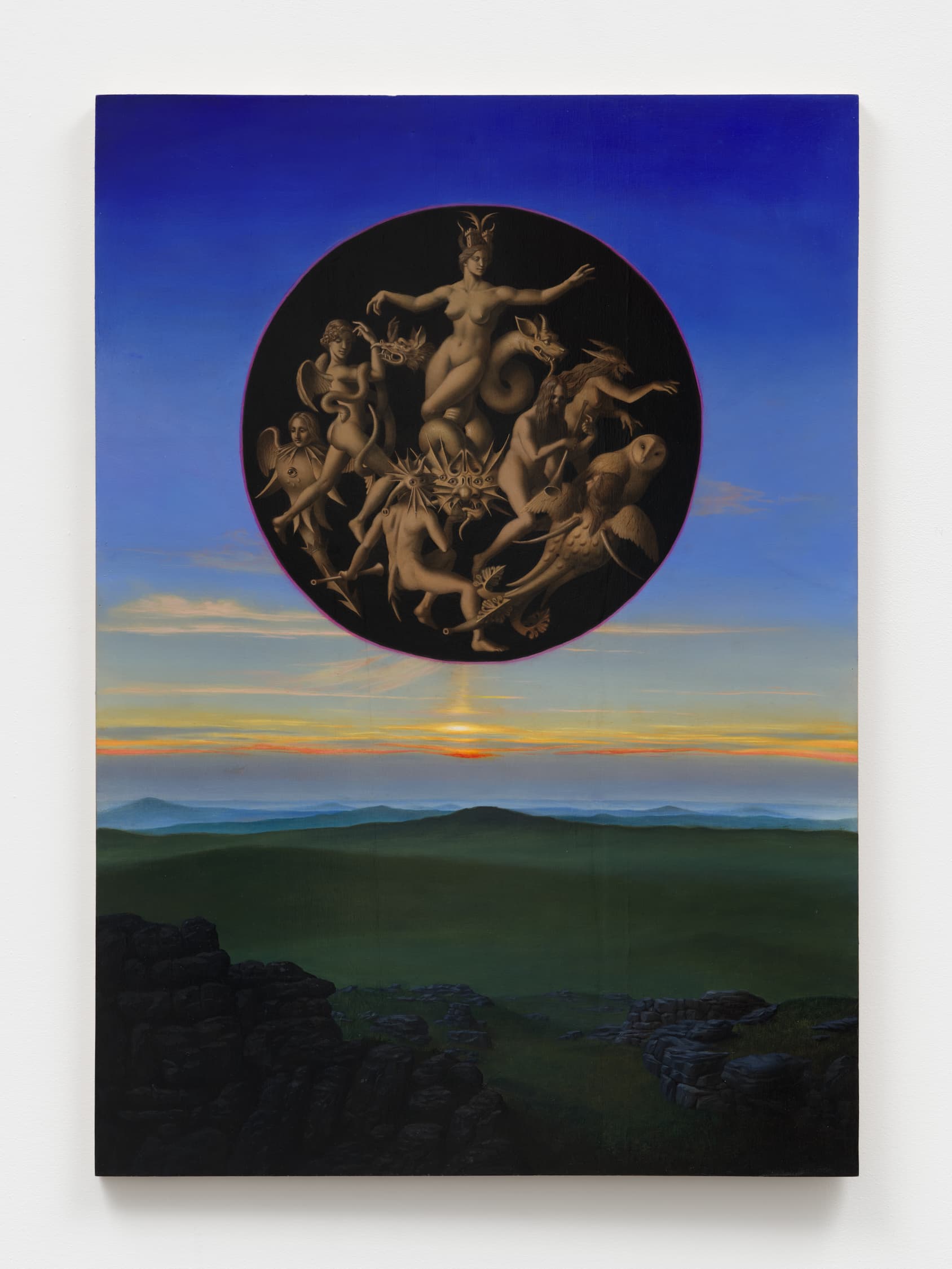
Ryan Driscoll, The Gate, 2026. Oil on wood, 33 ¹⁄₁₆ × 23 ⁵⁄₁₆. Courtesy the artist and Anat Ebgi, Los Angeles / New York. Photo: New Document.
Word count: 821
Paragraphs: 8
Anat Ebgi
May 2–June 13, 2026
New York
Hovering above the setting sun on the horizon with a darkening landscape below, a portal appears as an opening to another world of forms, of demons and nymphs in Ryan Driscoll’s painting The Gate (all works 2026). The aperture is also indicative of the entrance to a grotto, a cave sanctuary ubiquitous in the landscape of ancient Hellenistic Greek and Roman culture. The dark entities one encounters within conform to the original meaning of grotesque—of the grotto. “Grotto,” from Italian “grotta,” previously “cropta,” is a corruption of the Latin “crypta” from Greek “krypta” which means “hidden place” and is the root word of “crypt.” Tech Duinn, the title of Driscoll’s second solo exhibition at Anat Ebgi, likewise means “House of Donn” or “House of the Dark One” in reference to the dwelling place for the god of death in Irish mythology, and the otherworld of dead souls. In The Gate, a thematic representation of this doorway to the underworld materializes, as does an appropriate launch point for Driscoll’s distinct vision.

Ryan Driscoll, Untitled (Figure Concept of Felled Star), 2026. Watercolor and ink on paper, 11 × 7 ½ inches. Courtesy the artist and Anat Ebgi, Los Angeles / New York. Photo: New Document.
The distortion of bodies, with extra faces and limbs in strange places and insect-like, anomalous appendages was characteristic of depictions of demons and the devil in medieval and Renaissance art. Fantastic examples of this can be found in Michelangelo’s The Torment of Saint Anthony (1487) and Michael Pacher’s depiction of the devil with Saint Augustine in his Altarpiece of the Church Fathers (1471–75). This disorder was meant to signal an ontological state beneath nature, contrary to its inherent order, as punishment for the fallen angels. With the ascendance of the Catholic worldview that supplanted the pagan cosmology in Europe, the old demons of the grotto took on a distinctly moral-metaphysical dimension they previously lacked. By the fifteenth century, entrance to the otherworld, typified by Dante’s Inferno, became associated with a spiritual journey through the moral universe of damnation and retribution. Driscoll, in his deliberate pastiche of these modes of representation, returns the demon to its earlier pagan cosmology while maintaining the particular style of Renaissance artistry, which was itself a reappropriation of the ancient Roman pirating of Hellenistic mimetic realism. Folded into the matrix of Driscoll’s work is also a reference to the visionary tradition with Untitled (Figure Concept of Felled Star), a watercolor piece that startlingly resembles the work of William Blake. The other watercolor piece in the exhibition, Hound, similarly takes on a nineteenth-century symbolist vocabulary. And other works like Incorrupt and Nahemoth are reminiscent of Gustave Doré’s famous illustrations of Dante’s Divine Comedy as well. Driscoll’s faithful and masterful rendering of these mesmerizing images is a testament to a deep engagement with his subject matter.
To enter the grotto is to abandon the realm of the living, for a short time, in order to perceive the strange machinations of the netherworld. Art in this vein tarries with the “meanwhile” of duration described in the 1948 essay “Reality and its Shadow” by Emmanuel Levinas:
It is as though death were never dead enough, as though parallel with the duration of the living ran the eternal duration of the interval—the meanwhile. Art brings about just this duration in the interval, in that sphere which a being is able to traverse, but in which its shadow is immobilized. The eternal duration of the interval in which a statue is immobilized differs radically from the eternity of a concept; it is the meanwhile, never finished, still enduring—something inhuman and monstrous.

Installation view: Ryan Driscoll: Tech Duinn, Anat Ebgi, New York, 2026. Courtesy the artist and Anat Ebgi, Los Angeles / New York. Photo: New Document.
Central to Levinas’s mediation on art is the problem of iconoclasm and the tension between the monotheist moral universe and the pagan gods. This particular conflict, which backdrops Driscoll’s Tech Duinn, is also one between the undeath of images, frozen in time, and life as it is lived in the natural world where death marks the end of duration. The pagan underworld is a place composed of images, of dream visions and shadows, which stand outside of time in the “eternal duration of the interval,” the undead temporality proper to representation. Consider the sunsets in The Gate and Felled Star, the sea’s horizon in Nahemoth, the haze in Kelpie, the lone figure at the threshold in Lychgate, the dead bird and direct gaze in Hound: these are moments of eternal duration, suspended in the demonic promise of becoming without fulfilment.
In a contemporary image economy defined by surface, vibe, and style, where does this work fit? The more fundamental substance that would have grounded the symbolic logic of images in beliefs about the nature of life, of grief, and a connection to the seasonal rhythms of a world unsaturated by new media simulacra (yet a different kind of demonic grotto of images) seem not to apply. There is a temptation to draw from Driscoll’s pictures a nostalgia for another time, for an occult philosophy which must by its nature counter the present modernity.
Nicholas Heskes is an artist, writer, and translator.