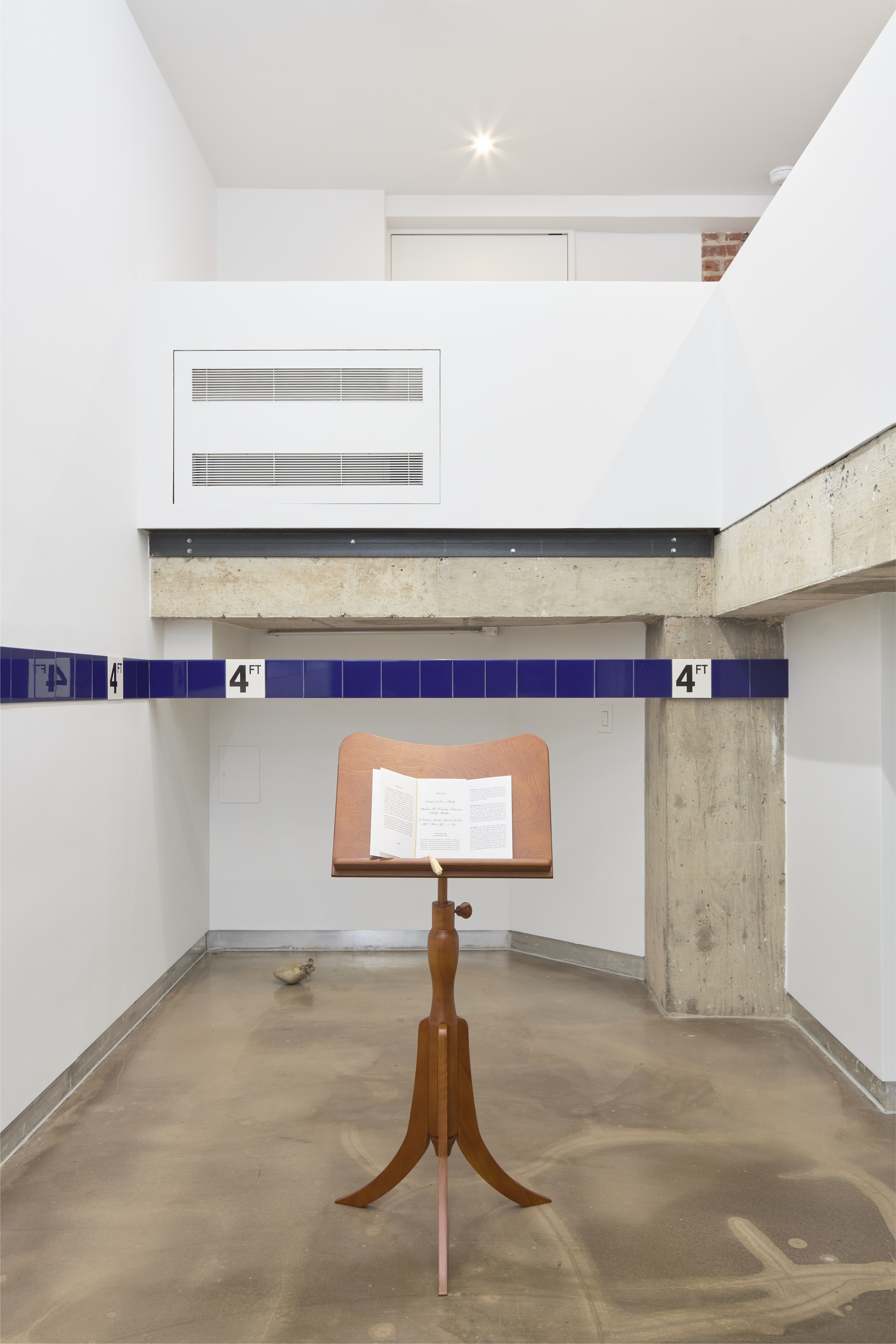
Installation view: Jill Magid: Pooler Room, Mister Fahrenheit, New York, 2026. Courtesy the artist; Mister Fahrenheit, New York; Olney Gleason, New York. Photo: Brad Farwell.
Word count: 949
Paragraphs: 11
Mister Fahrenheit
April 27–June 16, 2026
New York
Jill Magid’s Pooler Room, now on view at Mister Fahrenheit, unfolds in a sequence of interventions and acts of replication that simultaneously trace vectors of state power and clear space for contemplation and reverie. Passing through a quiet garden courtyard, visitors enter the exhibition from ground level, stepping down several steps to the first object (a carpet), and then down several steps more to enter the main space—a drained pool with rippling light cast through a glass brick ceiling. In a previous life, the room actually was a swimming pool, which explains its unusual length and depth. The space was created by Robert (“Bobby”) Muller to use for aquatic physical therapy, and this serves as the starting point for Magid’s thoughts.
On the upper level, Magid has installed a thick carpet replicating that on the dais of the White House Press Briefing Room. It runs down the gallery’s upper level, thick with wide-spaced stars on dark blue. The juxtaposition of pool and carpet leads to some White House lore: before it was the James S. Brady Press Briefing Room, the room had, in fact, held a pool. After President Franklin D. Roosevelt was diagnosed with polio, it was built for him—again for aquatic physical therapy.
The transformation from swimming to press pool took place during the President Richard M. Nixon administration, but most aspects of Magid’s semi-recreation come not from the Nixon or Roosevelt eras, but from the Kennedy administration. A typical day in the office for Kennedy included, reportedly, two dips. Drawing from that period, here Magid includes a fragment of the mural that then ran ceiling to floor (a ship on turquoise seas) and a row of cobalt blue tiles marking four-foot depth.

Installation view: Jill Magid: Pooler Room, Mister Fahrenheit, New York, 2026. Courtesy the artist; Mister Fahrenheit, New York; Olney Gleason, New York. Photo: Brad Farwell.
Magid’s project begins with a mirror-reference structure: Look at this thing and think about that similar thing. This is a therapy pool, so was that. This one is drained, so is that one. These stars are authentic Washington, DC carpet stars—if you want the source, watch the news. Extending this spooky-action logic, C-SPAN plays constantly at low volume in the gallery, and a wooden pedestal faces the wrong direction, holding an elegant program as if waiting for a ceremonial event. It’s uncanny how far these references carry a viewer toward feeling as if they are actually in the Press Briefing Room itself, waiting, inevitably, for some bad news.
But through details revealed in the exhibition press release and parts of her performance, Magid points out more specific vectors of power and harm. While serving in Vietnam, the former owner of the Mister Fahrenheit pool, Bobby Muller—who you will remember used it for physical therapy—sustained a spinal injury that left him paralyzed from the chest down (Muller later became a peace activist and campaigned for veterans’ rights). Kennedy and Nixon were both involved in the Vietnam War: first with increasing military presence, then a messy, dishonest withdrawal. And it's here a line is traced circuitously from presidential power to its inscription on our “already fragile” bodies, to paraphrase words from Magid’s Tender (2020).
Instead of an explicit discussion of disability, relative wealth, access—surely not all veterans who needed a pool had one—or, indeed, peace, Pooler Room takes a moodier, more poetic, and open-ended approach. It even feels a bit fatalistic. You won’t visit this show and think righteous thoughts, decry White House redecorating projects, or have a cathartic cry. Magid does nothing to create the illusion that visiting an independent gallery space in the West Village somehow constitutes an act of political resistance. But she does trace the shape and trajectory of power. Not by laying anything bare, exactly—it’s more like she injects an imaginary contrast agent, like iodine before a CT scan, into the metaphorical veins of subtle systems.

Installation view: Jill Magid: Pooler Room, Mister Fahrenheit, New York, 2026. Courtesy the artist; Mister Fahrenheit, New York; Olney Gleason, New York. Photo: Brad Farwell.
Magid has staged a series of performances to accompany Pooler Room, including a collaboration with experimental vocalist Charmaine Lee and bi-weekly performances by musician Stuart Bogie. Bogie’s solo clarinet left my pulse racing with the sense I had somehow fallen into a pool full of perfect nectarine juice. Gorgeous melodic phrases tumble through layers of drones—it was watery, verbal, tasty, sensual—one of the most synesthetic musical experiences I’ve had in a while.
Do whatever you can to go to the closing event with Lee and Magid on June 16. In mostly improvised performances, Lee uses amplification, loops, and feedback that extend the concept of vocal range far beyond pitch. That’s the grant description of the performance—and misses out by not mentioning how Lee is in her body. As erect as a flamenco singer, she sits wide-legged with boots on, the outward projection of her body contrasting with the comparative reserve of her eyes. Sitting under Magid’s four-foot water line, Lee leans over a table covered with audio gear to a microphone and, through water held unswallowed in her mouth, gurgles. That word is so wrong for what is produced—it is more a murmur, a purring, a pouring. Onto this Magid layers audio from an interview with Muller, adding and looping until the trickling becomes waves, a stormy sea, a tumult large enough to toss the painted ship on the wall into deep trouble.
The performance is powerful and atmospheric and at times very weird. When Magid reads a text she created by eroticizing the official directions for “poolers” (members of the White House Press Pool), I felt the true direction of the whole project crystalize. The performers filled the pool—but with what? The caught sensation of being a citizen, the urge to love despite certain loss, the softness of the body, comprehension and incomprehension of power.
Amelia Saul is an artist who lives in New York.