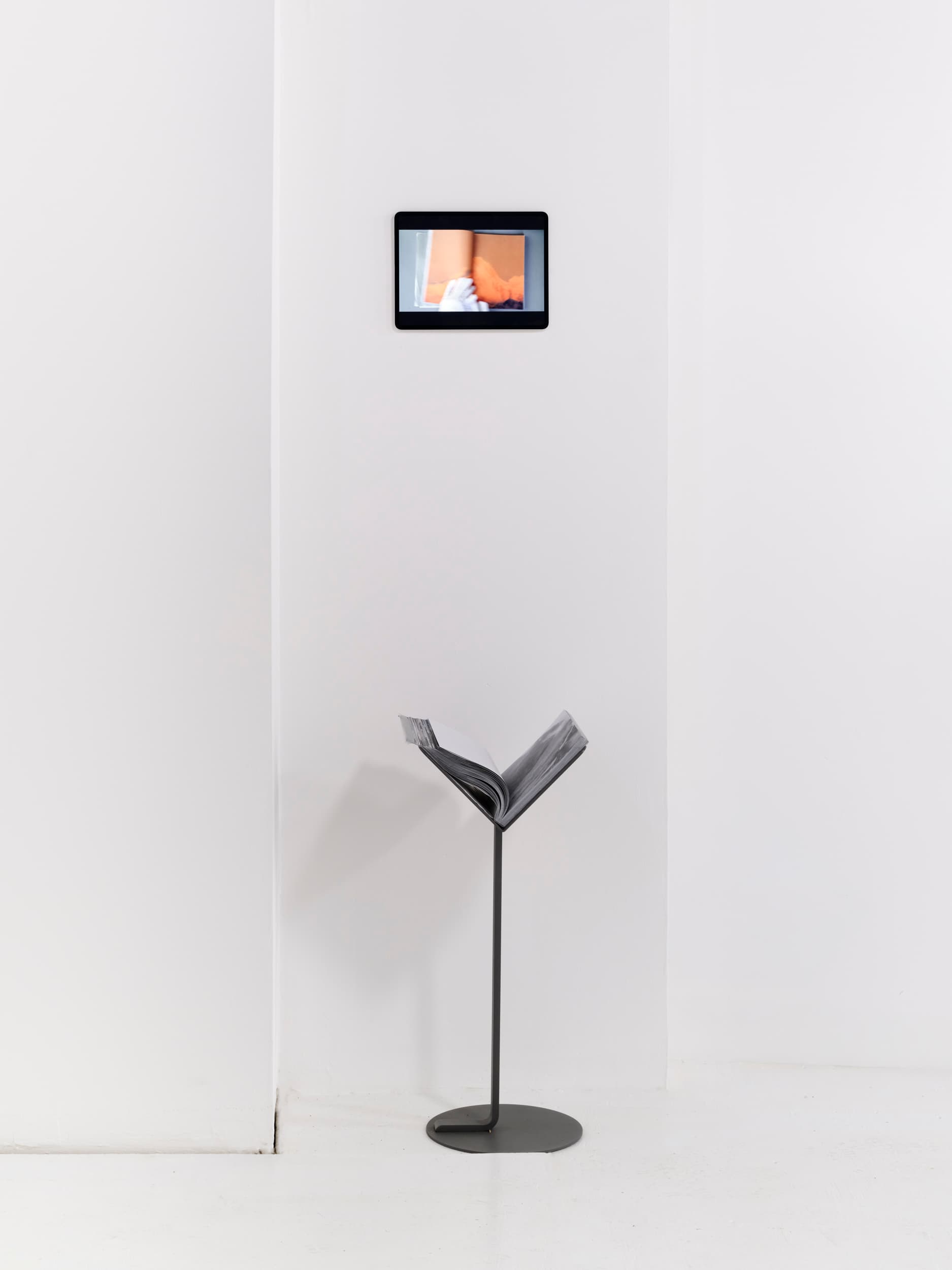
Installation view: Mad World 2026: A Bag to Breathe Into, SoMad, New York, 2026. Courtesy SoMad.
Word count: 924
Paragraphs: 6
SoMad
April 18–June 15, 2026
New York
A chain of international wire receipts wind through the SoMad gallery. It is the work of Abdel Karim Ougri, and its trail of collected material is the result of the artist sending money back to his family from Italy. The piece, Of Time and Tide (2024), guides us into the exhibition, but maybe it is more of a psychic tripwire that initiates us into the dense and interwoven relationships between labor, migration, surveillance, and ecological impact that the exhibition interprets through an effectively curated periphery. SoMad’s summer exhibition Mad World 2026: A Bag to Breathe Into comes at a time when opportunities for emerging artists are dwindling. It is an urgent call for relationality, to “anoint what cannot be fixed,” in the words of Hélène Cixous, as each of the artists touches the earth across borders and barricades to collectively form an embodied catena of experience. The divisions and displacements of our current world are not just depicted through the heartbreaks that it forms, but also through the new realities that these pressures generate.

Installation view: Mad World 2026: A Bag to Breathe Into, SoMad, New York, 2026. Courtesy SoMad.
The exhibition’s open call format produced a dynamic group of artists, some who are introduced here to New York for the first time. Many of the works in the exhibit function, on one hand, as reliquiae of accountability—as a monstrance that holds dear the injustices of their making. María-Elena Pombo, who is also included in MoMA PS1’s Greater New York, dredges Venezuelan petroleum to weave into fragile sculptures. Her piece Tejiendo el Petróleo (Weaving the Petroleum) (They Called it Mena') (2025) is an impressive and new form of sculpture that turns the oil into spindly scrolls and fibrilla. It is an impulse that is picked up by other artists in the exhibition to aestheticize or formalize these materials of oppression, and to translate their matter into form. This way of isolating the materials that confine and define us avoids positions that could otherwise fall into polemics and allows for the artists to “speak nearby,” a strategy of Trinh T. Minh-ha to engage with difficult subjects through adjacent proximity. It is this impressive formal fluency of the artists that evokes the deeper research based practices of the nineties and all of its associated rigor. Nadia Younes’s painting Second Lesson in Boundaries , (2024) turns an undisclosed barricade wall into sterile and repetitive slats. Younes’s investigation of the Gaza wall reveals the gruesome monotony of control and terror, but her handling of the material in oil paint renders it as a direct object. Its attentive form of painting, attributed to its large format that allows for the slats of the wall to be seen to scale, evokes both the work of the most dedicated observational painters, and the conceptual turn in painting. There is a connection to be made with Markus Lüpertz’s massive paintings of Germany’s western anti-tank barricades that were erected by Hitler. Similarly, Younes’s reduction of political connotation to pure form suggests that repetition is a poverty of imagination, and this idea of painting may be a way of dispossessing these forms of their power. But equally, this strategy could be thought of as meditations—durational performances that utilize painting to allow for the artist to sit with the static form of oppression long enough to understand it. Regan de Loggans’s installation across from it encourages visitors to the gallery to turn a sourced police barricade into a loom and weave together a new flag out of collected plastic bags that extends beyond nations and empires. All three reclaim oppressive materials to dispossess them of their original intent.

Installation view: Mad World 2026: A Bag to Breathe Into, SoMad, New York, 2026. Courtesy SoMad.
But the other impulse within the exhibit is toward the production and maintenance of new archives. Faith Brown’s Sweet Dreams (2024) is a cake of collected images. The artist has worked as a baker, and she has turned the cake into a new form of photographic archive that elicits a new synthesis with bell hooks’s production of images for Black life. The work comes with a book on sugar and research into food deserts, and the limitations and repressive impositions of access to healthy food within urban Black communities. The Insufferable Whiteness of Being (2018) by Liat Berdugo and Emily Martinez, who collaborate as “Anxious to Make,” is comedic at moments and discordant in tone. The work, consisting of critiques of the colonial introduction of Bitcoin into Puerto Rico, transposed over images of the island, are sourced from comment sections. It reveals that social media platforms desaturate the critique of these oppressive technologies and reduce reactions to cacophonous noise.
There is the old phrase, Ego te intus et in cute novi, which translates to, “I know you under the skin.” It is a deeper intimacy that is required to explore both the inter- and intra- subjective nature of violence and dispossession. We are each interpellated and hailed by it, described through our proximity to access and its lack. Mad World breathes on the glass to reveal these faultlines and to see what otherwise can’t be seen. It establishes a needed frequency of enharmonic scales, in hopes that we are able to find the fleeting moments within the stifling designs of authoritarianism. Somewhere there is a hole in the fence, a ruck in the fabric of borders and the forces that other us, and beyond it is a new landscape of asylum, an arcadia of new belonging that grows out of the real and lived realities of dispossession.
Andrew Paul Woolbright is an artist, gallerist, and Editor-at-Large at the Brooklyn Rail, living and working in Brooklyn, NY. Woolbright is an MFA graduate from the Rhode Island School of Design in painting and is the director of the Lower East Side gallery Below Grand. He currently teaches at Pratt and School of Visual Arts in New York.