Word count: 866
Paragraphs: 7
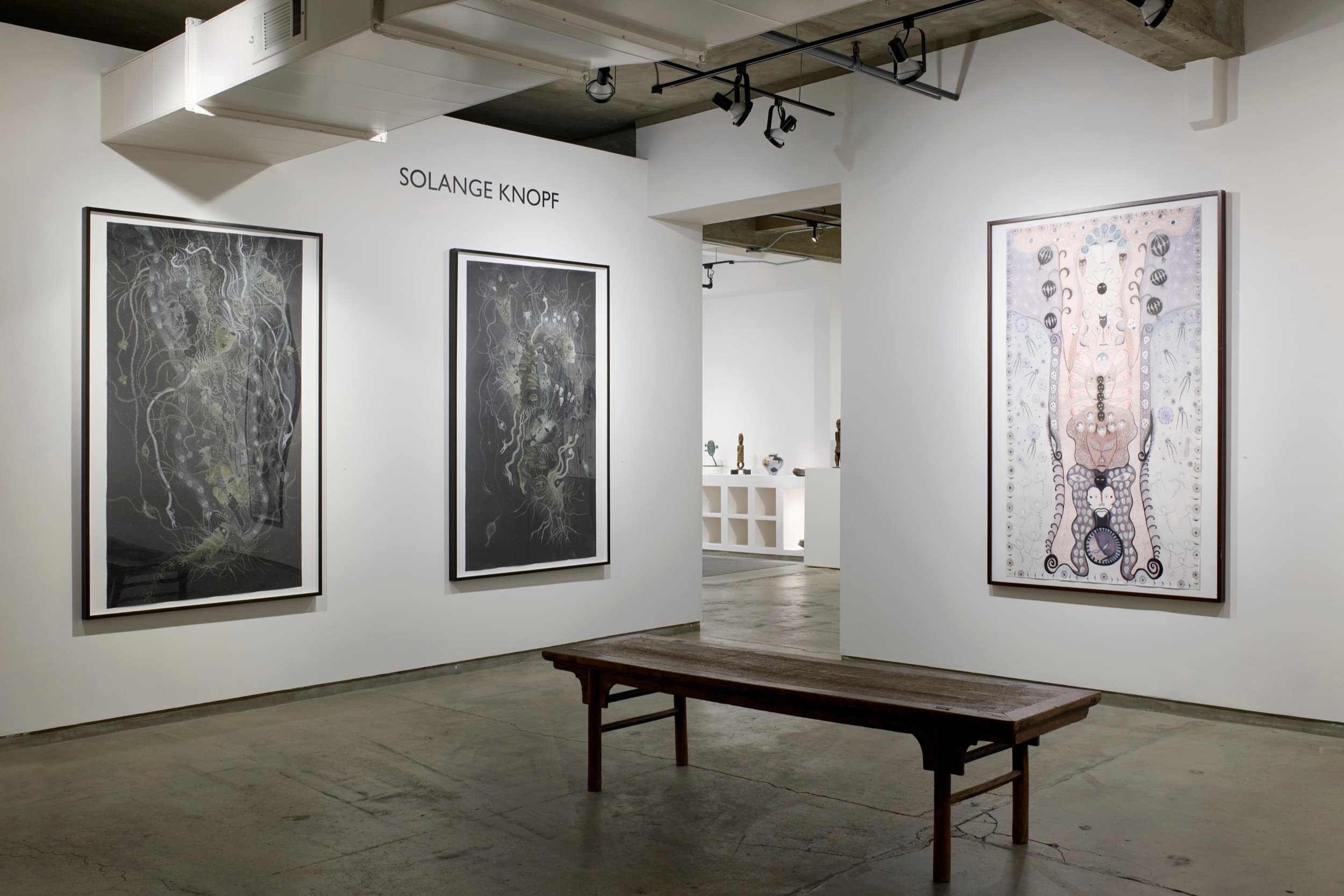
Installation view: Solange Knopf: Enlightened Darkness: New Drawings by Solange Knopf, Cavin-Morris Gallery, New York, 2026. Courtesy Cavin-Morris Gallery.
Cavin-Morris Gallery
May 21–July 3, 2026
New York
A famous artist, who was briefly married to a friend, also an artist, once labelled the kind of work her partner liked “kitchen art.” Nice to look at, maybe a little overelaborate but harmless, formally obvious, and conceptually undistracting. I’ve heard similar dismissals of so-called outsider art by insiders, usually a defensive response to hyped work that they somehow see as displacing their own. (Contrary to Phong Bui’s big tent theory, there are many who feel that art is a zero-sum game.) But to give them their due, what they seem to mean is that work not explicitly engaged with its historical moment—in dialogue with “issues” or with the status and evolution of whichever medium. In other words, work that is not an expression of artistic self-consciousness is not really art at all. What’s worse is if the artist actually believes in a pre-existent reality that sanctions, even commands, the work. A transcendental model, a vision, a subject. Such belief is the ultimate form of kitsch.
It has also motivated visual expression for thousands of years. It can involve everything from Christian religious conviction and cosmotheistic animism to extraterrestrial intelligences and revelations of inner psychic space—originating from without but arising from within. The symbols contrived by such art can be widely recognized or utterly obscure. A profound encounter with the reality of otherness motivates the paintings and drawings of the Belgian artist Solange Knopf (b. 1957). It’s scary and sometimes wearing to be around such work and the people who make it. Because they are communicating ultimate truth, they tend to lack a sense of irony, and because that truth is channeled through them, the hermeticism of their visual language is your problem, not theirs. Knopf offers renditions of her turbulent inner world, a world that doesn’t care about you or art history or the topics of the day but whose necessity for her is overwhelming. Knopf has said that she has to make these drawings; they are a form of psychic salvation and of universal import. I don’t know what the drawings mean or what the individual forms and figures in them represent. Knopf has said that she doesn’t know. Beyond the urgency and fecundity of her work (there are thirteen drawings in the show, all of recent vintage), we face the question: does it communicate?

Installation view: Solange Knopf: Enlightened Darkness: New Drawings by Solange Knopf, Cavin-Morris Gallery, New York, 2026. Courtesy Cavin-Morris Gallery.
Resoundingly, yes. Although I have been following Knopf’s work for years, this exhibition gave me an opportunity to think more carefully about how. The most obvious thing to notice is that Knopf works with two backgrounds: a dark sheet of paper and a white sheet. Most of the work at Cavin-Morris is dark, with colored pencil. The forms tend to be organic, almost cellular, often with masklike faces or skull visages. These weave in and out of undulating, tangled, almost vegetal structures. The overall effect is one not so much of menace or despair as fertility. She titles all the variants “The Inner Darkness.” We seem to find ourselves in a lightless place—the deep ocean floor?—where strange forms of life come into being, grow, and entwine with each other. The larger versions (No. 3 and 4, each made in 2025), 71 inches tall, are quite simply immersive. Viewing them is like being in a diving bell: like it or not, there is no easy way out.
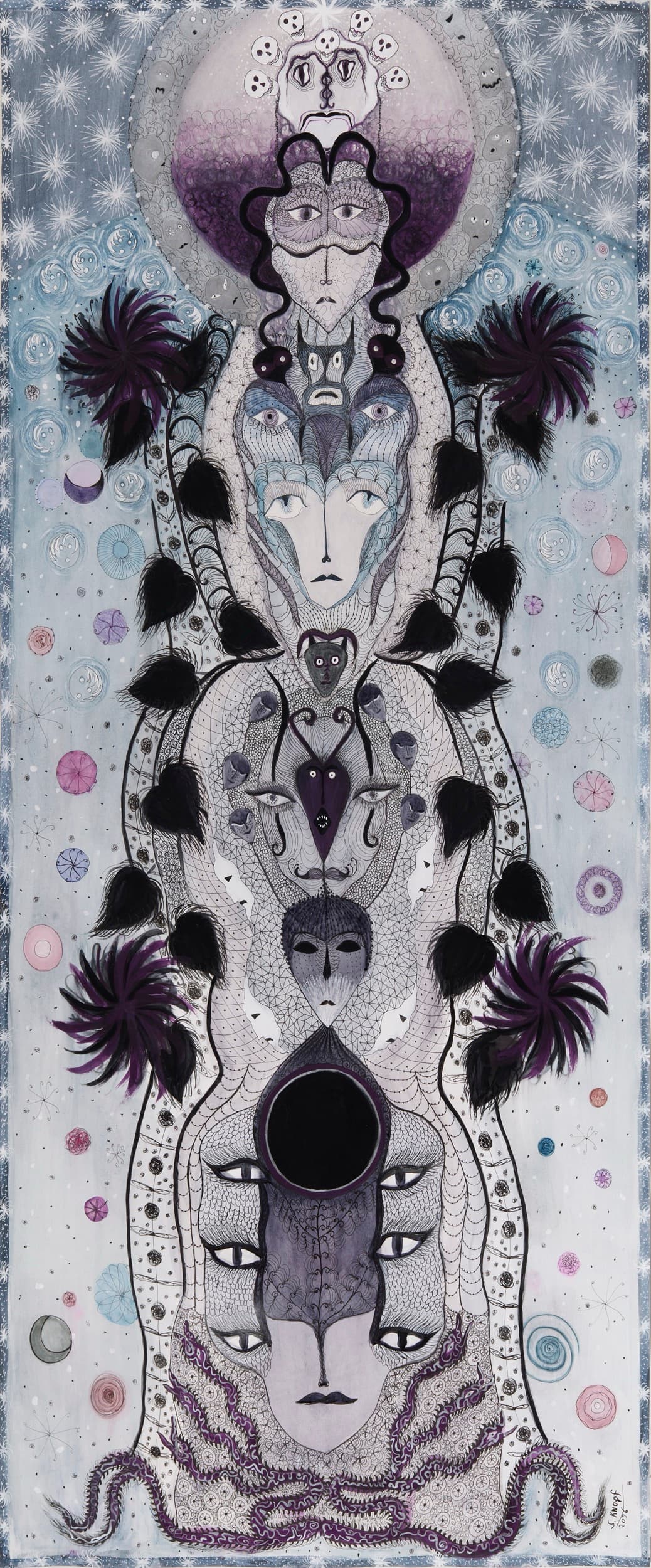
Solange Knopf, New Spirit Codex n⁰3, 2026. Watercolor, ink, gouache, pen on paper, 71 × 29 ½ inches. Courtesy the artist and Cavin-Morris Gallery.
The drawings on white paper, on the other hand, tend to be more formally regular, elaborating a bilateral symmetry. The hieratic presentation of the central figure in New Spirit Codex n⁰3(2026) resembles that of medieval icon painting or Afro-Caribbean renderings of orishas. The contrast is striking. Here, we are being presented images of order and regularity and invited to consider the relations of their elements. Titling the painting, a codex reinforces the injunction to read it. Knopf herself has offered the most revealing comment on the significance of the two approaches:
It's the same process for me: on white paper, the forms come from the void, like an apparition, a revelation, and on black paper, I draw from the darkness, which perhaps creates a more mysterious, more intimate atmosphere; the characters and symbols seem to emerge from a secret space. Depending on the medium, different images appear to me, but I think the universe is the same.
The images on dark paper, then, are very much about inner turmoil and the generation of form from emotion, from dread, and uncertainty but also a sense of energy and growth. The images on white paper, with their allusions to various spiritual traditions, offer revelation, a comprehensive, transcendental vision of balance embodied in a single figure. The bigger picture. Knopf might insist that this order actually exists in the universe, but it is the art that brings it into being, enacts it rather than simply represents it as an unchanging reality. That is why the process of art making could be deeply therapeutic, reaffirming balance and harmony. Therapeutic, too, the descent into the interior, where the risk is great, but without it, true harmony can never be glimpsed.
Lyle Rexer is the author of many books, including How to Look at Outsider Art (2005), The Edge of Vision: The Rise of Abstraction in Photography (2009) and The Critical Eye: 15 Pictures to Understand Photography (2019). The Book of Crow, his first work of fiction, parts of which first appeared in the Brooklyn Rail, has recently been published by Spuyten Duyvil Press.