Germaine Krull’s Chien Fou: Selected Writings
The photographer’s writing reveals she lived entirely in the immediate realm of action, not pausing until the very end.
Word count: 850
Paragraphs: 8
Germaine Krull
Edited by Kerstin Meincke and Petra Steinhardt
MACK, 2025
At times life proceeds in events, one verb after the other: short, choppy, and full of force, without the requisite time to breathe, so that, after several months of adrenaline, one is left dazed. From her writing, it appears photographer Germaine Krull (b. 1897; d. 1985) lived entirely in this realm of action, not pausing until the very end. But, a lifetime of journals can have that quality—a few sentences dashed off to later recollect key events. Krull’s writing is immediate. She does not process through her words; she records names and places in minutiae. She wears her nickname, le chien fou (translated from French as “the mad dog” and originally penned by a childhood friend for her unruly hair) with relish.
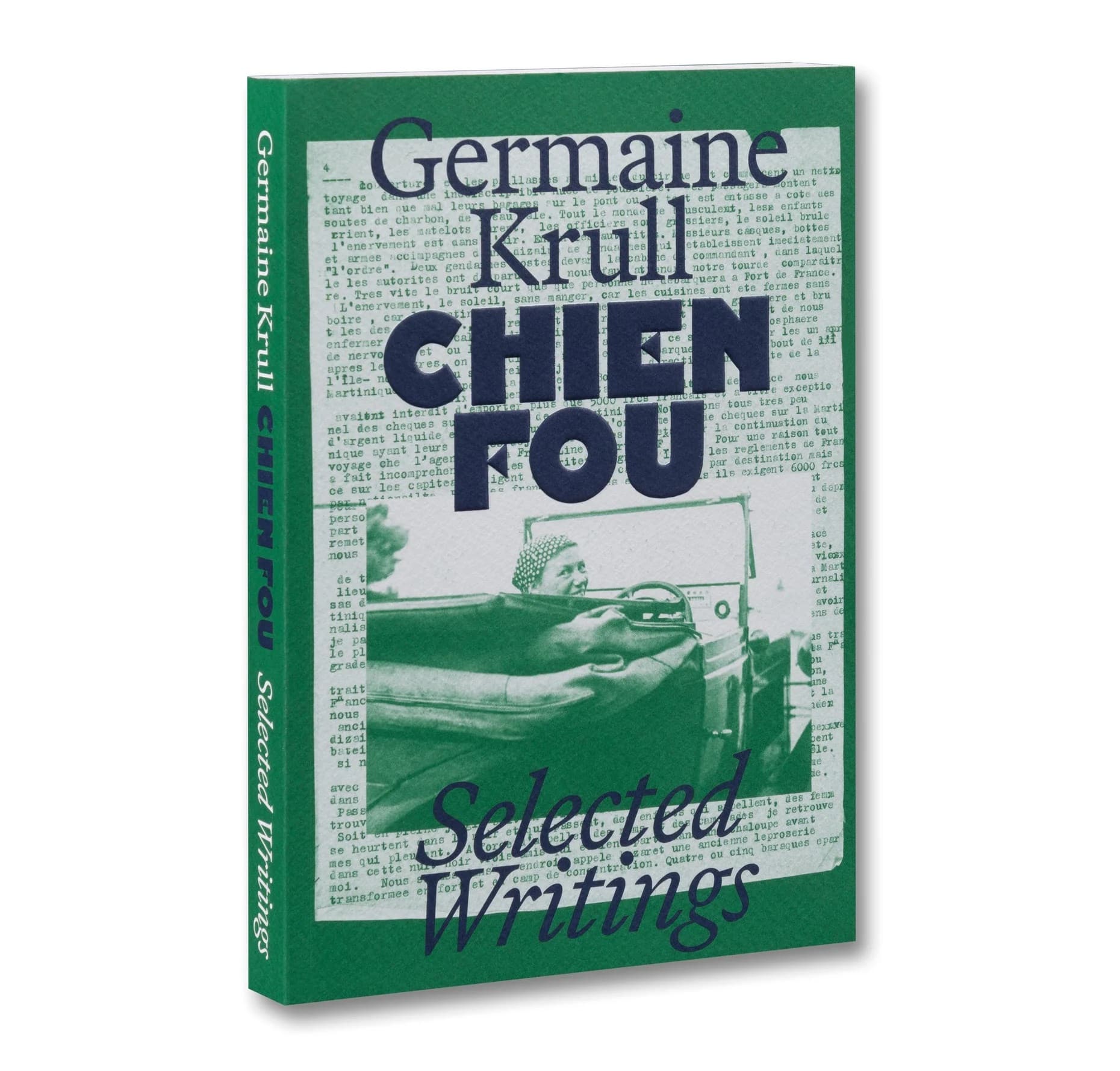
Chien Fou: Selected Writings consists entirely of Krull’s first-person accounts, biographical photographs from her archive at Folkwang Museum, her own documentary and artistic photographs, and a foreword and necessary explanatory note from the editors. Her words function as an alternative way of seeing, so the need for describing her photography process only comes when she’s tackling it head-first: finding a lab, finding subjects, pulling out a camera, getting some press. These are practical matters. During a brief period of living in Amsterdam, she becomes enamored with industrial structures at the port in Rotterdam. “Perhaps I’d been frightened by those metal giants, next to them, I felt very small, but an irresistible urge to get a fix on them—to get close to them and perhaps to make them more human—compelled me to photograph them.” These photographs eventually formed her photobook, Métal (1928), but not without encountering a great number of people who did not see these metal giants in the same light. Lucian Vogel, then art director of Vogue, however, did. Krull details the serendipity of finding him. “Everything was alive. Photography could not possibly remain static,” she wrote shortly after their meeting. From the moment Vogel met her, he fully embraced her vision.

The latter half of the book is devoted to Krull’s time as a war correspondent, hotel owner, and Buddhist. During this time, photography, though ever-present, is secondary. In the early 1940s the world was at war yet again. The Vichy government, sympathetic to fascism, sent her off, and thus began her journey to Brazzaville, then-capital of French Equatorial Africa and the center for Free France’s operations. Upon arrival, she is summoned to photograph for Radio Brazzeville’s propaganda materials. The subsequent pages follow her throughout Congo and Gabon; it is difficult to reconcile Krull’s then-liberal politics, a staunch supporter of Charles de Gaulle and definitively anti-fascist, and her views on the French colonization of African countries. At her disposal she has a number of assistants, all of them Black. She photographs the mines: she talks of the fear of being sent to the mines, and the forced nature of the work, yet never dwells on these inequalities. In Cape Town, she is pained by the blatant segregationist signs. But she writes, “I had to accept that people lived by different values.” Perhaps surprisingly, she adopts a compliant attitude.
It is only when she arrives in Asia that she rethinks colonialism. “In Africa, the problem hadn’t arisen for me. The black people I knew were fine. … Everything was really simple and independence was not an issue. It was different with the Annamese. They were a people with a history.” A reminder of the easy coexistence of white liberalism and racism. Krull’s unending love for France finally falters in Vietnam. She expresses surprise at the locals’ anger at the French and takes their side against the country she holds dear (but will never return to). She turns to Buddhism and eventually settles in India, cameras in tow.
This covers only a fraction of Krull’s writing, and even less of the woman herself. She wrote extensively over her lifetime. Editors Kerstin Meincke and Petra Steinhardt begin the book by explaining their method of curating, translating, and organizing the texts. The aforementioned spontaneity and choppy quality of Krull’s writing is acknowledged in the editors’ note and attributed to her lack of full fluency in French or the possibility of a typewriter without French characters. The book design directly addresses these challenges. The text intertwines writing from Krull’s archive to create a more chronological flow, utilizing a system of color-coded pages to indicate which source text is being referenced. The tinted colors also extend to the photographs drawn from her archives, which are tinted to indicate their source, while her own photographs remain in their original black and white. Omissions from the text are indicated by small marginal numbers that correspond to the missing pages of texts in her archive, which are fully accessible online.
The book concludes with a photograph of Krull seated at her typewriter in Dehradun in 1980. “I think it’s all over for me now,” she writes in her final lines. “I will dwell on the photo that has been my life for so long.”
Divya Mehra works with text, image, and code. She teaches at NYU and the Parsons School of Design.