The Art World’s Managed Fantasies: A Response to Josh Kline
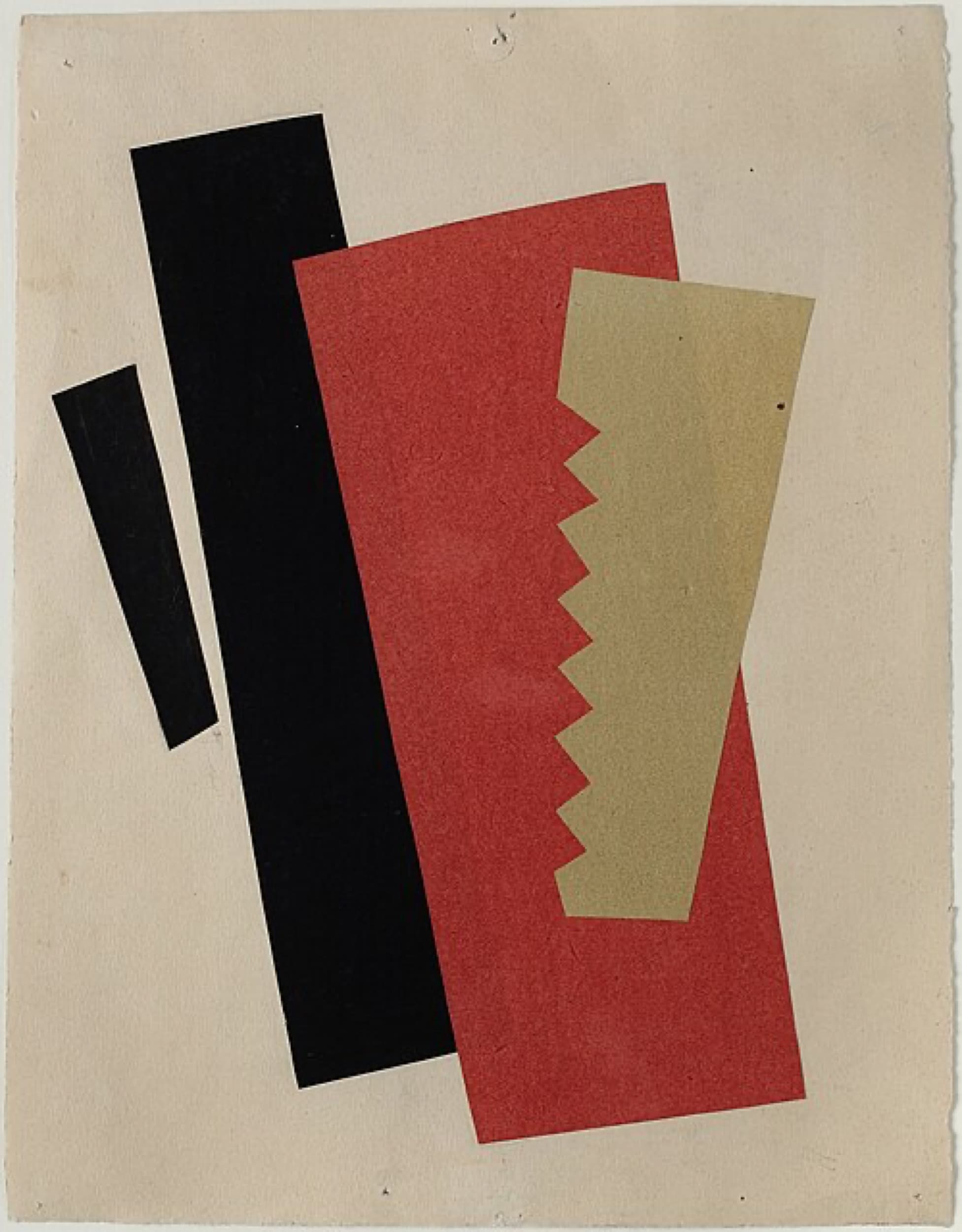
Liubov Popova, Composition (Red-Black-Gold), 1920. Collage, 11 ⅖ × 9 inches.
Word count: 1897
Paragraphs: 19
Josh Kline’s recent essay in October, “New York Real Estate and the Ruin of American Art,” is a solution in search of a problem, perfectly attuned to our presentist zeitgeist. One reads it with a sense of déjà vu—not least because of how closely it resembles the writings of Soviet Constructivists. Separated by a century and an ocean, both treat art as “political speech.” Constructivists, publishing in journals like LEF in the 1920s, took the symbiosis of art and politics for granted and bristled at the individualism of celebrated artistes and their finicky bourgeois patrons. Their aim was to purge any remnants of “socially useless” art and to become producers of socially useful art for the nascent Soviet state.
A century on, a mid-career New York-based artist is equally hostile to the art he dismisses as “speculative financial décor,” fit for “the palaces of the rich.” In a similar condemnatory tone, Kline speaks on behalf of those who are ready to wage “a larger battle to redistribute the political agency to the majority of the population and restore a democratic society.” The culprit, as before, is the capitalist order.
Kline’s argument is, at first glance, straightforward. Contemporary American art, he contends, is “sick with problems,” its capacity for “meaningful art” production undermined by the prohibitive cost of New York real estate, the burden of student debt, and the distortions of the market. The result is an art world in which artists lack the time, space, and institutional support necessary to experiment—or even survive. Under such conditions, meaningful art may no longer be sustainable.
To provide a theoretical framework, fitting for a journal of record, Kline reaches into the natural sciences, describing the present state of American art as a “dysbiosis”—a biological metaphor suggesting imbalance within a once-functioning system. The term implies that there exists, or once existed, a healthy equilibrium between artists, institutions, and the broader economy, and that this equilibrium has been disrupted. But like the underlying assumption that contemporary art ought to be sustained, this too is wishful thinking.
With the notable exception of the Federal Art Project (FAP), created in 1935 as part of the Works Progress Administration, the American art world has never resembled a stable organism. It has always depended on external systems—patronage, markets, institutions—each imposing its own priorities and pressures. But even the FAP is hardly an example of balance, for it was temporary and contingent, entirely the product of forces that had little to do with art itself. While it is often misremembered as a golden age of state support for artists, in reality, it was something more complicated. Artists on the federal payroll were working within the confines of thematic, stylistic, and physical specifications as rigid as early modern guild members on a church commission. Everything—from subject and dimensions to materials—was specified by the commissioning body.
Likewise, the postwar American art ecosystem, often invoked as a period of relative openness, was not just the product of cheap rents or a more forgiving economy. It was also the result of deliberate cultivation, and it came with a cost. As Serge Guilbaut showed in How New York Stole the Idea of Modern Art, the rise of Abstract Expressionism and its popularization across the globe was inseparable from the cultural politics of the Cold War. American painting—large, abstract, ostensibly apolitical—served as a representation of individual agency, a visual manifestation of the liberalism the United States sought to project abroad. It was meant to stand in contrast to the crude propaganda associated with its Soviet adversaries. Paradoxically, while Abstract Expressionism’s effectiveness depended on appearing untethered to politics, its autonomy was essential to its usefulness.
By the 1960s and 1970s, the alignment of political agenda and art production took on a more formal shape. The creation of the National Endowment for the Arts, alongside the growth of museum and foundation funding, marked a new phase in the institutionalization of artistic life. Kline’s mention of the pre-1990 NEA suggests a triumph of public support for culture, but like the FAP grants, it was also a mechanism for managing artistic output. The point is not that artists become instruments of the state or recipients of philanthropy in any simple sense. The mechanisms of influence are subtler: support operates through the stealth establishment of priorities and the discrete hedging of expectations. Certain kinds of artwork are rewarded—exhibited, written about, acquired—while others are left to wither on the vine. Over time, this produces a form of cultural selection driven as much by anticipation as by enforcement of unspoken rules.
Kline is not unaware of this dynamic. He admits that institutional funding comes “with strings attached,” requiring curators to “please, appease, and avoid offending” their sources of income. But he treats this as a recent distortion, exacerbated by contemporary politics—even the policies of the current White House administration—rather than as a structural feature of any system in which art depends on external financial or institutional support. The implication of Kline’s argument is that, under more favorable conditions, the tension might disappear. It will not. Whatever the mantra of romanticized artistic autonomy, in the twentieth century, the American art world has functioned as a managed ecosystem.
Tom Wolfe grasped this—and ridiculed it—in The Painted Word. In his account of a postwar art world governed by critics, curators, and theory, Wolfe argued that by the 1970s, works of art themselves had become secondary to the ideas that justified their creation. Painting functioned as an entry point into an interpretive apparatus that determined its meaning in advance. Art discourse became more thoroughly embedded in institutions, and art also became more dependent on the texts those institutions produced. So instead of liberation from the constraints of patronage, art became accountable to an intellectual oligarchy.
More recently, the intellectual and financial oligarchies have fallen out of their harmonious alignment, with predictable consequences for rank-and-file artists. For the past decade, American museums have increasingly organized their programming around political and social concerns, elevating identity and ideology as central criteria for determining value. And, as collectors have “abandoned the politically charged art about identity recently championed by institutional curators,” the museum coefficient no longer translates into sales. But again, instead of recognizing that this bifurcation would disrupt the traditional museum-to-collection pipeline, Kline treats it as further evidence of systemic breakdown.
One suspects that Kline’s diagnosis owes as much to personal experience as to the historical references scattered throughout his essay. In a recent interview, he describes the early months of the pandemic as a kind of reprieve: artists working (but not too hard), spending long stretches of time with friends, much of it outdoors, much of it without spending money. Then they return to what he calls “the grid,” as the city reopened and its reasserted, inflated costs came as a financially painful shock.
What Kline describes, without quite naming it, is a temporary escape from the modern economic tempo. Historically, such moments have produced what later generations recognize as bohemia. The Paris of Montmartre and Montparnasse, so often mythologized as sites of artistic freedom, were not, in fact, the product of stable support structures. Artistic freedom could thrive in the absence of such control, in the cheap rents, irregular work, and uneven rhythms of urban life. Artists with limited means found themselves, for a time, in conditions that allowed for both sustained work and sustained sociability. This was, of course, before the era of mid-career retrospectives in major museums, an era when living artists were not shown in museums at all.
The pandemic briefly recreated something similar: economic activity ground nearly to a halt, expectations loosened, and time—normally the scarcest resource—became available in unfamiliar quantities. That this moment should appear, in retrospect, as a lost equilibrium is understandable. But the assumption that it represents a condition that can be stabilized, much less engineered, is not. Kline treats its loss as evidence of systemic failure and seeks its restoration through greater support and structural reform. Alas, the history he invokes points elsewhere: such conditions arise not from managed systems, but from their absence.
When the Soviet state no longer needed Constructivists, whose work grew out of geometric abstraction, they were discarded in favor of realist painters and sculptors who could deliver more legible propaganda. Art is constantly negotiated within systems that never guarantee art beyond their usefulness. The Soviet experiment itself demonstrates that managed utopias have predictable endpoints.
For most of Kline’s essay, New York appears as an unavoidable gravitational force, a system that artists are “forced” to inhabit if they are to have a career. Yet his conclusion is that they are now priced out of New York and must relocate to more affordable cities and form new communities there. The suggestion is as sensible as it is unremarkable. Kline himself offers examples in support of this thesis. Artists have often gone where they can afford to live and work. The history of modern art is, in no small measure, a history of such migrations—of movements formed in marginal spaces that later, sometimes to the detriment of those artistic communities, become centers.
What emerges is dissatisfaction with the working conditions at the center rather than a structural diagnosis of the system itself. Here, Kline might have referenced the work of Dave Hickey, who observed the art world from within at every level: from commercial to institutional and bureaucratic. Having come to New York from Texas in the early 1970s—after running his own gallery in Austin and later managing the Reese Palley Gallery in New York’s Soho—he went on to edit Art in America and serve on panels for the National Endowment for the Arts. From this vantage point, Hickey echoed Michel Foucault, warning that support is never neutral: “care is control.” Writing about the art scenes of the 1960s and 1970s, Hickey noted that artists did not wait for access to the center, nor did they demand that it accommodate them. They worked from the margins they occupied—cheap studios and improvised spaces—and, in doing so, shifted the center of gravity itself. The point was not to gain entry into an existing system, but to relocate the center to their native margins.
Seen in this light, Kline’s complaint reads less as a critique of capitalism than as a complaint about access to a particular apex within it. New York is expensive because it concentrates capital and attention. While it may generate opportunity, it also breeds competition and exclusion. To insist on remaining within it, on more favorable terms, is to accept its centrality while objecting to its consequences.
Kline’s essay is most compelling when it describes the pressures of a particular place at a particular moment. It is least persuasive when it elevates those pressures into a general theory of art under capitalism or treats the alleviation of artists’ economic struggles as both necessary and possible. The difficulty of making art in New York is real, but it is not a crisis nor a dysbiosis. What Kline does not mention is the looming role of AI, which may reshape the art world more radically than real estate ever could. If AI leads to universal basic income, as has been predicted, it may at last resolve the question of how to support artists. In that scenario, Kline’s concerns about the New York art ecosystem may prove to be a problem already on its way to obsolescence.
Julia Friedman is a Russian-born art historian and critic living in California. Her writing can be found at www.juliafriedman.org