Word count: 2648
Paragraphs: 19
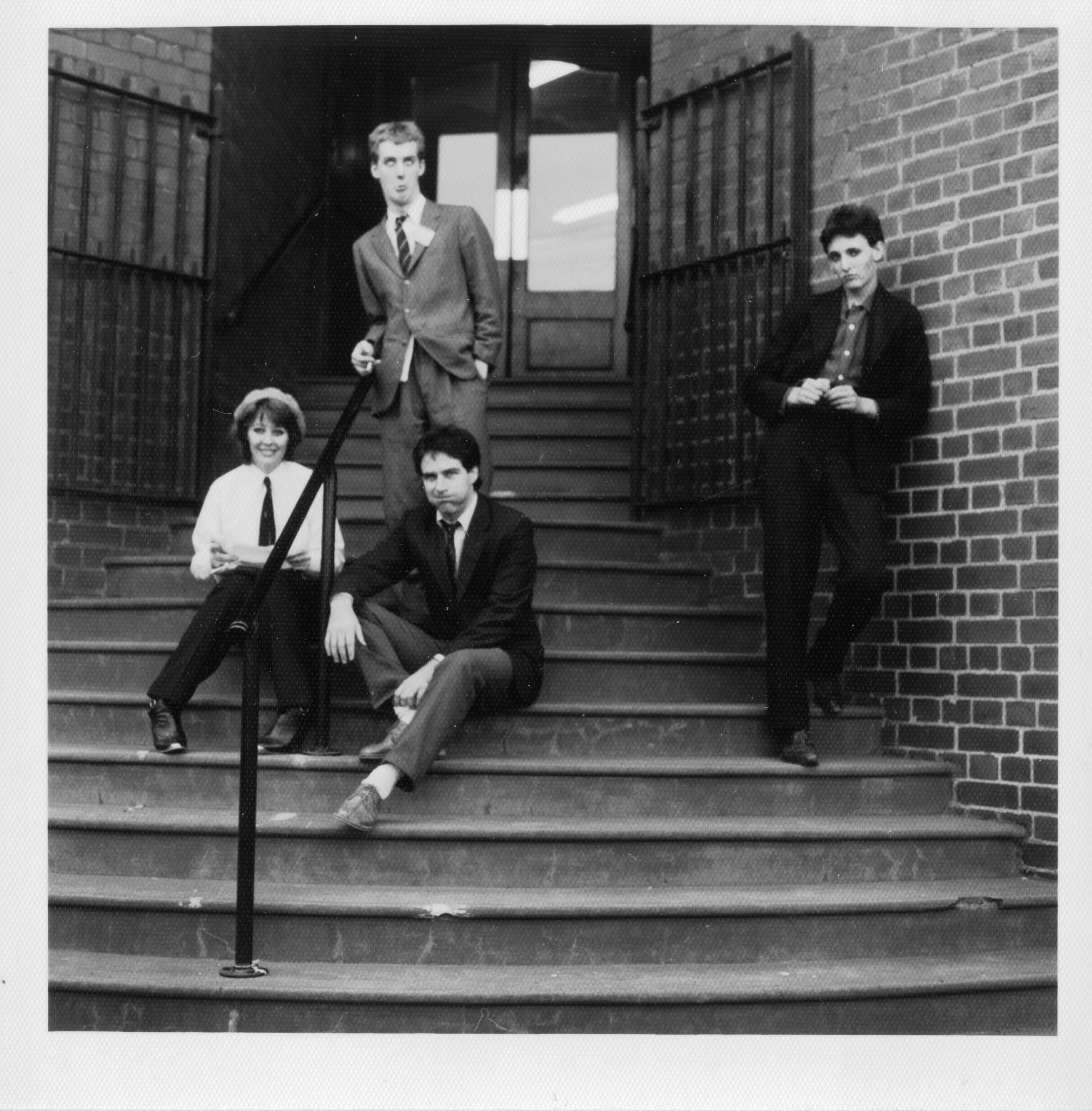
Young Charlatans. Courtesy David Lang. Photo: Philip Morland.
When I enter Vicious Sloth Collectibles in Melbourne, Australia, I tell Glenn Terry, who’s sorting through a box of records near the counter, “I am here for the Boys Next Door and the Birthday Party,” and I ask, “how do I find the recordings of the Young Charlatans?” I tell him I’m here to unearth the rare, precious artifacts of a bygone era, composed of niche musical marginalia unique to the St. Kilda neighborhood of Melbourne. I tell him I’ve waited twenty-one years to wander the same streets and visit the old haunts of Rowland S. Howard. I also tell him that I am here on my honeymoon. This journey began when I was fifteen.
At fifteen I make friends with Jake on a website called “PunkConnect.” Jake’s nineteen years old, with a tumbleweed of box-dyed black hair. He wears a too-small black tuxedo jacket, wrist bones poking out from cuffs, broken branches for arms. We email back and forth about music. I’m his little sister’s age, and it turns out I’ve met her—another delinquent punk from my suburb who hangs out at the same train station my friends and I do. I go to Jake’s house for the first time soon after. He selects a record from his vinyl collection, and when the needle drops my world turns upside down.
The record is by the Birthday Party, the album is Prayers on Fire, and the song is “Zoo Music Girl.” I’ve never heard anything more belligerent, cruel, and erotic. Nick Cave’s yowls perforate the living room where Jake, his sister, and I sit. I’m silent for the entire record, taken in by the carnival of nightmare. I feel changed. I ask Jake everything he knows, every record he has, every song. He shows me a shitty fan page with photos of the band, explains who Cave, Mick Harvey, Tracy Pew, Phill Calvert are, and then I point to a photograph of a moon-eyed boy with a faraway look. Jake says: “that’s Rowland S. Howard.”
My mom drives me back over to Jake’s house. He’s obsessed with Nick Cave, tries to dress like him. I tell him that I found the early Bad Seeds records on LimeWire and he replies, “Blixa’s great, but no Rowland.” He says there’s a band that Rowland was in before the Boys Next Door, but you can’t find hardcopy recordings. I asked him to show me more of Rowland, so he plays Teenage Snuff Film. The minute “Dead Radio” kicks up I’m a goner, sucked up in the unctuous smoke of Rowland’s voice and his keening guitar.
Like many young suburban punks with refined taste and cultural ennui, Jake discovers his mother’s pill cabinet and fades to black by the time he’s twenty-eight. I learn of his death via Facebook. Private funeral, family only. It reignites my obsession with the Birthday Party, with Rowland. I start doing more digging, trying to find the tracks from Rowland’s band before the Boys Next Door: the Young Charlatans. I’m convinced that if I can hear these songs it will bring Jake back to life. It’s more than that, of course. In my mid-twenties, I’ve watched one after another of the brightest, most talented subcultural creators in my friend group go the way of Jake. I begin to believe these missing tracks will somehow bring the voices of the dead back to life.
Researching the Young Charlatans, I listen in earnest to Ollie Olsen. Jake had burned me a copy of Whirlywirld’s Complete Studio Works after a conversation about Rowland’s guitar; the way it banshee’d horizontal to reality and wept starlight from its strings. Jake said Ollie was that same kind of visionary, otherworldly genius. I had stowed the burned CD and forgot about it and only dug it out after Jake’s death. I was spellbound by “Window to the World,” flung out into some chasm of arpeggiated synth and cyclonic drumbeats, a little starship set adrift among endless, churning sky. There was a cosmic, almost science-fiction-like scope to the careening sound and lyrics. It made sense to me that Ollie and Rowland would, like dueling suns in a binary star system, ignite each other early in life, only to be flung to strange, far corners—Rowland with the hypnotic and incantatory bloodied spool of post- and art rock, and Ollie embracing the near future mechanical strangeness of synthesizers and metallic snaring. The legendary Bruce Milne of Missing Link and Au Go Go Records, manager of the Young Charlatans, told me with a smile that Ollie, “always had ideas, was always moving forward musically, often in directions I had no interest in.”
The Young Charlatans’s bassist Janine Hall would later go on to join punk icons the Saints. Drummer Jeffrey Wegener would join the Laughing Clowns. I’m humbled by the outsized impact of four people in a band who played a baker’s dozen of live shows, and recorded barely enough songs for an EP. The Young Charlatans became an incubator of creative genius, of rhythm, of innovation of sound. I think of Jake, and all the Jakes, and begin considering legacy as something very separate from fame and fortune. Legacy as the second lives of the dead and remembering as an act of love.
The last time I see Jake is sometime in January of 2010. He texts me “Rowland’s dead,” and we meet up at a bar. He wants to play Rowland’s music on the digital jukebox but they have none. Jake’s wearing a home-made cut up black t-shirt with “MODEL OF YOUTH” block printed on the front of it. He’s nodding off across from me at our table in the back of the bar, hair grown out to its natural blonde, but still wild and styled. I tell him “you’re not so young anymore,” and he laughs. We talk about how things would have been different if Rowland had been allowed to sing “Shivers” instead of Nick for the music video. We talk about how we’re going to comb Discogs until someday the Young Charlatans’s elusive recordings show up.
A decade passes after Jake’s death and I watch my artist friends peel themselves back into oblivion with drugs and suicide and the other side effects of rock-and-roll. My obsession with the various genealogical threads of the Birthday Party increases. I listen to Teenage Snuff Film and Pop Crimes so often that when the world around me falls too quiet my head is full of the nasal drone of Rowland’s solipsisms, the ricocheting reach of his white Fender Jaguar, always one song or another stuck in my head. The older you get the more haunted you get, and the more your ghosts start to wear the faces of others. Unlike the majority of my life’s obsessions, my fixation with the artists who arose from St. Kilda intensifies, and I begin writing essays, papers, presenting at conferences, teaching classes. I want everyone to know about these bands, these artists. I want everyone to know about Rowland S. Howard.
My husband and I choose Melbourne for our honeymoon. He accompanies me on my self-composed walking tours, pilgrimages to gravesites to leave flowers, whiskey, notes of appreciation. He’s patient with me as I prep questions to interview Mick Harvey. He takes endless photos of me in front of the George Hotel, Colin Sheppard’s Birthday Party mural, the Espy, Prince of Wales, and so on. Serendipity rises to meet us. I’m bowled over by the generosity of the St. Kilda punk scene's surviving members. I encounter genuine community, people coming together with love, affection, and celebration of each other. Folks sharing the knowledge that they’ve been a part of something profoundly special: one of the most self-fecundating and relentlessly sustaining music scenes of the last century.
I meet many friends of Rowland’s, of Ollie’s. On the backend of the trip, I meet even more. People whose names are iconic to me, people whose art changed the trajectory of my life, people who were and are a part of something so singularly precious. Each is generous with their time and memories. Rob Wellington, a prolific musician, director, and archivist of the St. Kilda punk scene blows open my already expansive appreciation for the world. Outside of his remarkable charisma and curiosity, Rob’s love and preservation for St. Kilda’s culture is breathtaking and devout. Later emailing with Rob about Rowland and Ollie, he shares direct quotes from his personal documentarian footage about the origins of the Young Charlatans, including Rowland on Ollie:
Ollie was the first person (I met) who took it all seriously and could walk the walk. It was obvious that he was very smart and talented.
Punk rock had come along but it was obvious there was going to be more. The whole point of punk rock was that it gave you unfettered freedom to do anything.
Ollie was really interested in groups like Can, people like Eno. We wanted to harness the energy of punk but make it something greater than that and just as surprising.
Anyway we made this decision at the Swinburne gig that we were going to form this band together.
We went to Sydney and found Janine Hall who couldn’t play the bass terribly well but it was easier to find someone we liked and teach them than audition hundreds of horrible musos…
And Ollie talking about how his deafness in one ear led to his relationship to sound:
I'm completely deaf in one ear. I was sick when I was a baby, it wasn’t punk rock that did it.
So I think that because I’m a mono person I’m more aware of sounds. It’s a big issue. Most people think nothing of having two ears and I have no idea what it’s like. So I think that’s one of the main reasons I got attracted to sound. It has a big influence on the kind of sounds I made.
I was naturally attracted to the frequencies involved in electronic music because of the fact of not having two ears. It had an impact on how I perceive sound. To me they sounded like they were moving in the space in my head but when I listened to rock it didn’t have that effect on me. I could see where the synthesizer was in space.
Rob’s married to Angela Howard, Rowland’s sister, full of poise and a profoundly sophisticated and unique musician herself. I am struck by the embarrassment of riches this small fingerprint of space and time has, and by the intimacy of creatives who have the privilege of growing and creating together over half a century. I repeat to everyone I talk to, “You know it’s not like this in other places. It’s not like this.” What they have is special. Who they are is special. Later I will bring this up to Bruce, and he’ll share:
You mentioned that you don’t see this in a lot of other cities. One of the lucky things, in some ways, about Melbourne and its music scene is that we’re at the end of the world. You’re never gonna make a lot of money making non-mainstream music … so you’re making music for the right reasons, for your art.
At Vicious Sloth Collectibles my husband and I spend three hours chatting with Glenn and Peter. I listen, starstruck, as Glenn shares stories from the Crystal Ballroom days, of seeing the Boys Next Door play their early shows before they’d jet to London and arrive transfigured as the Birthday Party. Peter brings out a copy of the coveted Missing Link rare, live Birthday Party record It’s Still Living on vinyl, autographed by Rowland. I know I’m going home with it. I ask Glenn, “How do I get ahold of the rumored Young Charlatans tracks? I’ve been searching for twenty years and can’t find anything aside from ‘Shivers’ in hard copy.” Glenn says, “You’ll be able to hear them soon.” When I ask him if he’d seen them live, he tells me he hadn’t, but he did, “see both Boys Next Door with and without Rowland in the line-up,” and that he could “attest to the fact that their sound gained an extra dimension.” He continued by sharing that, “the strange part is the Young Charlatans provided members for several famous bands and projects,” the impact and legacy of all four musicians sending shockwaves throughout various punk, post-punk, and other projects.
We leave Vicious Sloth and head to the bowlo for the Peptides’s show, featuring the walking-St. Kilda-art-installation Fred Negro (arch prince of the art punks), Rob Wellington, occasionally Angela, and a host of other abominably talented folks from legendary St. Kilda punk bands like the Ears. I meet so many wonderful, smiling people that night: Deborah and Richard, Rusty, and Colin. Colin, who painted the Birthday Party mural on Little Grey Street, wears a shirt he painted himself featuring in block print “ROWLAND S HOWARD.” I smile and I remember Jake’s shirt. When it’s time to leave I cry. My husband and I take the long way back to where we’re staying, turning up Rowland S. Howard Lane where I leave a dozen red roses and a lit cigarette.
About a month later, Australian label Eminent Vinyl releases 1978, live and studio recordings from the Young Charlatans. Of the members of the band, only Jeffrey lives, but in these recordings, all you can hear is life. Rowland, Ollie, Janine, and Jeffrey rise off the record, only just burgeoning but nevertheless foreshadowing their subsequent full bloom over the decades which follow. Some songs (“Broken Hands,” “Beginning of a Real War”) exhibit the influence of Roxy Music or New York Dolls, some go full Stooges (“Accident”), and some speak to the roaming and caterwauling influence of Pere Ubu (“Drowned,” “Win/Lose”). Rowland’s voice thrums and woos—a fragile toy piano version of what would become his deep, sanguine purr. Ollie’s voice, an arrow shot to the heavens rising high and then falling over his own guitar, preludes the alien landscapes he’d come to cartograph in the following decades over synthesizers. Janine’s bass hits you in the chest, drives the songs forward, unrelenting and taking no quarter. Jeffrey’s drums are as much a call to arms as they are a call to the dance floor, a variegated pounding you feel in your teeth.
Many of the live tracks sound like a field recorder stashed in a purse, but it doesn’t matter. This is a missing piece of St. Kilda’s musical history, and over time, a missing piece of mine slotted perfectly into place. The record articulates the violent creativity of birth, of what it means to be alive with a voice and a vision and the indefatigable desire to share it. It is ambitious, gravid with potential. It’s petulant and inspired. It’s real, true punk. These are artists carving themselves from stone, breathing life into themselves, chafing against each other to start fires that would go on to becoming blazing infernos changing the shape of music to come. The record is precious to me, and it is precious for all who seek out these rare, obscured records that remind us of the fragility of life, and the un-severed umbilicus youth has to purpose, promise, and potential. As Bruce himself told me, “I’ve always known that Melbourne is one of the great music cities of the world.” I’ve known that too.
I sit in my living room, and I pretend I am sitting in Jake’s. I listen to 1978 and I close my eyes. I see Jake on the loveseat in front of me next to the record player where his collection existed. On the sofa to his left sits Rowland and Ollie. On the chair to his right, Janine. I smile at him to myself and I listen to the voices of the dead and I think to myself how alive we all are.
Sasha Ravitch is a lifelong die-hard fan of the music of Rowland S. Howard, Anita Lane, and Nick Cave. She lives in NYC where she completed her MFA in Writing from Sarah Lawrence College, and has work both forthcoming and published by Weirdpunk Books, Revelore Press, Strange Horizons, Bloodletter Magazine, and many more. She teaches workshops and classes, as well as privately consults on writing and cultural and critical theory, and is premiering the Offal Literary Salon at Public Records.