Word count: 1136
Paragraphs: 11
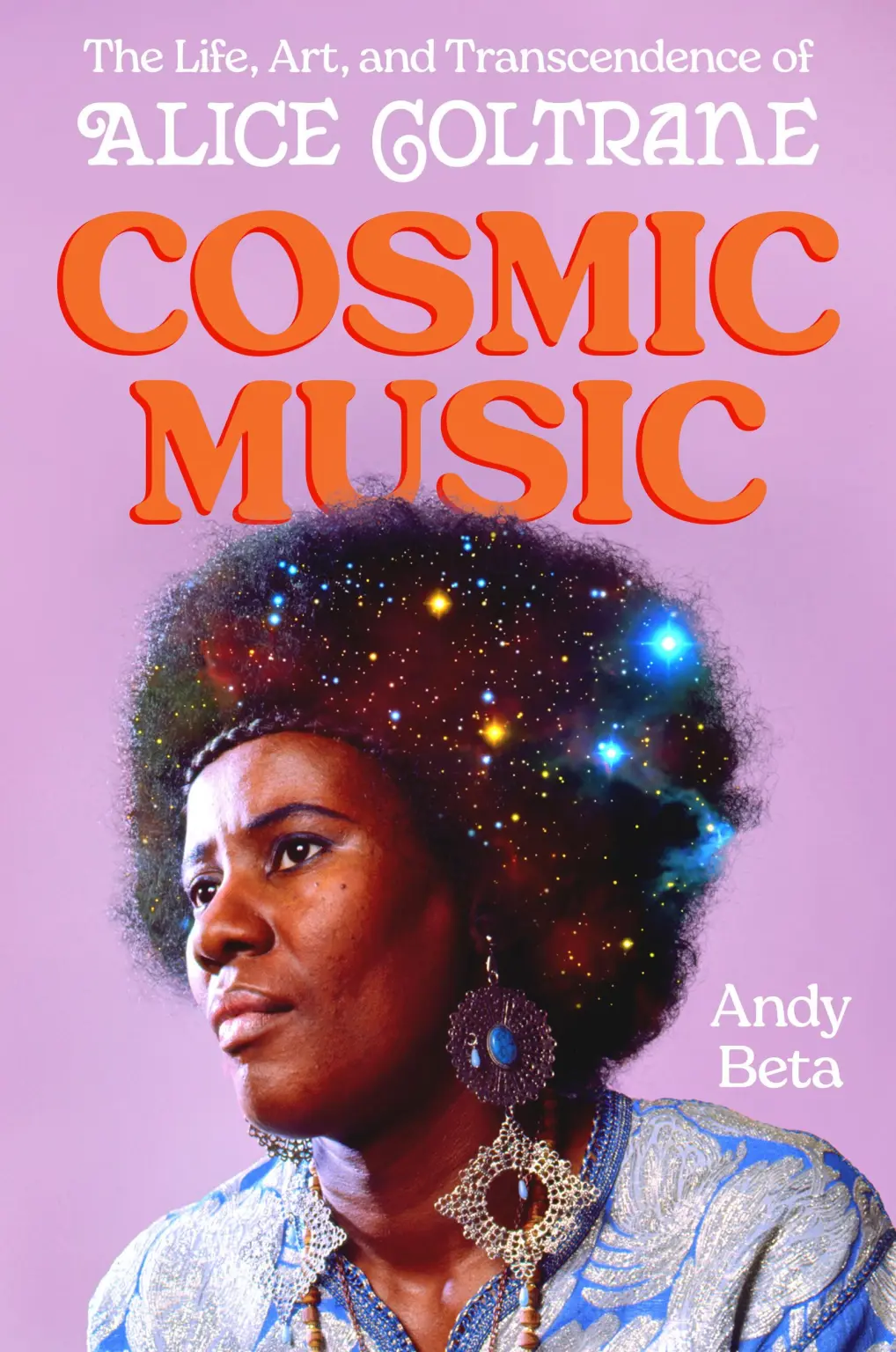
Cosmic Music: The Life, Art, and Transcendence of Alice Coltrane
Da Capo, 2026
A biography is the story of how a person came to be their true self. That’s often a compelling journey, particularly in the case of an artist, and the value in telling it goes up exponentially when the subject is someone who has been too little known in their life and legacy. And that, indeed, is Alice Coltrane, born Alice McLeod in 1937 in Detroit into a musical and worshipful family in one of the great jazz cities in America; later married to John Coltrane; and at the end of her life was Swamini Turiyasangitananda, called simply Turiya. Alice Coltrane: talented young Christian musician; then a modern bebop pianist, avant-gardist and leader in spiritual jazz; finally a mystic, swamini, and devotional music maker.
In a way, that’s a circle: the alpha and omega, two sides of the same coin. It’s the story that Andy Beta tackles in his new biography of Alice, and setting out the course of her life, with many important details, makes this book invaluable. It also has its flaws, but in the meta sense those point to another essential part of the story, which is Alice Coltrane’s place in modern America’s musical and social culture, and how both the mainstream and her acolytes have at times had difficulty seeing who she was and remains.
Beta is one of those acolytes. His first hearing of her 1971 Impulse! album Journey In Satchidananda, one of the classics of spiritual jazz, set him on his own path to her. As a writer, Beta has always been drawn to the connection between music and spirituality. This is a general concept but always a completely personal experience; our epiphanies are private. The sitar drones, washes of harp arpeggios and glissandos, the modal centering of a music journey around a cosmic-feeling tonal root, and the plain, biting blues and Pharoah Sanders’s complex earthiness didn’t just speak to his ears but to his soul.
She spoke to many this way through her music, but not to everyone. Critics discounted her playing and, for the most part, couldn’t get over her replacing McCoy Tyner in the John Coltrane Quartet. Many saw this as Alice’s pernicious influence over John, redirecting him from the formally contained improvisations of the mid-1960s toward a type of existential freedom that they found uncomfortable and incomprehensible. This also had to do with the soul, with using music not just as personal expression and communication but as a means to open up some kind of rift in everyday reality and touch something godlike. The epiphanic is the personal, is the musical.
Alice and John were equal partners in this, and clearly drawn together like moths in mutual attraction to the same flame. What Beta does well is describe how Alice McLeod not only got to that point but had the soul for it. Her family was musical—half-brother Ernie Farrow was an important bassist in Detroit, one of the great jazz cities, and younger sister Marilyn wrote “Love Hangover” and other songs for Motown—and church-going. Alice’s upbringing as a musician was inseparable from the church, where she became an experienced public performer and arranger while still a teenager.
As valuable as her pre-John Coltrane history is, this is where the book’s deepest flaws are. As Beta acknowledges, there’s hardly any biographical information on the first twenty or so years of her life, and he relies on a self-published autobiography, two self-published biographies written by devotees, and Franya Berkman’s Monument Eternal: The Music of Alice Coltrane (there are extensive notes and an index, but no bibliography). Beta is not critical, but devoted, and often leans on the side of hagiography. He credulously quotes Alice, via a previous biographer, talking about how she performed astral projection as a child, and his writing about John—an essential part of this story—is often close to J.C. Thomas’s embarrassing 1976 biography Chasin’ the Trane, which features such myth-making moments as John’s bandleader in school falling into reverent silence the first time the young Coltrane makes a sound on the clarinet (something that has never, ever been worth reverence).
There’s also a strange, extensive reliance on Berry Gordy’s memoir as the source for setting the Detroit scene in the late-1930s/late-1950s, and another extensive side trip into Aretha Franklin’s time in Detroit which has no relevance to Alice. The emphasis on how the Detroit school system and an audience that had taste and some money produced top level jazz musicians, and the Alice filling in for Barry Harris showing how good she was, is satisfying. But some key events in her life seem smoothed over so as not to be critical in any way. An early, short sojourn in New York is used to hint at some kind of failure to be accepted at Juilliard, when it seems she never organized herself enough to apply. And then there’s a stretch she spent in Paris.
This is a key part of her story, because Paris is where she both studied a bit with Bud Powell and first saw and met John, when he was in the Miles Davis Quintet for their 1960 European tour. Beta is tight-lipped about how she got there. Sometime in 1959, aged twenty-two, she entered an effectively secret marriage to the older singer (and junkie) Kenny Hagood, and the two left for France. By the time they returned in the fall of 1960, they were divorced and Alice had her newborn daughter, Michelle. Why would someone devoted to her family, community, and church do this? Beta doesn’t even speculate about the obvious impulse toward rebellion, as if that’s something Alice wouldn’t do, while it’s also something that adds so much to the honest picture of her.
This, and the Juilliard story, are odd choices. When in the early 1960s, playing with vibraphonist Terry Gibbs, Alice meets John again and their partnership begins—and it is key because John’s death shattered Alice, and Hinduism was essential to putting herself back together—the story speaks substantially for itself, and Beta’s own devotion to Alice makes it sympathetic in an insightful way. This also grounds the fullness of the albums she made for Warner Brothers, which go past jazz into a devotional practice with a clear, formal personal voice. In other words, Alice Coltrane as she is becoming her true self. But an uncritical acceptance of everything prior to 1962, say, means accepting a mainstream and bourgeois context for her that was never true to her. We know Alice Coltrane never needed to be part of Juilliard, that would have been wrong for her, and we know that without her personal, social rebellion her path to John and their mutual journey, and her final destination, would not have begun.
George Grella is the Rail's music editor. He is the author of Minimalist Music and Miles Davis' Bitches Brew (Bloomsbury).