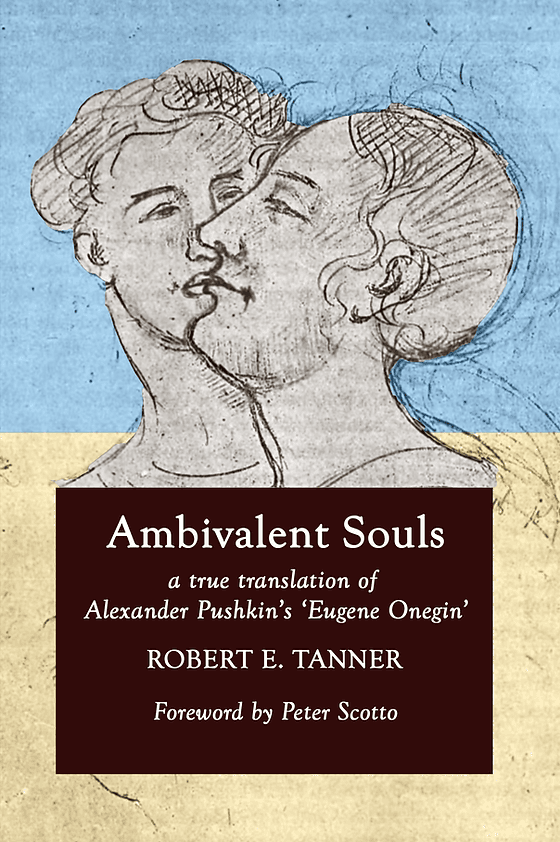
Robert E. Tanner’s Ambivalent Souls: A True Translation of Alexander Pushkin’s ‘Eugene Onegin’
Word count: 1010
Paragraphs: 18
Ambivalent Souls: A True Translation of Alexander Pushkin's ‘Eugene Onegin’
Poets & Traitors, 2022
The plot of Eugene Onegin, Aleksandr Pushkin’s famous novel-in-verse, is barebones. Our eponymous hero is a Byronic fop, bored by aristocratic life in early nineteenth-century Saint Petersburg. After moving to his inherited estate, he meets his friend Vladimir Lensky’s fiancée’s sister Tatiana Larin. She falls in love with Eugene Onegin, who condescendingly rejects her. After an ill-fated ball, Onegin kills Lensky in a duel. Years later, back in Saint Petersburg, Onegin sees a now married Tatiana. Now it’s his turn to confess his love and be symmetrically rejected. Unlike in the novels of Tolstoy and Dostoevsky, there is no intricate network of characters, no metaphysical quest for the meaning of life itself.
Instead, Pushkin gives us sparkling, encyclopedic digressions on urban and countryside Russian life. The poet-narrator is as much a character as those outlined above, his asides and personality at times overtaking narration in feats of dexterous versification. Most famous among these digressions is his stylistically varied confession to a foot fetish. Pushkin begins with a Romantic elegy:
O feet! Where are you now? Your fleet
and tiny paces left no traces
on melancholy, northern snow.before transitioning to a mock neo-classical tribute
Diana’s breast, the cheeks of Flora
are, yes, delightful, dearest friends!
Terpsichore, though, has an aura.
Her little foot – for me – transcends.and concluding with a Sturm und Drang version:
When sea awaits a storm’s transgression,
how I would envy every wave.
They run, recall, in rough succession
to lie down at the feet they crave!
I quote these nimble variations on a theme from Robert E. Tanner’s recent Ambivalent Souls: A True Translation of Alexander Pushkin's ‘Eugene Onegin’. As Peter Scotto details in his foreword, Tanner learned Russian while working for the Peace Corps in Ukraine, where he met the love of his life and was inspired to translate Eugene Onegin. Especially in the context of Russia’s ongoing full-scale invasion and Putin’s attempt to erase Ukrainian identity, Ukraine is, to put it far too mildly, a fraught entry point for Tanner’s interest in the Russian classic. Pushkin occupies the central role in Russian literary canon. His image has been mobilized by the current Putin regime (and the Russian Empire and Soviet Union beforehand) to justify the Russian imperial imagination. Furthermore, Pushkin had his own imperialist, anti-Ukrainian and anti-Polish texts. Tanner’s translation does not shy away from this problematic, leaning into Pushkin’s text as compromised and received. In Ambivalent Souls is not a timeless classic, but a messy, constantly shifting text, always approached from a particular historical perspective.
Translating Eugene Onegin into English also has its formal challenges. The novel is composed in rhymed stanzas (aBaBccDDeFFeGG) of iambic tetrameter. With notable exceptions like Boris Dralyuk’s My Hollywood and Maggie Millner’s Couplets, contemporary formal verse can sound archaic or child-like. Vladimir Nabokov’s infamous literal translation of Eugene Onegin dispenses with form altogether, the text’s “greatness” conveyed instead through two volumes of commentary. Formal fidelity, chosen by others like Charles Johnston, can at times result in accurate but dated versions that fail to capture the narrator’s chattiness. Tanner makes Pushkin as fluid and glittering in English as he is to contemporary Russian readers.
So why the change of title? Eugene Onegin has multiple stanzas and lines omitted in standard editions of text, seemingly the result of self- and tsarist censorship. Tanner fills in each of the omitted lines and stanzas with his own reflections on the novel through the lens of Nabokov’s translation and commentary, his personal experience learning Russian, and early 2020s America—keeping the form all the way through. These additional digressions contribute to the cheeky and glancing rhythm that defines the original. From the foot fetish digression, the italics marking Tanner’s additions:
… I love their feet
(or legs – for Russian lacks discrete
expressions. Really. And in folly
I wonder, where did Pushkin stare
when claiming but three shapely pair
in all of Russia?) Melancholy,
cool, he remembers yet each one,
and in his dream his heart’s undone.
A side-by-side comparison of Ambivalent Souls and Eugene Onegin shows the translator adding where no lines were omitted. The following conclusion to Chapter Six showcases all digressive codes swirling together:
… And yesterday we had the jolt,
our “Januaryist” revolt.
While I’m aware this will blow over,
as ill-conceived as what was true
(our Pushkin’s failed Decembrist coup),
it roils and threatens like a rover
the U.S. deck of freedom’s deep.
That battle flag disturbs our sleep.
The reference is to January 6 as the “Januaryist revolt” feels dated and almost quaint from the vantage point of Trump’s second term in office and its accompanying escalation of authoritarianism—but that’s the point! We, as readers of Tanner’s “true translation,” are never permitted to forget our historical moment, how we receive Pushkin’s text.
When I described Ambivalent Souls to my colleagues, they responded with some version of “Oh, so it’s more of an adaptation.” However, Tanner’s text, true to its subtitle, is a translation. In his recent The Philosophy of Translation, Damion Searls argues that, rather than providing a word-for-word reproduction of a text in another language, a translation is a record of a reader’s experience of the original. Ambivalent Souls captures Tanner’s experience of Eugene Onegin, including the multiple historical layers that separate him from the original and his means of making sense of it.
Last semester, I took a risk and assigned Tanner’s “true translation” for an undergraduate survey course on Russian literature and culture—to great success (“I normally don’t read anything poetic, but this was cool,” etc.). In the classroom, Ambivalent Souls allowed me to demonstrate the deadening effects of canonization, how revering texts puts them behind cabinet glass and limits our experience of them. What Tanner does for Pushkin should be done for all “great writers”—beyond translations, think of Baz Luhrmann’s Romeo + Juliet or Jean Rhys’s Wide Sargasso Sea as a post-colonial prequel to Jane Eyre. The translator’s self-insertions rescue Pushkin’s novel-in-verse, foot fetish and all, from the stuffy air of “greatness” and brings its voice back to life.
Venya Gushchin is a poet, literary translator, and assistant professor of Slavic Languages and Literatures at the University of Southern California. His translations of Vladimir Mayakovsky and Elizaveta Mnatsakanova have received the Columbia University Slavic Department Pushkin Prize. His translation of Blockade Swallow, selected poems by Olga Berggolts, appeared from Smokestack Books in 2022. His translation of the Russian-language Kalmyk poet Dordzhi Dzhaldzhireev is forthcoming from World Poetry Books in 2027. His writing has appeared in The Rumpus; Exchanges; Ballast Journal; No, Dear; and elsewhere.