Word count: 826
Paragraphs: 12
Canon
Viking, 2026
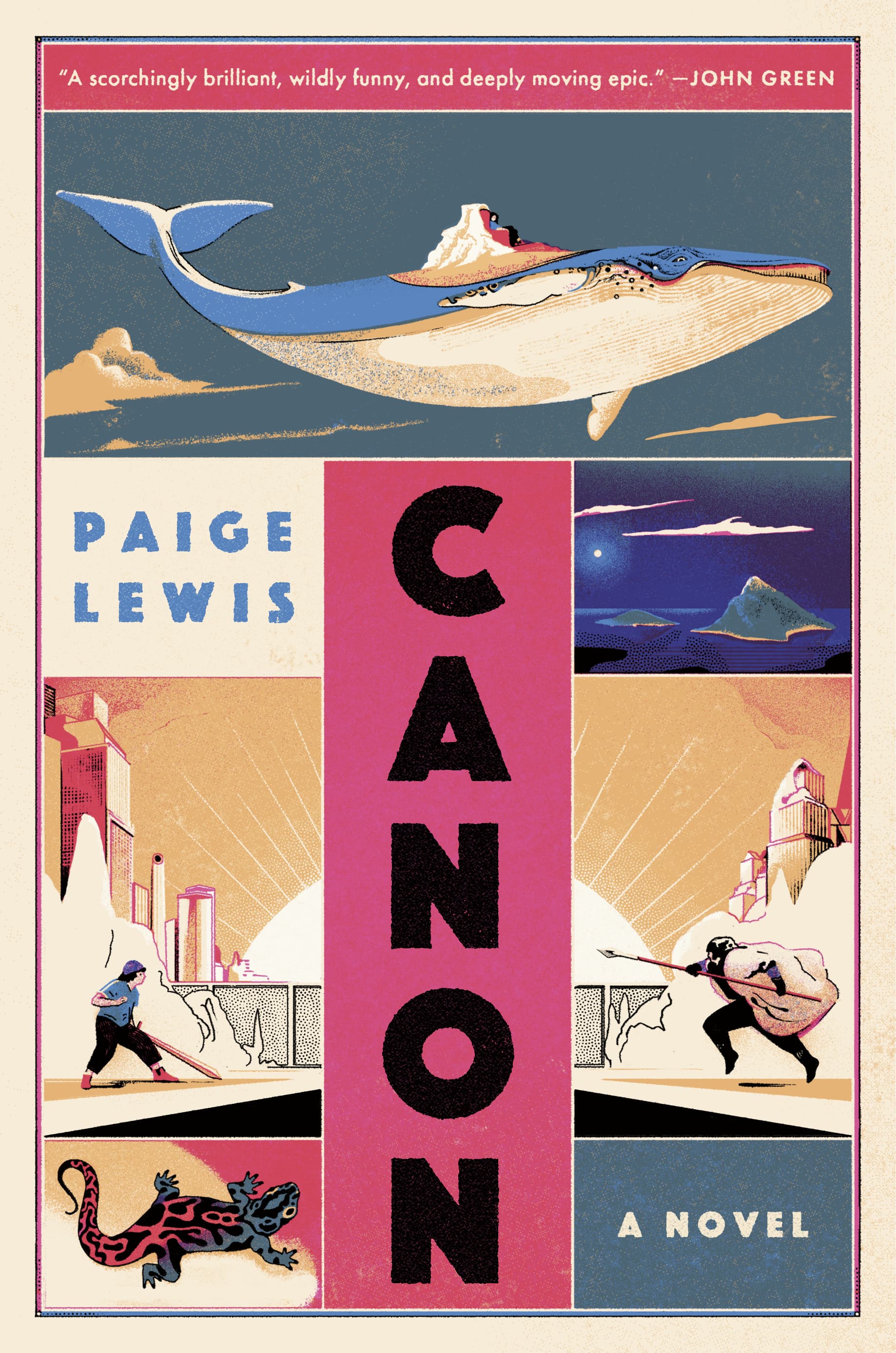
Stop me if you’ve heard this before. In Paige Lewis’s brilliant debut novel, Canon, the beautiful wife of an army general is abducted. War breaks out. A mercurial God pulls all of the strings. A hero journeys far from home, and meets powerful mentors along the way that prepare them to face the ultimate villain before they can return home again.
Except, this isn’t Ancient Greece. It’s mainly taking place sometime in the nineties. We meet our hero, Yara—a gentle, nonbinary eighteen-year-old with a serious case of Obsessive-compulsive disorder—when they encounter God, clad in a “Vatican-brand tracksuit and Birkenstock clogs,” outside of their house. God has chosen Yara for a Big Mission: They must kill Dominic, the leader of the Bad Guys, to bring an end to the war. The story toggles between Yara and Adrena—God’s onetime favorite prophet, who thinks there must be some mistake. Surely, she should be the one to slay Dominic? When Adrena confronts God about His bizarre choice of hero, God is frank: “I’m losing worshippers! I need to recapture the public’s attention, to jingle my keys in front of the masses, so to speak.”
For millennia, God has been recycling the same tropes that we all know from Homer, Virgil, Dante, and the Bible. By the time we get to the action in Canon, the schtick is getting stale. The novel’s omniscient narrator can barely conceal their exasperation, relaying key details like place and time with a winking mix of hostility and resignation. “Let’s Fast-Forward Past the Boring Parts,” reads one chapter heading. Later, “Some Jonah Bullshit” when introducing a chapter in which a whale invites Yara to sit inside his mouth. When God sends a wall of water rushing toward the men at war, the soldiers are irritated by having to deal with yet another flood.
When God hands out trophies during a men’s bodybuilding competition, replacing the usual bikini-clad women, the contestants struggle to hide their disappointment. Yara is God’s big swing; His bid to win back mankind’s attention and admiration. If someone like Yara—a weak, small, extremely passive teenager—can kill a Bad Guy like Dominic, then everyone would know that God was behind it.
Lewis blends together ancient and contemporary references, name-checking Ajax and Gilgamesh alongside Rock Hudson and the band Sublime. There is “complimentary sunscreen offered in little packets at all daytime battles.” A soldier daydreams about appearing on Oprah once he makes it big as a musician. This mashup lends the novel an eerie sense of time, collapsing in on itself, as though God’s creation were a dying star.
In one particularly vivid sequence, Adrena and Harpo (leader of the Good Guys) ride their horses to the mall. They narrowly avoid spending eternity at a Nuts4Nuts cart, before Adrena falls prey to a Two Faced Skin Care Consultant. “The sun is especially close to Earth today,” the consultant says as she grips Adrena’s wrist, “And it seems you’ve caught the harshest light.”
Loneliness is pervasive in this story. Yara is on their own, having recently been kicked out of their parent’s house when their father discovered them on a date with a woman. Their mother, Sabrina, is the Penelope to Yara’s Odysseus—the person they may never get to come home to. Adrena, whose powers have driven away every would-be partner in her life, wants to kill Dominic so that she can earn a spot next to her immortal mother in Heaven. Yara’s mentors, all God’s former “chosen ones," spend eternity on their own private islands, where they go mad from the isolation.
In the world of Canon, this loneliness is by design, and it goes straight to the top. Near the end of the journey, Yara is reunited with God, who tasks them with creating their own world from scratch in which to practice killing Dominic. “‘What matters is here,’” God coaches Yara, poking His finger into their chest. “‘Your loneliness…. There is colossal power lurking inside loneliness. I’m the perfect example. Do you think I would have created this universe if I’d had someone to keep Me company?’”
Can a person break free of this centuries-long cycle of solitude, war, and needless death if everything flows from God, and God made everything from loneliness? Yara’s version of the world has no disease, violence, or hunger. But, eventually they must confront that none of it is truly theirs: “The problem,” Yara thinks to themself, “was that Yara and the Dominic replica were God-made…. Yara wanted no more of it.” What remains to be seen, and what the novel seeks to answer, is whether there is a way out.
In choosing the title for Canon, Lewis is both nodding to the Western texts that serve as the novel’s foundation, and offering an audacious mission statement: that something original can indeed be made from used parts. It can also be funny, chaotic, warm, and impossible to put down.
Kate Preziosi is a New York City-based writer. Previously, she worked at the Wall Street Journal and theSkimm, where she was a founding team member. She holds an MFA in nonfiction from the New School.