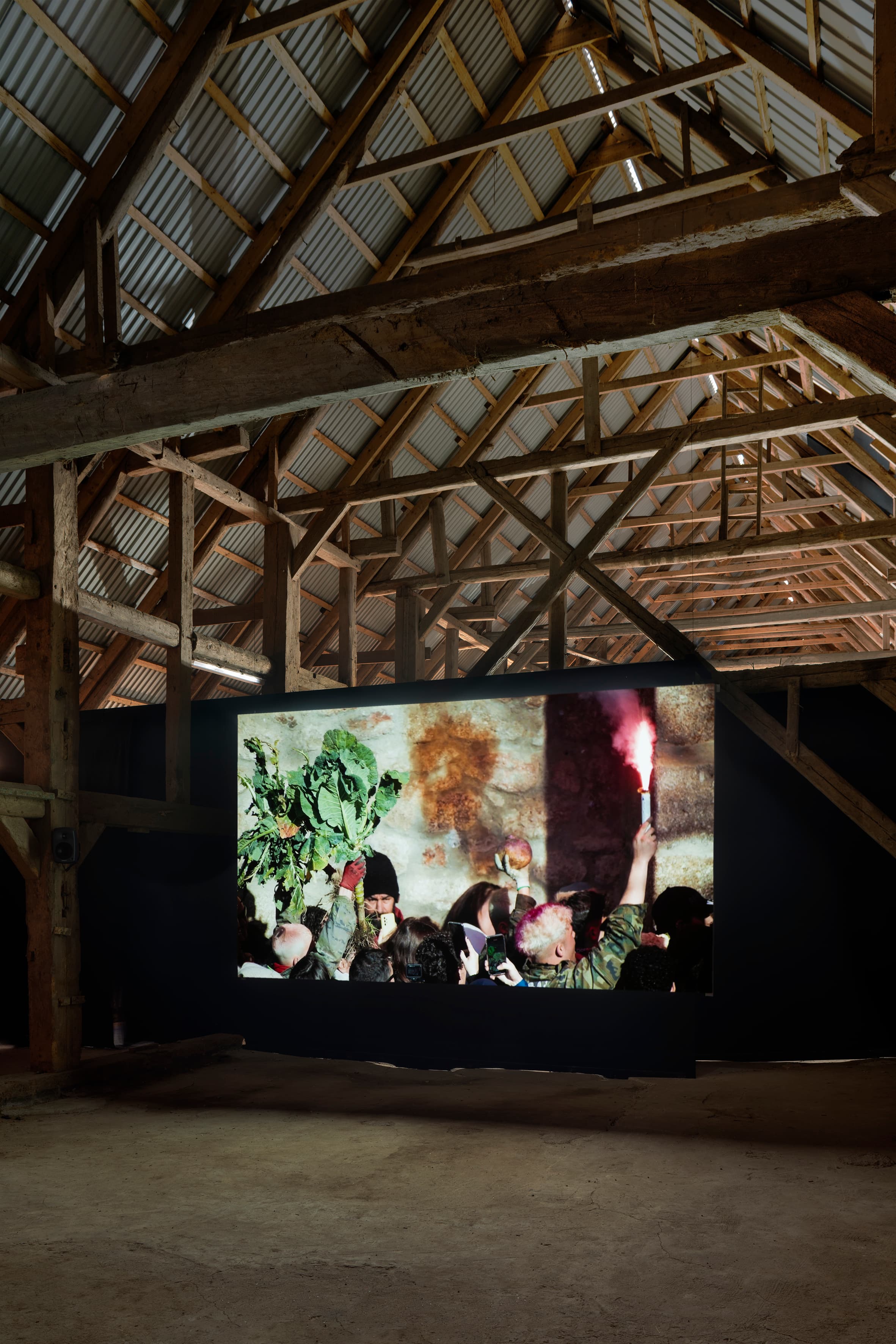
Yalda Afsah, Jarramplas, 2025. Digital color video, with sound, 15 minutes. Courtesy Kunsthal Thy. Photo: Jacob Friis-Holm.
Word count: 857
Paragraphs: 10
Kunsthal Thy
March 28–May 24, 2026
Hurup Thy, Denmark
A crowd surges forward, oscillating between dead-eyed fury and glee as they clamber over one another to hurl projectiles at an unseen victim. It turns out to be thousands upon thousands of turnips. Some tens of thousands of the vegetables are shipped each year to the mountain village of Piornal in western Spain for the historic Jarramplas festival, to be flung at a fictional character called el Jarrampla. People wait decades for the honor of being the demonic cattle thief who is run out of town.
The German Iranian filmmaker Yalda Afsah takes us into the midst of the festival in her film Jarramplas (2025), which documents the ritual, though purposefully never fully shows el Jarrampla. Only hints of his elaborate costume—a carbon-fiber grinning mask topped with horns and a jacket adorned with multicolored ribbons—are visible at times. Afsah is more concerned with the subtleties of the crowd and often holds the camera steady to allow characters to move in and out of shot. At one point, we see a young participant—with hair dyed half pink and half blonde to emulate the appearance of a turnip—get smacked, to his astonishment, in the chest by a turnip.

Yalda Afsah, Jarramplas, 2025. Digital color video, with sound, 15 minutes. Courtesy Kunsthal Thy. Photo: Jacob Friis-Holm.
This is one of two films being shown by Afsah at the Kunsthal Thy in the rugged northwest region of Jutland in Denmark. Having opened in 2023, this is the first year in its new location in a barn of the old Boddum Bisgaard manor, overlooking the shallow Limfjorden that connects the North Sea and Kattegat. The Kunsthal Thy is also now neighbors with the National Gallery of Denmark’s outpost SMK Thy, which opened its new renovation in 2025. Inaugurating the 2026 season for Kunsthal Thy, Afsah explores the cinematic construction of space and the perception of rituals, often rooted in the power dynamics between animals and humans.
In Jarramplas, there is a dangerous sense of mob mentality, as if the jovial atmosphere could change in an instant. At one moment, the crowd is suddenly stopped when el Jarrampla calls for a pause. Some people look concerned for the wellbeing of the volunteer, while others seem desperate to get back to the onslaught; with nowhere to put their bloodlust, the energy of the crowd threatens to boil over. Afsah shows one boy tossing turnips at a doorway before the festival really gets going, alluding to the precarious displacement of violence.
As el Jarrampla gives the go ahead to restart, everyone is back on the move—men, women, children. Context tells us that this is a family-fun carnival, beloved by the local community, but one can’t help feeling a sense of unease watching the barbaric tradition unfold. Part of the reason for our unease is the soundtrack, which Afsah has largely crafted in post-production. Some sounds come from filming, while the majority are derived from sound libraries or later recordings made to correspond somewhat with the action seen on screen. The results are marvelously disorientating; the discordant gap between representation and presentation intensifies our experience.

Yalda Afsah, Jarramplas, 2025. Digital color video, with sound, 15 minutes. Courtesy Kunsthal Thy. Photo: Jacob Friis-Holm.
The founder of Kunsthal Thy and fellow artist Rasmus Søndergaard Johannsen chose Jarramplas and the second film on display, Curro (2023), because of their resonance with the local area—Jarramplas for the traditional turnip crop that is grown in unforgiving Thy soil and Curro for the horse-culture in this part of Denmark. In the latter, Afsah captures the Galician custom of Rapas das Bestas, which means “Shaving of the Beasts.” Each year, hundreds of wild horses are rounded up from the mountains and ushered to the village of Sabucedo and into a circular pen, known as the “curro,” to have their manes and tails forcibly cut. The distress of the horses is hard to watch. As an outsider, it feels like an unnecessary display of machismo and domination, but the local community would argue that the Rapas das Bestas is a vital ritual for the health of wild herds, which now includes deworming and spraying for ticks.
The film begins in the lush green hills above Sabucedo, where the younger residents ride horseback and motorbikes to corral the herds. Astonishingly, one stands completely upright on the back of his horse. The symbiosis between the horses and men is evident in such calm control in the face of the untamed horses, and attests to the close relationship between the two species in Galician culture. Down in the curro, there seems little difference between the heaving, clammy bodies of horses and men. It takes several full-grown adults to bring a horse to the ground, gripping the animals’ ears to keep them steady. The men work in pairs or small groups, leaning breathlessly against or holding one another in sweaty, homoerotic, coded encounters.
Afsah’s framing of these rituals, keeping so much of the action off screen, invites an unsettling vision of the human potential for innate, bestial violence and the transference of that antagonism toward the victim of our choosing. Afsah also places us at the heart of these rites—we are not merely onlookers but swept up in the furor and just as culpable.