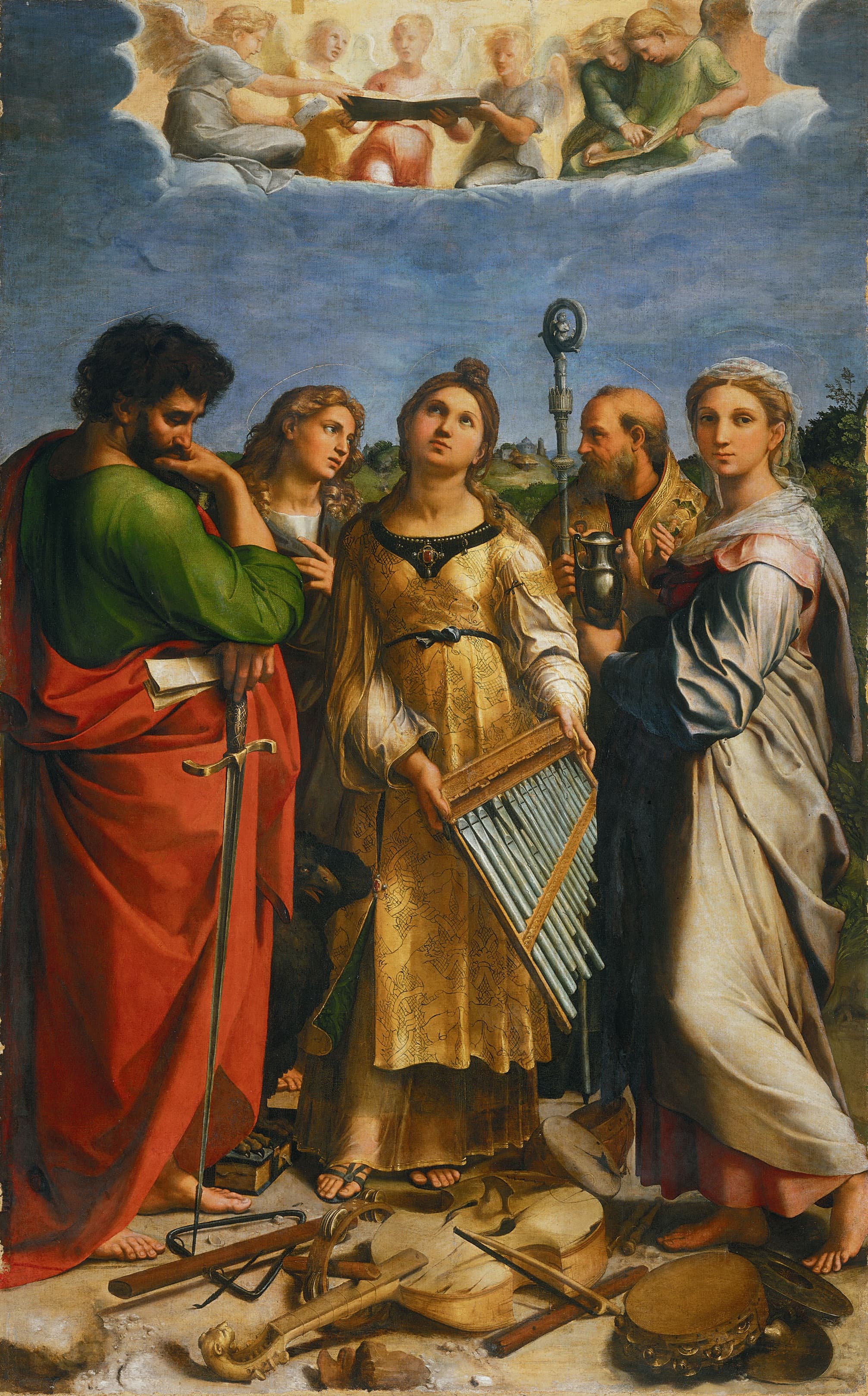
Raphael, The Ecstasy of Saint Cecilia with Saints Paul, John the Evangelist, Augustine, and Mary Magdalene, ca. 1515-16. Oil on canvas, transferred from wood, 93 × 59 inches. Courtesy Polo Museale dell’Emilia Romagna, Pinacoteca Nazionale.
Word count: 607
Paragraphs: 5
The Metropolitan Museum of Art
March 29–June 28, 2026
New York
In 2003 the Metropolitan Museum of Art presented Leonardo da Vinci, and in 2017 it displayed Michelangelo. Carmen Bambach, who worked on both of those shows, organized this exhibition—the last of these Met exhibitions devoted to the three canonical figures of the High Renaissance. Employing more than 170 paintings, drawings, cartoons for paintings, and tapestries by Raphael, his immediate predecessors, and his contemporaries, Raphael: Sublime Poetry provides as complete a presentation as is imaginable of this amazingly prolific artist. Accompanied by a massive catalogue, the exhibition is an amazing achievement, the first comprehensive showing in the United States of Raphael.
In the painting The Ecstasy of Saint Cecilia with Saints Paul, John the Evangelist, Augustine, and Mary Magdalene (ca. 1515–16), Cecilia looks upward. With damaged musical instruments at her feet, she rejects earthly music in favor of an inner spiritual song. The Miraculous Draft of the Fishes (from the Second Edition of the Acts of the Apostles Tapestry Series) (late 1540s or early 1550s) represents the first version of the scene, with the fishermen in the background. And The Annunciation (Cartoon for the Left Scene in the Predella of the Oddi Altarpiece) (ca. 1503–04) is a full-size drawing for a painted altarpiece. Raphael ran a large studio, so as this list indicates, what we find on full display here are the sources of the large, immovable frescoes that made his reputation. “To appreciate the full beauty of (Raphael’s Vatican decorations),” Ernst Gombrich writes, “one must spend some time in the rooms and feel the harmony and diversity of the whole scheme in which movement answers to movement, and form to form. Removed from their setting and reduced in size they tend to look frigid.” What we do get at the Met, rather, is a marvelous exercise in connoisseurship, a revelation of Raphael’s development in the crowded world of painting in Rome circa 1500. If you had taken Sublime Poetry to be a fully realized Raphael exhibition, then you might find it something of an exercise in frustration. But if you conceive of it as a postmodern exercise in revisionist interpretation, then you will see a brilliant art historical display, an equivalent to Tom Stoppard’s Rosencrantz and Guildenstern Are Dead (1967). Just as Stoppard turns Shakespeare’s masterpiece into theatrical fragments focused on two figures who, in the original text, were apparently minor, so the Met reveals Raphael’s sources but not his finished works. This show is like a production of Hamlet without a Hamlet at center-stage. And that result is instructive and surprising.
One favorite art writing text is Sydney J. Freedberg’s survey Painting in Italy: 1500–1600, which has a brilliantly condensed account of Raphael’s career. None of the renowned history pictures included in that narrative are on display at the Met—they cannot be, for they are frescoes in the Vatican. (If you wish to understand Raphael’s achievement in historical context, then you really must go to Rome.) Late in his career, Freedberg says, for Raphael, “ethical and aesthetic values are indissoluble from each other, and meant to be.” I am uncertain that the materials in this show allow seeing that. But they do something at least equally interesting. At the Met you can find an absolutely enthralling presentation of the artist’s activity of visual thinking, and that is very exciting to see. This was an extremely popular exhibition, crowded on a day when the rest of the Met was not particularly busy. The public, I was pleased to see, is fascinated with Raphael.
David Carrier is a philosopher and art critic who has published books on topics such as the methodologies of art history, Poussin’s paintings, Baudelaire’s art criticism, and the aesthetics of comics. He has held academic positions at Carnegie Mellon University, Case Western Reserve University, and the Cleveland Institute of Art. His recent works include Philosophical Skepticism as the Subject of Art: Maria Bussmann’s Drawings (Bloomsbury, 2024) and Bill Beckley and Narrative Art: The Word-Image Riddle and the Aesthetics of Beauty (Electa, 2023).