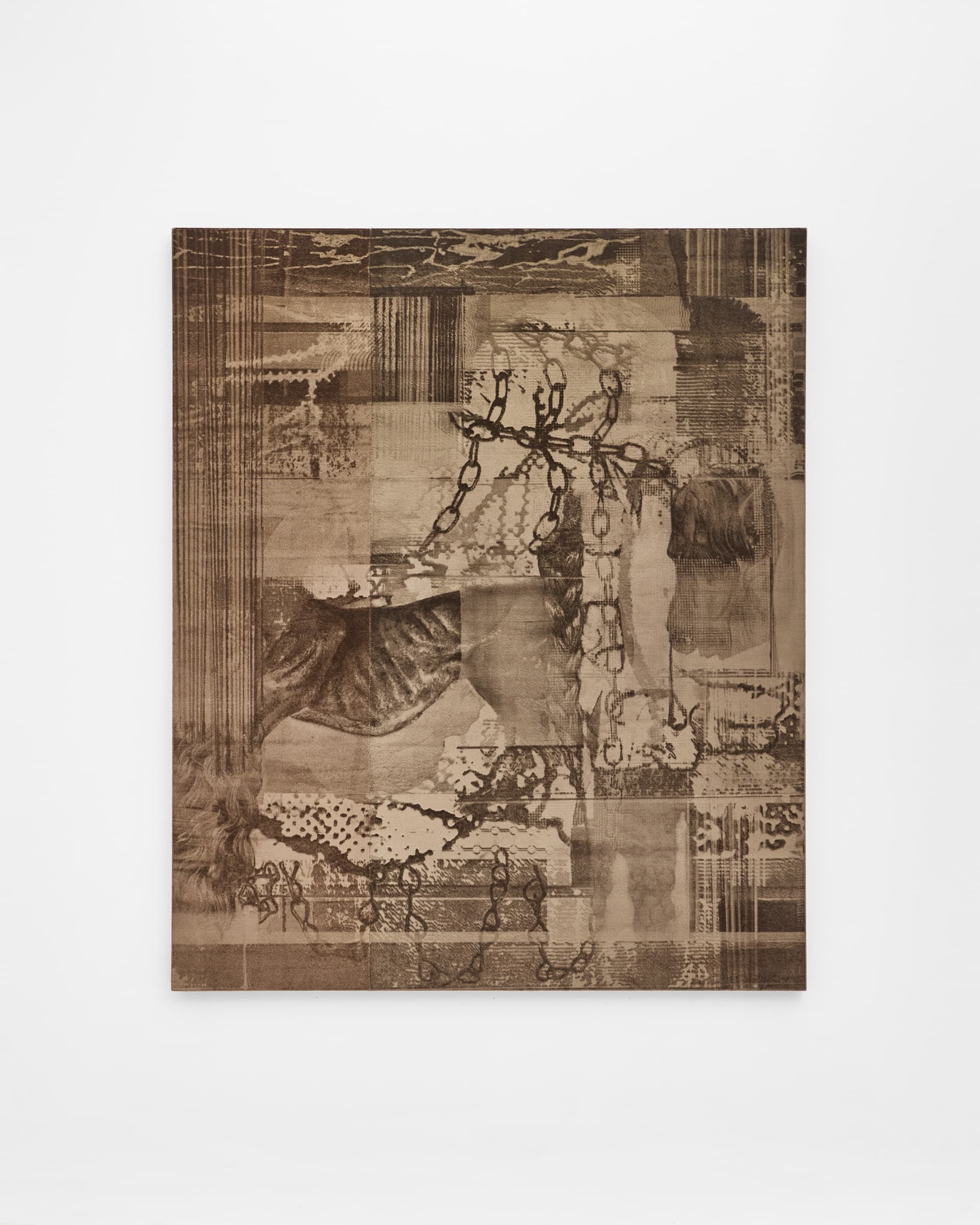
Leonardo Meoni, From a living room, 2026, Mixed media on velvet, 70 ⅘ × 59 inches. Courtesy the artist and the Address. Photo: Alberto Favara.
Word count: 674
Paragraphs: 6
The Address
April 11–May 31, 2026
Brescia, Italy
With nearly seventy years between their birth dates, Marion Baruch and Leonardo Meoni broach a markedly similar set of concerns with the aid of a comparable set of artistic media, and the temptation is very high to look for some sort of instructively revealing assemblage of contrasts within the outcomes of their investigations. Should one?
Baruch’s work, especially, is directly built of a series of open questions. Composed of leftover textile cast-offs of the type discarded by apparel manufacturers after a pattern had been cut from a strip of cloth, they are hung up from nails and hooks in varying configurations. Some, like Torre (2017) with its thin black wool frame outlining a vague semblance of a shirt-and-tie combo out of the white wall behind, tease at figural referent and pareidolia inherent to abstract painting. La musique autour d’un bassin (2018) remixes the off-white subtraction of Minimalism with the rough elegance of Arte Povera by way of a beige-toned, quasi-rectangular cotton shapes abundant in raw stringy edges and trailing threads; yet others, like Porta nel paesaggio (2017)—suspended from the ceiling in an angular drip of polyester—recall Robert Morris (of whom Baruch is two years senior) and a concern with entropy and post-Minimalist formlessness. All along, they toy with the expectations of abstract painting’s Suprematist paradigm, with its rectangles and neatly stacked geometric figures conjured through holes and absences. What is left after the form is extracted? Is the remainder a form in itself or a trace outline of an essence wrung out and displaced elsewhere? Open-ended koans within themselves, the pieces clue up that Baruch is more concerned with posing questions than providing definitive answers.

Installation view: Marion Baruch & Leonardo Meoni: Mi fa pensare a…, The Address, Brescia, Italy, 2026. Courtesy the artist and the Address. Photo: Alberto Favara.
The questions in Meoni’s works come in a different key. There is an ineluctable baroque elegance and opulence to his plush, velvet-based collagist drawings executed by smoothing the supporting material’s fibers in deliberately calculated patterns of depression. Not unlike Baruch’s, these pieces disclose images found, discovered, and conjured out of motley materials. These works play with the human eye’s innate helplessness toward the expectation of shape and pattern while hovering on the edge of disappearing altogether: in Meoni’s case, all it would take is a shoulder brush across the canvas in a crowded vernissage room or an unfortunate selfie–back-up against it. Equally, there is a shared concern for the past within both of these practices, an investment in what is left behind. One detects partial views of horse limbs—seen from different angles and degrees of remove—interrupted and intercut by links of a metal chain, barcodes, and marble veining within the fuzzy brown velvet of From a living room (2026). Meoni’s works twin the ephemerality of his medium to an import of fleeting uncertainty of meaning. They are imprints, like the imprints on memory of random snatches of visual data, scrambled and distorted. Sumptuously and tangibly lustrous in its jewel-toned bronzed olive and chartreuse, and disquietingly enigmatic in the swirls, drips, and bursts of its abstract motif that calls up the almost-but-not-quite sensical patterns of a smashed but still functioning laptop screen, Laborious inertia (2026) is a good example of how that ambiguity of data plays a tandem with Meoni’s sensuously physical support media.

Installation view: Marion Baruch & Leonardo Meoni: Mi fa pensare a…, The Address, Brescia, Italy, 2026. Courtesy the artist and the Address. Photo: Alberto Favara.
What, then, conjoins Meoni’s and Baruch’s bodies of work is an interest in the remainder of industry in both senses of the word—the large-scale corporate manufacturing complex and the private systematic labor, as well as the ironic mutability and the fragile equilibrium of form and concrete meaning they have come to see emerge from that remainder as a testament to the futility of the endeavor. The show’s contrast between Meoni’s rich and Baruch’s poor materials serves to underscore that affinity, as well—as does their dedication to absences and placeholders. There is, in the end, a touching fragility and a paradoxical elegance within both of these bodies of work in things that really shouldn’t come across as sleek as they do, yet somehow manage to, anyway.
Valerie Mindlin is an art historian, critic, and curator based in Madrid.