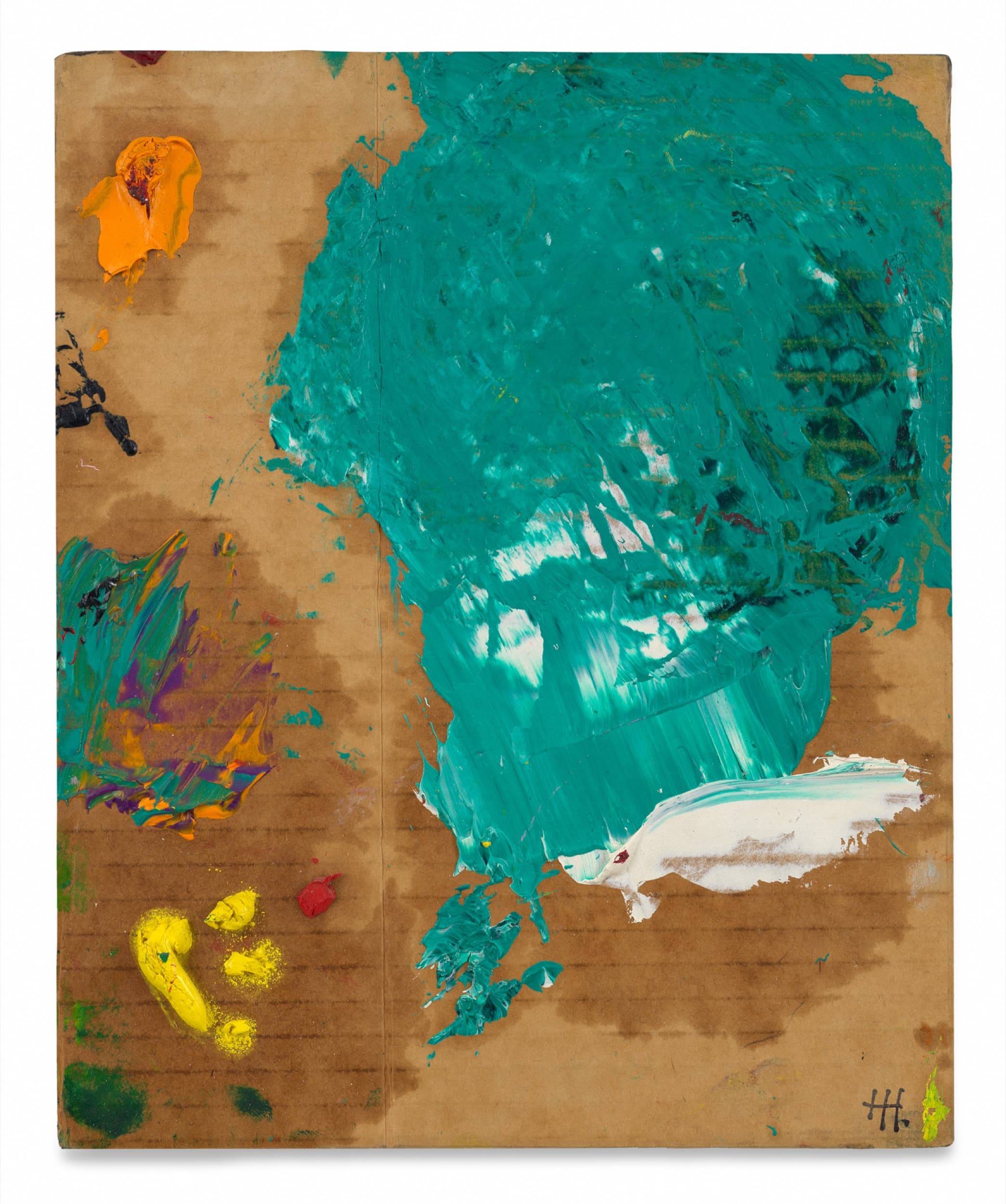
Hans Hofmann, Untitled, ca. 1960–65. Oil on cardboard, 9 ⅝ × 8 ⅛ inches. With permission of the Renate, Hans & Maria Hofmann Trust/Artists Rights Society (ARS), New York, NY. Courtesy Miles McEnery Gallery.
Word count: 853
Paragraphs: 8
April 2–May 9, 2026
New York
How are we to account for the persistent vitality and significance of Hans Hofmann’s art? While recent presentations of Franz Kline and Joan Mitchell revealed the perennial limitations of Abstract Expressionism—its artists’ formulaic repetition of compositional devices and the resulting diminishment of pictorial intensity—the Hofmann paintings currently on view at Miles McEnery are audacious and provocative, showing an artist several generations older than his colleagues but restlessly inventive well into his eighties.
From the beginning, Hofmann was an artist out of time. A contemporary of Pablo Picasso, Kazimir Malevich, and Paul Klee, he moved from Munich to Paris in the early years of the twentieth century, arriving there just before the appearance of Henri Matisse’s Le Bonheur de vivre (1905–06) and Picasso’s Les Demoiselles d’Avignon (1907) ushered in those twin poles of Parisian modernism—Fauvism and Cubism. Though he would eventually integrate both styles into his painting, Hofmann’s art developed at a remove from that era’s rush of experimentation. By 1940—the date of the earliest picture in the exhibition, Submerged—Hofmann had relocated to the United States and been active in the New York City avant-garde scene, primarily as a teacher and theorist, for about a decade. Exposure to this milieu rejuvenated his painting, and, just as he’d spent the interwar years synthesizing the earlier innovations of Matisse and Picasso, in the final two decades of his career—those covered in this show—his art was catalyzed by the examples of Abstract Expressionism and Color Field painting.

Installation view: Hans Hofmann, Miles McEnery Gallery, New York, 2026. © Renate, Hans & Maria Hofmann Trust /Artists Rights Society (ARS). Courtesy Miles McEnery Gallery.
Though his work is unusually resistant to generalization, Hofmann’s painting became, in broad terms, more unbounded throughout the 1950s and 1960s, with expansive gestures and larger forms replacing the linearity and detail characteristic of previous decades. He did not share the Abstract Expressionists’ existentialist pathos, yet his small paintings on cardboard and panel exhibit the rough paint handling, speed of execution, and singular focus typical of their work. For example, a small untitled oil-on-cardboard painting from 1963 features only a tangle of two or three swift blue brushstrokes, cresting, blending, and crashing into a chalky dollop of white paint. The simplicity of this picture belies its hurried visual speed and the sense of direction captured by Hofmann’s mark-making. In another similarly sized and untitled piece in the same medium from (ca. 1960–65), an impending turquoise mass presses in from the corner, looming over a disparate array of fugitive marks: one small red dot, a daub of bright orange, and a few crusty blobs of yellow among them. In both paintings, pictorial elements are calibrated to the dimensions of the support, producing a sense of scale that far exceeds the works’ physical size.
Though he spoke of nature as the source of his art—and while some of his abstract paintings, like Night (1952), feature brushwork that feels descriptive of landscape—color is at the heart of Hofmann’s painting. In a 1957 essay, he described his painting practice as “a process of metabolism, whereby color transubstantiates into vital forces that become the real sources of painterly life.” Hofmann was exceptionally sensitive to color’s temperature, weight, and translucency—tactile qualities that are emphatically asserted throughout the works on view. Floating Mirage (1961), for example, is a study in the imbalance and symmetry of color, as the painting’s largest form (a wash of light blue that fills most of the left side), is upstaged by a stroke of red a fraction of its size. A similarly extreme contrast is found in The Prophet (1962), where a bold and opaque yellow shape is set against a splotchy brown background, these two elements comprising the entire painting.

Hans Hofmann, Grief, 1961. Oil on canvas, 72 × 60 inches. With permission of the Renate, Hans & Maria Hofmann Trust/Artists Rights Society (ARS), New York, NY. Courtesy Miles McEnery Gallery.
Hofmann was one of the few Abstract Expressionist painters (the other was Clyfford Still) whose work was responsive to the developments of early 1960s Color Field painting. This influence was reciprocal, as it was in paintings like Kenneth Noland’s circles that Hofmann’s theory of the spatial “push and pull” of color found its clearest expression. The color forms in Grief (1961), one of the strongest pictures in the show, and Mirage (1962) are floating, suspended, nearly weightless. In contrast to the imposing impasto construction of Blissful Darkness (1959), the disembodied color of Grief and Mirage seem whispered or breathed onto the canvas.
In the decades following his death in 1966, circumstances conspired against Hofmann’s art: his importance and influence as a teacher overshadowed his own painting, and his extreme stylistic pluralism was at odds with the “signature style” approach of his Abstract Expressionist colleagues. What’s more, the character of Hofmann’s art ran counter to the prevailing mood of his time. The palpable sense of abandon in his painting was matched only by that of Willem de Kooning, and his generous exuberance was found nowhere else in that milieu. (Witness the springing curls of resplendent, high-keyed color bouncing down the surface of the untitled work dated ca. 1960–65: a confident, commanding work that nevertheless projects ease and grace.) The current exhibition at Miles McEnery laudably showcases these qualities, foregrounding the diversity and complexity of Hofmann’s painterly life. It is a challenging and rewarding effort.
Alex Grimley is an independent art historian specializing in postwar and contemporary art, particularly Color Field painting. His writing addresses intersections of visual art, criticism, and experimental music.