Looking Beyond Photography’s Expansion: Starting with Death and Ending with a Smile
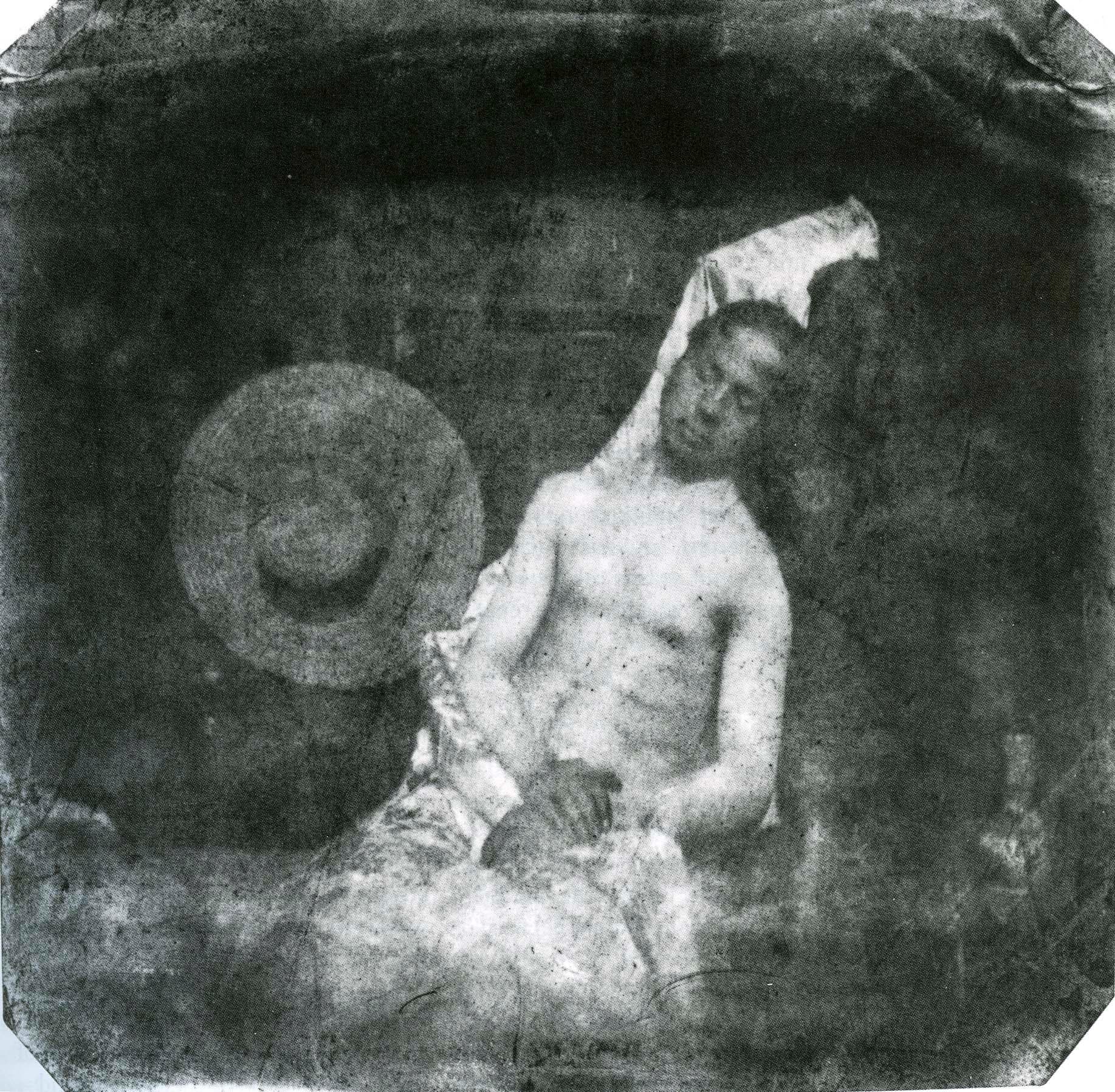
Hippolyte Bayard, Self-Portrait as Drowned Man, 1840.
Word count: 2338
Paragraphs: 24
Photography has an unnerving existential angst weaving through it. Death, personal and that of others, looms large. Hippolyte Bayard’s Self Portrait as a Drowned Man (1840) was a protest against the French Academy’s surpassing his three years of work in favor of Louis Daguerre’s now famous presentation (enjoy Bayard’s accompanying letter that drips with sarcasm). The second half of the nineteenth century presented a new career path for artists; photojournalists captured the brutality of war, as well as the wreckage of humanity (and human-made or natural landscapes). Susan Sontag’s famed 2003 essay “Regarding the Pain of Others” feels apt in looking at these older images, too. The philosophical questions of memory, evidence, presence, absence, veracity, by thinkers at every point in the field’s ongoing developments undermine its constancy or consistency. It’s not only a troubled field but one that troubles.
France was embroiled in the Franco-Mexican War when Édouard Manet took a photograph of Victorine Meurent for Le déjeuner sur l’herbe (1863). The nude of Meurent shows her in the pose of the scandalous painting famously anchored by her gaze. She modeled for him regularly and would for several more years, before committing to her own ambitions as a painter, so the photograph raises interesting questions about why Manet took it in 1863; he changes the angle but the gaze and gesture of the photograph align with the painting.
Cameras then were tripod mounted, heavy wooden boxes that used a wet-collodion process, so photographers also lugged a portable dark room to develop the plates; easy in Manet’s studio, harder on a battlefield. But exposures were under thirty seconds and the development took less than twenty minutes—so much faster than only a couple decades earlier. A sort of peace had settled on France since the losses of the Crimean War, the first war in Europe to have extensive photographic documentation of the belligerence; a new cable line provided more frequent telegraph reports to update news readers.
The images of wars in the second half of the nineteenth century shifted sensibilities. The historian and blogger Heather Cox Richardson recently described how the loss of life emboldened Julia Ward Howe to conceive of a movement and a “festival which should be observed as mothers’ day, and which should be devoted to the advocacy of peace doctrines.” Women after the wars of the next century would similarly wonder why they could labor for nations during war times but were dismissed afterwards.
Just over fifty years later, another war would rage in Europe. Marcel Duchamp had fulfilled his military service by working as a print engraver, but the patriotic fervor of the Great War made his non-participation a grave discomfort for all. His brothers were at the front; his sister worked as a nurse. Despite the need for combatants, he was deferred for some unspecified condition (a heart murmur is occasionally mentioned in the literature). In Paris, such a young, seemingly healthy man appeared a shirker. His sister-in-law reproached him and pedestrians yelled at and spat on him.
Determining to depart from Europe, in his own words: “I am not going to New York, I am leaving Paris.” He would say something similar about World War II: “I left France during the war in 1942, when I would have had to have been part of the Resistance. I don’t have what is called a strong patriotic sense; I’d rather not even talk about it.” There are no pictures of Duchamp in uniform from his brief period of military training (although some of him as a child dressed as a soldier do exist, discussed by Kieran Lyons in Tate Papers).

Marcel Duchamp, Box in a Valise (From or by Marcel Duchamp or Rrose Sélavy), 1935–41. Leather valise containing miniature replicas, photographs, color reproductions of works by Duchamp, and one “original” drawing [Large Glass, collotype on celluloid, 7 ½ x 9 ½ inches], 16 x 15 x 4 inches. Courtesy the Museum of Modern Art, New York.
Given the significance and growth of photography across the period of Duchamp’s life, it can be surprising to realize how little they seem against the other works in his oeuvre. The art-historically thorough current exhibition at MoMA (albeit dry for such a witty artist) shows his many paintings and objects, but the photographs are frequently by others, representing his adoption (or appropriation) of copies and reproductions in his work. It’s not that photographs aren’t there or don’t matter—a commercial photographic supply box holds the facsimiles of The Box of 1914 (1913–14), strikingly analyzed in relation to war by Dalia Judovitz. His call upon photography, however, more often seems interested in the idea of its reproduction, commercial force, popular distribution, than as an interest in the medium—part of why he gets stamped a Conceptual artist. And yet, his changing the definition of art (as so frequently espoused) doesn’t align with the emphatically political definition of his contemporary, or the one now grasped at.
“Photography will never be the same after today” said Edwin Land at the April 1972 company meeting for the Polaroid SX-70. Indeed. Previous instant cameras, like the popular Model 250 from 1967, required eight pages of instructions. Not only did general audiences want to take pictures immediately of everyone and everything in their lives, but even famed photographers like Ansel Adams and Walker Evans enjoyed using it. Andy Warhol carried the camera with him everywhere he went, taking pictures of nothing and no one, just as frequently as he captured the rich and famous. The discourse surrounding photography initially dismissed Polaroids for their amateurishness and snapshot phenomenon. Years passed before Warhol’s use of the Polaroid camera could be interpreted as a flâneur’s visual diary of the mundane, epitomizing a vernacular that prefigured social media.
Photography is a cultural-historical form, not an ontological substrate as a medium or even a practice, according to the scholar Peter Osborne. It may even be emblematic of the dissolution of medium specificity, when considering “the variety of different photographic forms coexisting within the present: chemical photography, film, television, video and digital imaging—to name only the five main forms,” which is what makes it “a still expanding field” (contra Rosalind Krauss’s expanded field of sculpture). Frustrating that endless expansion, because photography seems to be both everywhere and impossible to define and thus identify.
Photography’s sociality becomes evident in Land’s 1974 booklet of instant photographs, where he declared: “A new kind of relationship between people in groups is brought into being by SX-70 when the members of a group are photographing and being photographed and sharing the photographs.” The social here does not exist prior to being constructed through the photographic association. The necessity of a commercial good to establish a social encounter implicitly privatizes a public experience. And yet, in contrast to the reproducibility of the photograph generally, the Polaroid reintroduced a single, unique image. In so doing, it reclaimed the auratic here-and-now–ness of the original, which is how the Polaroid could authenticate the encounter. From being an inadequate medium for art, it has become rarified and so finds renewed appreciation today. That’s not a change in the material but the social, precisely to Osborne’s point.
The term photography holds an idea that groups together a set of technological practices associated with indexicality—an association with witnessing, having captured a moment through presence. Chemical photography is typically indexical, meaning it records a physical trace of light bouncing off an actual object. Cyanotypes, Polaroids, and digital photographs manage to retain the sense of indexicality—although the first makes no use of a lens and camera, and the last had to produce a renewed argument that light hitting the lens to materialize the digital file still preserves an indexical trace. The difficulty with the image generation associated with diffusion models or GANs is that the output is iconic without being indexical; the process produces images that resemble reality without ever having been in material contact with a physical subject. Osborne makes a statement that is dense but spot on:
This unity derives from connections at the level of both the material form of the technologies (an imprinting of light upon light-sensitive surfaces of different kinds) and their predominant socio-cultural functions and uses (as epistemically privileged representations of the real). All technologies are by definition unstable unities of material form and social use: abstractions of the rationality (logos) of specific processes of making (techné) in the service of the generalization of their uses.
The connections we build about how photographs work, both in terms of their making and social impact, is why he proposes that photography has a “distributive unity.” All those images circulating that we call photographs—the memes, the screenshots, the selfies, as some examples of the untypical “photos” stored in our handheld devices—are not unified by a single and coherent idea that founds our understanding. That is one difficulty.
The other problem of a distributive unity occurs through the absence, therefore, of a “logic of specification”—the lack of an identifying structure (a genus, species, or classificatory system)—with implications for the sociality that photography claimed by Land or others. There is no order. The things of photography are such by “spatial contiguity” (clumped together on your device, or placed as such in a museum), or a “temporal contiguity” (when something seems to derive from a photographic practice, whether in its material production or by nature of the artist’s former creative practice). That doesn’t feel social but a pell mell of confusion with no ground for meaningful connection.

Matias Sauter Morera, Cristian en el “Amor de Calle”, 2023. Chromogenic print, 20 x 20 inches. Courtesy Craig Krull Gallery. Photo: Matías Sauter Morera.
An example of this contiguity appears in Matias Sauter Morera’s image that was much discussed for its being the Getty museum’s first acquisition of an AI photograph in 2025, although the institution would later minimize this fact. The image was one made using various models and Photoshop for a series about pegamachos—a reimagining of a clandestine period of Costa Rica's queer history, in the conservative era of the 1970s and ’80s, when straight men—often cowboys—from rural areas maintained their conventional masculinity and heterosexuality despite participating in discreet encounters with other men.
Morera initially considered a straight photographic documentary approach, in keeping with his creative practice, but the artist explained that “AI provided a way also to achieve this without intruding on real lives,” not outing people or placing them in danger within their communities. This exemplifies Osborne’s temporal contiguity. Morera didn’t think his image should be identified as a photograph, but it’s in that Getty museum department; the catalogue entry for it mentions nothing about its use of models or softwares, although the description briefly does. That’s the spatial contiguity.
The established German photographer Boris Eldagsen has emphatically resisted the collapse of distinction. In April 2023, he turned down the Sony World Photography prize in the creative category. He submitted a vintage sepia-style image that was generated using DALL-E 2, because he was a “cheeky monkey” and wanted to know if organizations were ready to deal with evolving technologies; in an interview he replied: “[They] are not.” Sony wouldn’t acknowledge the problems with using generators in his many email communications with them following the information that he won the award. He wanted to provide a space for dialogue in the field. His proposals went ignored and at the prize ceremony, he found a moment to walk on stage where he announced his refusal of the award. His image was removed from the prize website (along with any mention of the issue).

Boris Eldagsen & Tanvir Taolad, “TRAUMAPORN”, 2023. Mixed media: photography, promptography, wallpaper, flags. Neue Galerie im Höhmannhaus, Augsburg. Courtesy the artist.
Eldagsen continues to use generators, both still image and video, but refers to these works as promptography, as a dividing line that helpfully points to the politics of these corporate generators. The works in “TRAUMAPORN Reloaded” examine the easy assimilation of fascism, but “not as ideology, but as design language: clean, seductive, highly reusable.” I read Eldagsen’s arguments as identifying the way generators present a different cultural historical form, to return to Osborne’s argument, which gets evaded in maintaining a contiguity with photography. User friendly is also a mechanism for accelerationism and obfuscation, by speeding processes so deliberation gets lost with the push of a button. Presto!
In the book Anywhere or Not At All, from which I have been quoting Peter Osborne throughout, Osborne provocatively claimed: “The photographic image is, among other things, the dominant visual form of the American empire, through which we are currently experiencing its decline.” That was 2013. He describes its global image-space as “photo-capitalism,” in contrast to the earlier print capitalism of nationalism, and specifies it as “a distinctively transnational and translinguistic cultural-economic form.” Though photography is ever-expanding and will continue in just the same way that painting did not die, it may well be worth tempering the ongoing genealogies with photography assumed in discussions of large language and diffusion models, or generative adversarial networks.
As many have noted, generators depend on language as much as image. Steeped in tagging and text prompts, online image scraping and stock photography, both print and photo-capitalism are doubtless part of the current cultural economic forms wrought by generative systems. To be clear, I do think histories of photography matter here. Just as I think histories of rhetoric, people, and land, air, water, or power in all its forms matter.
Amidst the proliferation of protest documentation about the conditions of the world and the media discourse around militaristic politics—both of which participate in cultural economic forms with purposes we shouldn’t forget when we absorb them—I keep returning to historical moments. “We’re continually experiencing new ruptures of consciousness,” said Sara VanDerBeek in a smart conversation with Sara Cwynar about some of these issues, but we’re still held by established cultural economic forms. We reach for familiarity amidst the dissolution of known registers, or feel torn holding both. As Marshall McLuhan and Quentin Fiore wrote in The Medium is the Massage (1967), and is always on my mind:
These are difficult times because we are witnessing a clash of cataclysmic proportions between two great technologies. We approach the new with the psychological conditioning and sensory responses to the old. This clash naturally occurs in transitional periods.
The clash of oppositions globally and politically is also occurring locally and personally. No wonder few can muster the luster of a photogenic smile. Instead, we’ve got an emoji for that.
Charlotte Kent is Associate Professor of Visual Culture at Montclair State University, an Editor-at-Large for the Brooklyn Rail, and an arts writer.