ArchitectureMay 2026In Conversation
BRUTHER with Nile Greenberg
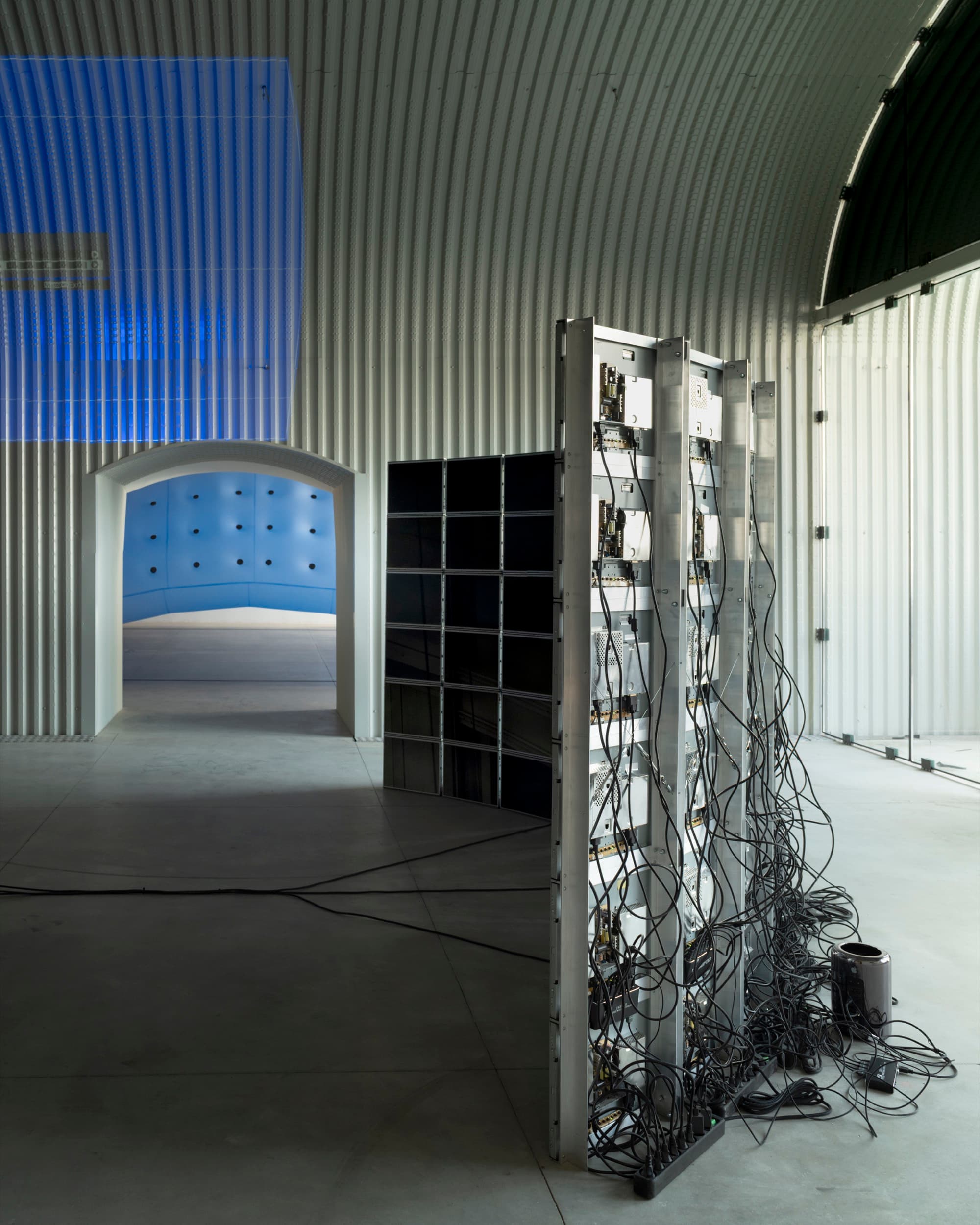
DropCity Milan, Bruther. Photo: Arnaud Bostelmann.
Word count: 2999
Paragraphs: 42
Bruther, the French architecture office founded by Stéphanie Bru & Alexandre Theriot, is important. In their still young career they have shifted architecture into a direction characterized by spatial richness and exposed, technical construction. Their impact is clear to architects in the field. Bruther produces architecture of the real. I was prompted to talk with them after seeing the exhibition bruther.fbx at Dropcity in Milan. The show was an experiment in architectural and technical formmaking. Specific architecture without specific function. Despite their dedication to reality, their work makes for a vivid image. My conversation with Alexandre Theriot explores an architecture where the contradictions between flexibility and functionalism are revealed.

DropCity Milan, Bruther. Photo: J Schwartz.
Nile Greenberg (Rail): Let’s start with your 2025 exhibition bruther.fbx at Dropcity in Milan. It was one of the best architecture shows I’ve seen in quite a long time. Can you describe the show and what made it important for you?
Alexandre Theriot (Bruther): An exhibition, for us, is a lever, a moment where the work is put on hold, a way of looking back at what we’ve done, reorganizing it, shifting it slightly. The starting point was a slight misunderstanding with Dropcity, the organizer of the exhibition in Milan. At first, the idea was to present the practice—images, drawings, models. But quite quickly, we felt it could become something else, not to show what we do, but to question how it is constructed, how it transforms, and sometimes, how it escapes us. The exhibition was set across two vaults beneath Milan Central Station, each extending over a great length. One mainly presented digital material: looping video sequences, working drawings, and other material. The other vault showed physical objects: prototypes or artifacts, things we build without a very precise function. These are our experiments in mechanisms, actions, moving forms, and constructive behaviors.
At the center of the exhibition was the shelf in our office where models accumulate. We scanned it very thoroughly to produce a film—a journey through this archive. The camera moves without a stable scale, it shifts from one fragment to another, from one project to another, without hierarchy. Models coming from very different contexts, programs, and scales are brought into relation within a single continuous sequence. You no longer really know whether you are looking at a detail or a whole, an object or a territory. The film becomes almost like a traversal with this loss of reference that you find in certain scientific representations, where scale becomes undecipherable. In this process, the models stop being simple representations. They acquire a kind of autonomy as if they could transform, assemble, or drift independently from the projects they originate from.
The exhibition made visible a latent dimension of the work: a set of possibilities not yet stabilized in a built form, but that continue to exist and to reconfigure. At the same time, the working drawings remind us of something very concrete: building. All the drawings we produce are oriented toward construction. The exhibition sits precisely in this tension between objects that explore possibilities—sometimes indeterminate—and their translation into precise construction systems. It is within this gap that, for us, the very possibility of the project lies.
Rail: I understood that building is completely central. Technical ideas in construction, materiality, and technical assemblies were privileged over narrative or theory. There’s a real dedication to reality in your work. How do you define architecture and how do you see its limits?

Cité Internationale Universitaire de Paris (CIUP) student residence, Bruther. Photo: Maxime Delvaux.
Bruther: The question of construction is central, but there are several ways of understanding that word. Of course, there is construction in the material sense: assemblies, systems, implementation. But for us, it begins much earlier. It begins with the construction of ideas with the setting up of a narrative field that guides thinking and orients the project. This is what allows intentions to be transformed into spatial devices, situations, spaces. In that sense, technique is only a means, a lever. Cedric Price once said: “Technology is the answer, but what was the question?” In other words, the question is not what technology allows us to do, but what we are actually trying to produce. From there, it’s not about moving away from construction but rather expanding it—not reducing it to a technical dimension, but opening it up as a process that connects thought and matter. From that point on, the limits of architecture are understood differently.
Rail: How would you describe the object of architecture?
Bruther: For us, the question of the object of architecture does not refer to a form or an isolated element but rather to an operation. Architecture consists of putting things together—assembling heterogeneous elements: uses, constraints, construction systems, situations. This act of assembling is a reorganization of existing things. A reorganization that can be expected, intuitive, sometimes unstable, but that always produces new associations and therefore new spatial configurations. What interests us is not only the form produced, but also what this assembly makes possible. A column, a slab, a façade—these are never purely technical elements, but they organize distances, rhythms, movements, ways of inhabiting. In that sense, architecture acts less as an object than as a framework capable of accommodating situations. For us, these situations are always tied to use.
We believe that uses are more important than functions. Function defines. It fixes. Use, on the contrary, opens, transforms, allows appropriation. The most interesting spaces are often those that escape their initial program, that are used in unexpected, diverted, reinterpreted ways. The goal is therefore not to produce perfectly defined forms, but to set up devices that are open enough to allow this freedom. In that sense, the object of architecture is not what we draw, but what happens afterwards.
Rail: Who are you optimizing for, and what are you optimizing?
Bruther: We don’t optimize objects. We optimize situations. Optimizing, for us, is not about reducing; it is instead about amplifying. In other words, it’s about finding the point where minimal action produces maximum effects. For this, we are very attentive to the relationship between what we put in place and what it triggers: how a structure, a plan, a detail can activate a space beyond its primary function.
Optimization is not an economy, it’s an intensification. It does not aim at performance as such, but at the capacity of a project it aims to generate uses, appropriations, transformations over time. That’s also why it is almost never purely economic—it can go against immediate profitability if it allows the project to open up further. I think a project is optimized when it becomes greater than what it was supposed to be.

Cultural and Sports Center, Bruther. Photo: Maxime Delvaux.
Rail: There is a particular dedication to the open plan in public facilities where it is important that the outside and inside are connected, and that the climatized, secure, protected interior can serve different functions within an envelope. The periphery is what makes it specific. Your Saint-Blaise Cultural and Sports Center is a compelling example of this typology. How do you see that functioning?
Bruther: For us, the open plan is not really about freedom, it’s more about non-definition. At Saint-Blaise in Paris, the idea was not to create a flexible space in the conventional sense, but rather not to saturate it. The starting point was understanding that the more a space is defined, the more it limits its uses. So we try to maintain a certain indeterminacy, to allow as many situations as possible to emerge.
The ground floor is essential in that sense. We think of it as an active ground, in continuity with public space, something that can be crossed, occupied, appropriated quite freely. And ultimately, the continuity between inside and outside is not a question of transparency, it’s a question of use. It’s about being able to do the same things inside and outside. From that point on, the building becomes almost a support, a framework that allows things to happen.
Rail: You mentioned Cedric Price, who operated as a British inventor of technological architectural projects, the most iconic of which is the Fun Palace, which is conceived as a machine for public space. His work seems formative to your practice.
Bruther: Cedric Price interests us less for the machine than for the way he asks questions. What matters is not the object but what it triggers. A project does not exist only in itself, but it exists in what capacity it produces around it. The questions are always the same: What does it change? How does it activate a situation, a site, a context? Sometimes it does this with very little—a ground, an opening, a continuity—but with very concrete effects. A project is right when it produces more than what it contains.
Rail: I think you have a different idea about technology than other practitioners, one which is about invention. Has your work gone more high-tech since you began?
Bruther: For us, invention is not linked to technology. It comes through assembling, reassembling, through putting existing elements into relation. We don’t invent objects, we invent situations. In that sense, we feel closer to a lo-fi culture than to high-tech: in the realms of Arte Povera, lo-fi music, or someone like Daniel Johnston: poor, unstable, imperfect means but with a very strong intensity. Here, weakness becomes strength. In architecture it’s quite similar, in that it’s not about accumulating technique, but about working with what is already there and seeing how far you can go with it. Technology only interests us when it stops being an objective and becomes a means to produce situations.
Rail: Your description of the intensification of life seems like one of the goals of the practice. Your projects have occupants who are very regular: public buildings, housing, schools. How do you see that intensification of the real emerge in the use of these spaces?
Bruther: The intensification of life for us is not a question of form or effect. It’s a question of use. A space becomes intense when it is used, appropriated, sometimes even misused. And often, the most interesting situations are precisely those we didn’t anticipate. It can also be very simple, joyful things.
The question of joy is essential to us, how to intensify everyday life with almost nothing, such as opening a window, drawing a curtain, sitting somewhere. In housing—which is a very difficult typology—we work a lot on these moments. Bathing in the sun or cooking in front of a window are very ordinary situations that can become very powerful if the space supports them. Glass, for example, is very present in our projects. This is not out of material fascination, but for its capacity to extend space and to bring the outside inside. Ultimately, intensity comes from that: from the superposition of uses, temporalities, but also from these micro-experiences of everyday life.
Finally, then, there is that moment when the project escapes us and it starts to live on its own. To intensify is not to add, it is to open. It is to make a space capable of producing more than what we had imagined.
Rail: You call housing the most difficult typology. You take that difficulty, the burden of the non-existent user, the unknown user, the market economy, the speculative interior, and project it onto all of your work. An unknown inhabitant might always be present in a speculative interior. There’s always a non-precise user behind your highly precise building.
Bruther: Yes! And that’s a good thing! As soon as you try to define the user, you simplify them. You imagine someone who behaves exactly as planned and the project becomes poor. In reality, a user is elusive. They can be multiple, unpredictable, sometimes even the opposite of what we imagined. So, we prefer to work with this uncertainty, to carry it with us, and to let it pass through the project. This is exactly what allows spaces to remain open and truly appropriated.
Rail: I get the sense that if you designed a house for yourself, it would have a lot of unknown functions and very open, undescribed space.
Bruther: That would be difficult, because we don’t really like houses. We’ve never really wanted to live in one—except maybe those by Terunobu Fujimori, which are almost like fictions. The house, in general, is a very defined object, very stabilized, almost too much. We are more interested in open, collective situations that can evolve. So if we had to design a house, we would probably try not to make one at all, or at least to make it open enough so that it can become something other than what it is supposed to be.

New Generation Research Center, Caen, Bruther. Photo: Julien Hourcade.
Rail: Your buildings are all very beautiful, and they operate as an exercise in image-making even before they’re built. The fact that they renamed the Caen research center based on your aesthetic aims is notable, because I think you’ve had a part of your success within the architecture world through this incredible, seductive image of architecture. It’s generated quite a lot of attention. Can you describe this romantic image of the high-tech that is so prevalent?
Bruther: Yes. But what interests us is not so much the image itself, but what it produces. If our projects generate strong images, it’s probably because they are quite readable. You can almost understand them immediately and take them apart mentally, like an engine, to see how things are assembled and how they hold together. There is something slightly mechanical in that approach: an assembly that is sometimes strange, not entirely rational, but still understandable. And at the same time, we hope it doesn’t stop there. These assemblies also produce something more, which is a capacity to suggest and to open interpretations. A strong architecture, for us, is something very clear but that never says everything.
Rail: For this, you produce images in a very strong, particular way. How do you think of the images in your own practice of work?
Bruther: The image is a result, not an objective, and it comes quite late in the process. It derives from a method, and from a way of constructing the project in a broader sense. We try to avoid direct aesthetic judgments as much as possible, because that’s often where things freeze. Instead, we work through narration. The narrative is a thread, like a lever that connects very different elements of the building together. Ultimately, the image of the work appears at the end, as a consequence of that process. It’s not something we aim to produce, it’s something that emerges.
Rail: Architecture didn’t always think about style. And now, if we find one, there is an impulse to do everything to undo it, and to work differently. If a style emerges from a practice very suddenly, I think that’s maybe the worst thing you can say about a practice.
Bruther: Style in architecture… We should probably not care about it. And at the same time, it remains fascinating. It can be seductive, radical, almost addictive. But today, it becomes obsolete the moment it appears. Style works in fashion. In architecture, it’s more problematic, because architecture lasts. So we need to be cautious about it. But at the same time, we can’t ignore its cultural power. Today, we are somewhere else. We are in hybridity, in impurity, in unstable forms. And that is probably more interesting than style itself.
Rail: Your work is incredibly ambitious. I couldn’t do this kind of work here in New York; it would be so hard. I’m curious about your relationship with this long history of French architecture, steel, and freedom of language.
Bruther: We don’t have a fetishist relationship to history; there is no model to recover. History is there, of course, in the background, but for us, it is mainly a toolbox. It is not a catalogue of images, but a set of principles that can continue to be activated today. There are moments when we get lost, when we don’t quite know how to move forward, and it is in those moments that we return to certain figures—Jean Prouvé, Aldo van Eyck, Price—not to reproduce, but to find a direction again. History does not guide us. It equips us.
Rail: I’m curious about your relationship with history, because the people committed to the present often reject history, replacing it with ideas of functionality, optimization, structure, rationality. The attitude, though, is a real commitment to the real. How do you see your buildings aging?
Bruther: A building is a bit like a car: it needs maintenance, repair, parts replaced, and that’s fine. Nothing lasts forever, and now even less so, if you look objectively at the construction techniques we use today. Of course, a stone wall will last longer than a metal cladding. But at the same time, these more recent techniques have enabled other qualities. The question then is how not to feel guilty, but to accept that aging is part of the project, and that we have to work with it rather than against it.
A building that ages well is not necessarily one that remains intact, but one that can be dismantled, repaired, and transformed. What remains interesting over time is the structure, the way the building can evolve, transform, be partially replaced without disappearing.
Rail: You have used two words in this interview that I’m interested in: capacity and lever. How do you see those two working together?
Bruther: For us, capacity and leverage are ways of producing something improbable. A project begins with accumulation. We absorb everything—context, constraints, uses—almost mechanically, without really prioritizing. We collect, we keep, we assemble, and then, at some point, something happens. It is a slight shift and then a bifurcation. That’s where the lever acts. It transforms that accumulation into something unexpected, something that was not obvious at the beginning. And ultimately, in architecture, our role might simply be this: to create the conditions for something improbable to emerge. And if it works, it almost becomes obvious.
Nile Greenberg is the editor of the Brooklyn Rail’s architecture section and operates the practice ANY in New York.