Special ReportApril 2026In Conversation
NORA RAZIAN with Natalia Gierowska
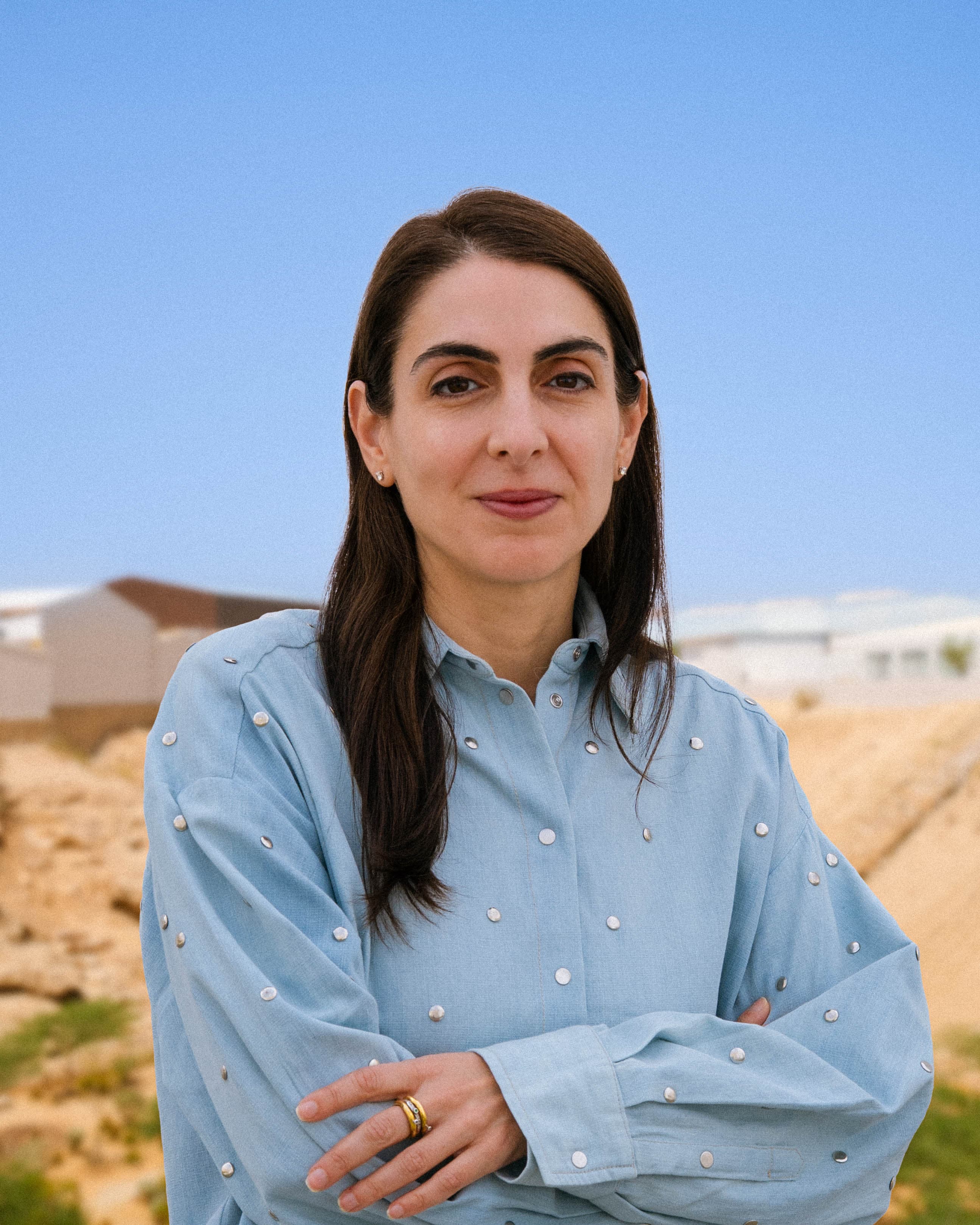
Nora Razian. Courtesy the Diriyah Biennale Foundation.
Word count: 2178
Paragraphs: 25
On January 30, 2026, the third edition of the Diriyah Contemporary Art Biennale opened in Riyadh, Saudi Arabia’s capital. In Interludes and Transitions, the theme chosen by the Artistic Directors Nora Razian and Sabih Ahmed, considers the world as a multitude of processions, taking as its point of departure the movements, migrations, and transformations that have long connected the Arab region with the world. Processions here extend beyond the purely physical or migratory, encompassing verbal, environmental, and metaphysical forms that operate as modes of cultural production.
Rather than proposing Saudi Arabia itself as a site “in transition,” which it undeniably is, the Biennale foregrounds movement as a historical and ongoing condition of the region, with the circulation of people, stories, sounds, and materials acting as vessels of transmission. Translation, too, emerges as a form of migration, represented as a way in which narratives travel and accrue meaning across time. It is from this reframing of the present moment, and from multiple vantage points rather than a single narrative of transformation, that I spoke with Nora Razian about the Biennale, as the theme of procession was approached through its literal, musical, poetic, and political registers.

In Interludes and Transitions, Diriyah Contemporary Art Biennale, 2026. Mohammed Alhamdan (7amdan), Folding the Tents (2026). Courtesy of the Diriyah Biennale Foundation. Photo: Alessandro Brasile.
Natalia Gierowska (Rail): This edition of the Diriyah Contemporary Art Biennale is titled In Interludes and Transitions. What drew you to this theme at this moment, and how did it shape the way you selected and worked with the artists in the exhibition?
Nora Razian: We have conceived the Biennale as a series of processions passing through Diriyah and the JAX district; processions of stories, of songs, of characters from the past, of commodities, of trees, rocks, elements and species. The procession as a theme came about from our reflecting on the role of movement in producing cultural forms in this region, drawing on the history of early Arabic poetry. Processions can be joyful, and they can be commemorative and mournful, they are a community made visible in ritual and in movement.
The title In Interludes and Transitions for us evokes cycles of movement and pause, and a transformation through relation. The first title for the Biennale was of course in Arabic (we opted for two distinct but related titles, rather than translating one language to the other)—and this is ‘fil hil wal terhal’, a phrase that is used to profess solidarity in times of change and upheaval, but also describes a central tenant of life in a region with nomadic and Bedouin cultural roots. In the English title, we also intimate at registers of performance and musicality as these were forms and histories we were keen to explore.
This notion of solidarity and connection through transitions was the foundation for approaching the Biennale artists—and this theme is a reflection of the times we are living through in this region, a time of genocide in Gaza, of loss and occupation but also a time of ongoing social and economic transformations that have positively marked a generation in Saudi.

In Interludes and Transitions, Diriyah Contemporary Art Biennale, 2026. Mohammed Alhamdan (7amdan), Folding the Tents (2026). Courtesy of the Diriyah Biennale Foundation. Photo: Alessandro Brasile.
For the opening weekend of the Biennale, we commissioned artist and producer 7amdan to think about the contemporary procession—and the evolution of its role and symbolism in Saudi society. He developed a procession with performance and music that was also celebrating popular local cultural symbols related to this form. The procession took place on the opening night, and invited the public to participate and celebrate the arrival of the Biennale together. It is in dialogue with several such artistic practices, which are at the intersection of art, music, theatre and architecture that the exhibition takes shape.
Rail: You explicitly describe this Biennale as a “thinking from” rather than “thinking about” the region. What responsibilities, and what freedoms, does that position create for you as curators working in Diriyah?
Razian: We were very aware of the fact that we are working in a region that is—and has always been—heavily represented especially via endless news cycles. At the same time, with biennales there is generally a desire to bring the ‘world’ to a specific place—to showcase a globalised art world to a localised audience.
Rather, with both of us being rooted here for many years, our interest was in thinking how the world looks and feels from where we stand, to look at lines of relation and vectors of movement that can be traced outwards from here. We are also interested in interrogating the frames through which we read the world, and especially as we have now passed the first quarter of the twenty-first century. While the political order of the twentieth century still bears its weight on the present, there is no doubt we are living through a global shift, and there is a clear need to think of new terminology and new lexicons to describe our present moment.
In working with the curatorial team and developing many of the ideas that informed our approach—we came to realise we were not interested in situating conversations in relation to, or in opposition to, dominant cultural narratives or dominant cultural centres; and this in itself was quite freeing.

In Interludes and Transitions, Diriyah Contemporary Art Biennale 2026. Installation view, Trương Công Tùng, The State of Absence… Voices from Outside (2020–ongoing). Courtesy of the Diriyah Biennale Foundation. Photo: Alessandro Brasile.
Rail: You frame procession not only as a metaphor but as a method of thinking history and belonging. In a region marked by forced movement and contested returns, how does procession allow you to speak about migration without aestheticising displacement? Further, not all movement is equally visible or equally, studied and/or mourned—how did you decide on which migrations to show?
Razian: The world has always been on the move, though never more than it is today. This region has always been a nexus of trade, and pilgrimage, though never more than it is today—hosting some of the biggest and highest volume trading ports. And while global geopolitics have always rippled through here, perhaps this is now more keenly felt, seen and heard. It is also one of the regions which feels, and will continue to feel, the effects of climate change more acutely. In thinking through the procession, we want to think through the ways worlds are co-produced, of the worlds carried within all these movements, of worlds in constant co-relation; a world of disjointed choreographies. Many of the artists in the Biennale are working in contexts that have seen immense upheaval, whether currently or in the recent past, and their work proposes not a reflection on the past, but a working with it and through it. There is resilience and there is an insistence on presence in many of the works.

In Interludes and Transitions, Diriyah Contemporary Art Biennale 2026. Installation view, Théo Mercier, House of Eternity (2026). Courtesy of the Diriyah Biennale Foundation. Photo: Alessandro Brasile.
Rail: This edition builds on earlier Biennales, including Ute Meta Bauer’s After Rain. Did you consider your project as a continuation, rupture or transformation of those earlier curatorial grammars?
Razian: This is the third edition of the Diriyah Contemporary Art Biennale with previous editions curated by Phillip Tinari (Feeling the Stones, 2022) and Ute Meta Bauer (After Rain, 2024). It’s a relatively young biennale platform but has already had a substantial impact on how audiences experience and learn about contemporary art in Saudi in particular (the Diriyah Biennale Foundation also produces the Islamic Arts Biennale which has had two editions thus far 2023, 2025). Both Phillip and Ute’s Biennales were testing grounds in building connections with audiences—the Diriyah Contemporary Art Biennale was and still is the largest platform for contemporary art and is free to access, and the majority of visitors are mostly local to Saudi. We learned a lot from their experiences and their curatorial vision—while at the same time crafting a biennale that is quite distinct. What’s interesting is that the venues for each edition are always the same, so you necessarily recall and index past editions while curating and designing your own.
The large warehouse spaces of the Diriyah Biennale Foundation enable a kind of blank-slate approach to spatial design and scenography, which prompted us to really think about how the design of the exhibition would connect to the curatorial thematic. We worked with design studio Formafantasma, who really understood our vision to create spaces that felt light, enabling artworks and ideas to be in conversation, yet not give away everything as you walk through the spaces. We wanted a sense of choreography as well, and we feel like the scenography and design elements really amplified that. Colour was also important to us—as a frame that brought works into dialogue as well as a signal of shifting choreographies, and from the get-go we wanted to have a colourful Biennale, no white walls or floors!

In Interludes and Transitions, Diriyah Contemporary Art Biennale 2026. Installation view, left; Guadalupe Maravilla, Disease Thrower: Purring Monster with a Mirror on Its Back (2022), La alegría del fuego (The Joy of Fire) (2023), Popusa (Retablo twin) (2023), El Boquerón (Retablo) (2023), Una vez me salvó la vida un pez (Retablo) [Once a fish saved my life (Retablo)] (2024), right; Shadia Alem, Transformation – Jinniyat Lar (1996/2026). Courtesy of the Diriyah Biennale Foundation. Photo: Alessandro Brasile.
Rail: You describe sound not simply as medium but as a curatorial method. How does listening, rather than seeing, reorient power relations between artworks, audiences, and (social) histories?
Razian: Storytelling and transmission were important anchors for us at the outset of thinking around the Biennale. We were interested in how stories and cultural forms get carried and transmitted through time, from body to body, and how folktales, music, poetry and literature were, and still are, important modes of storytelling and repositories of cultural memory—especially in times of erasure. This produced an interest in the oral and aural, and the exploration of sonically connected geographies. Some works in the Biennale engage directly with these themes, such as composer and sound artist Nancy Mounir’s Solh (reconciliation in Arabic); a musical composition that draws on archival recordings that pre-date the standardisation of Arabic music into quarter tones, as well as field recordings and Nancy’s own score recorded in an old church in Cairo. Nancy is interested in the history of microtones and the wide range of tonality that existed in Arabic music before it was “modernised” during the first Cairo Congress on Arab Music in 1932—which adopted a western notation system as a regional standard, and excluded what was perceived as traditional or unmodern sounds. Pio Abad’s Vanwa recreates, in mud-brick, an excerpt from a traditional Ivatan poem that is sung in both celebration and in sorrow, during moments of transition.

Nancy Mounir, Solћ (2023–2026). Courtesy of the Diriyah Biennale Foundation. Photo: Alessandro Brasile.

Nancy Mounir, Solћ (2023–2026). Courtesy of the Diriyah Biennale Foundation. Photo: Alessandro Brasile.
Rail: Hall B3 foregrounds sensing technologies, data, and AI alongside ancestral and cosmological knowledge systems. What did you want the audience to feel between these modes of orientation?
Razian: In the hall titled “A Collective Observation” we look at the tools and knowledge systems we use to orient ourselves in the world. Karan Shrestha looks at cosmologies around water in the Kathmandu Valley, Ruba Al Sweel looks at the ghost in the machine and our relationship to technology, Rohini Devasher investigates the different methods and modes of interpreting the cosmos through time, looking at the sky from the bows of a container ship, Abdullah Al Saadi maps his daily walks on stone, and Mochu looks at the rendered self and the act of “looking in the mirror” in the context of big data and AI. As Donna Haraway wrote, “It matters what stories tell stories; it matters what stories make worlds, what worlds make stories” and we wanted audiences to think about the story of technology that is being written.

In Interludes and Transitions, Diriyah Contemporary Art Biennale 2026. Installation view, Dineo Seshee Bopape (Raisibe), Matrices: thelletjang: Sedibeng, it comes w the rain (2026). Courtesy of the Diriyah Biennale Foundation. Photo: Alessandro Brasile.
Rail: Borders are usually imagined as lines or checkpoints. Your emphasis on sound and resonance suggests other forms of bordering, be it through language, accent, noise, or silence. How might the Biennale encourage us to think of borders as sensory and affective technologies?
Razian: We prefer to think of resonance shaping affinities and connection rather than thinking through the logic of bordering. Many of the artists in the Biennale developed their practice form a place of movement and itineracy (chosen or forced), challenging the logic of bordering be it geopolitical, ideological or whether it be borders between species and beings. Pacita Abad and Samia Halaby both thought about their work via movement, with Samia explicitly articulating this aspect of her thinking about the word ‘while we are moving’. Kamala Ibrahim Ishag paints the deep connection between trees, plants and people. Her paintings Lady Grown in a Tree (2017), People and Tree Face (2016) speak directly to her relationship to the world around her, while her painting Procession (Zaar) (2015), depicts a Zaar ritual where the lines between the physical and spiritual are blurred. Daniel Otero Torres sculptural works in “Echoes of Earth”—a commissioned work celebrating martyred environmental defenders—fuse together human and animal forms.
Rail: If the Biennale is a procession rather than a destination, what do you hope continues to move after it ends… in audiences, whether regional or international, or in your own curatorial practice?
Razian: We hope that audiences come to see themselves as part of processions that are shaping the world, and in that sense be attuned to their relation to the world and their agency within that. Biennales, were for me, foundational for my curatorial practice and the hope is that this biennale also leaves a mark. Working on this edition has been a collaborative process from the very beginning, a collaborative and co-thinking process with Sabih and later on with the curatorial team—Maan Abu Taleb, May Makki, Kabelo Malatsie, Lantian Xie and the assistant curators Mona AlJadir, TshegofatsoMabaso, Elena Bongiorno and Reem Marji—and the conversations and ideas we shared will stay with me for some time yet.
Natalia Gierowska is a political scientist and art critic whose research has been featured in various academic journals, including Springer. Her areas of expertise include the politics of the Middle East, public policy, and refugee law. At Brooklyn Rail, Natalia is an Editor-at-Large and predominantly reviews exhibitions outside the United States. Together with her cousin, Łukasz Dybalski, she jointly leads the Stefan Gierowski Foundation, dedicating efforts to advance its cultural and educational missions.