Noé Soulier’s The Waves
Candice Thompson reads Noé Soulier’s intricate choreography against the Virginia Woolf novel that inspired it.
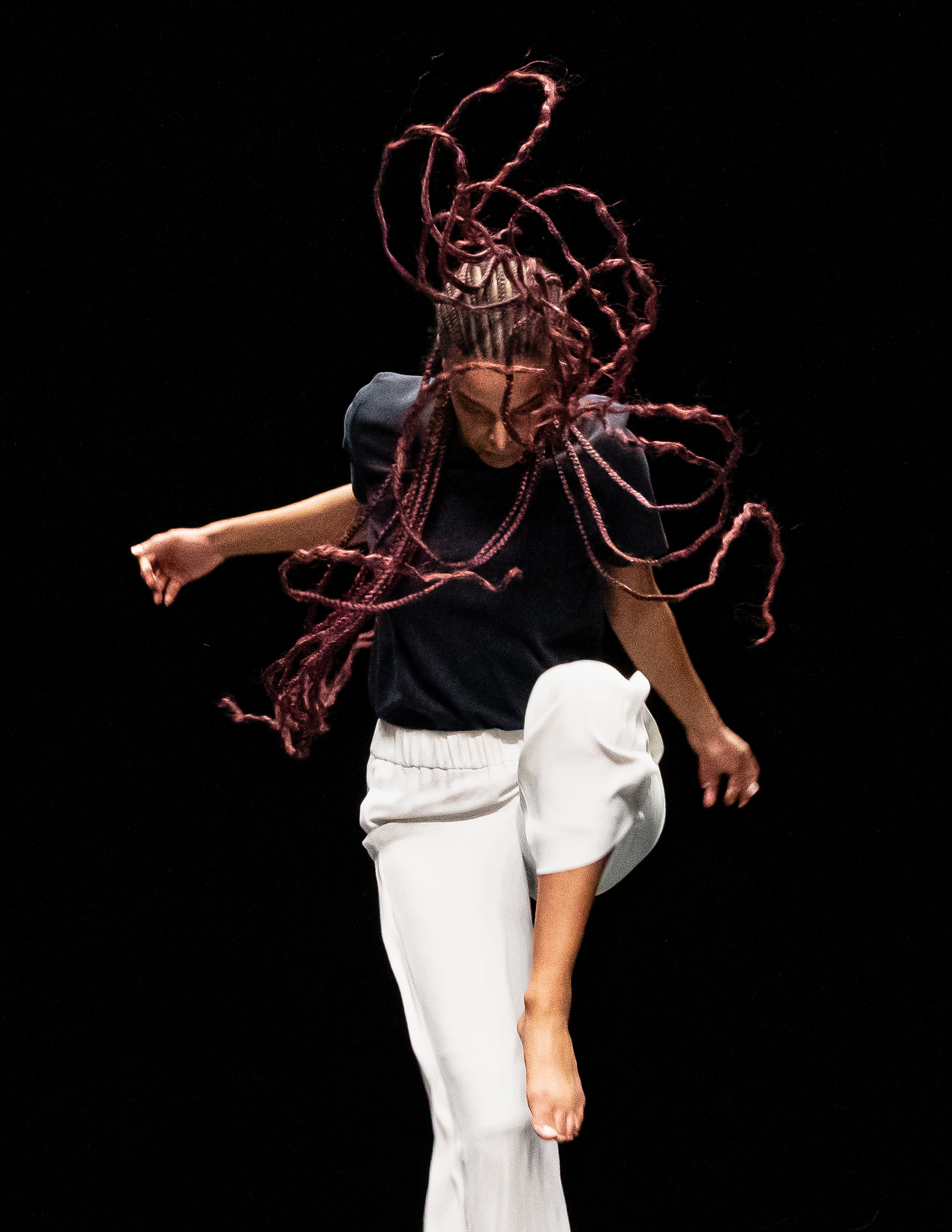
Meleat Fredriksson in Noé Soulier’s The Waves, The Joyce Theater, 2026. Photo: Steven Pisano.
Word count: 1113
Paragraphs: 15
The Waves
The Joyce Theater
March 4–5, 2026
New York
A rattling noise shakes the dark stage of the Joyce Theater. Lights rise to reveal two musicians with an arsenal of percussion instruments. Six dancers jump, hinge to the ground, and push themselves up. An ominous undertone in the score scatters them in a cascade of questioning movements; with bodies almost touching, they skip over one another, heads rolling skyward, looking about themselves, at their hands, for some kind of answer.
In this opening section of Noé Soulier’s evening-length dance The Waves, the dancers inhabit individual worlds that briefly cohere into rushing moments of unison, only to easily dissolve back into solos, not so unlike the tide that animates and inspires the Virginia Woolf novel of the same name. Presented in the Dance Reflections by Van Cleef & Arpels Festival, The Waves was part of a slate of twenty international productions across nine venues that enlivened the bleak days of a lingering New York City winter. Soulier, a French choreographer who directs the choreographic program at CNDC — Angers and has made works for Nederlands Dans Theater and the Trisha Brown Dance Company among other notable companies, created the work in 2018 in conjunction with the original cast. Rather than evoke the idiosyncratic characters and friendships that bend time in Woolf’s experimental novel, Soulier’s The Waves plays with an abstract, physicalized memory seemingly inspired by Woolf’s embodied command and poetic use of language.
Invisible patterns trace across the floor as dancers roll in and out, walk in circles, stack and melt their bodies together, land their jumps in wide crashes, or snap their arms to draw the body into itself. Chimes, whispering brushes, and other playful sound effects from percussionists Tom De Cock and Gerrit Nulens encourage them.

Stephanie Amurao and Nans Pierson in Noé Soulier’s The Waves, The Joyce Theater, 2026. Photo: Steven Pisano.
Time is not simply linear in the novel, but like a wheel, it progresses even as it retreads old ground. The book braids two strands: a day is charted from the natural and sensorial experience of sunrise to sunset and in alternating chapters, six lives extend from nursery school to old age. In the final section of the novel, the narrative structure whittles from six voices down to one. That last perspective, the musings of the now older poet Bernard, recounts clarifying vignettes from his life and the lives of his group of friends. But to begin, again, from the beginning, he says:
I must tell you a story—and there are so many, and so many—stories of childhood, stories of school, love, marriage, death, and so on; and none of them are true. Yet like children we tell each other stories, and to decorate them we make up these ridiculous, flamboyant, beautiful phrases.
Rather than placed near the end, this quote anchors the first half of the dance and Soulier decorates the monologue with flamboyant, beautiful gestures. The disclaimer then leads into a duet of interlocking limbs.
Stephanie Amurao and Nans Pierson roll on the ground, their legs snaked together and hands gripping onto feet. They rock into uneasy repose, with Pierson pulling Amurao’s foot tight to his chest while Amurao extends her own leg, threaded like a needle through his, toward the sky. There is a sense of comfort and suffocation, commitment and frustration, in their grappling through shoulder stands and various pretzel shapes. Are they meant to be the outsiders-turned-lovers, Rhoda and Louis? Is this a fantasy of Neville trying to hold onto his beloved Percival? Or is this all of us, clinging to the vestiges of our youth or trying to hold the present moment captive? It is clear in this partnering that one need not have read the novel to enjoy or understand the competing emotions that form the foundation of this precarious architecture.
In fact, the wonderings of such connections to the story may, in fact, take away from the enjoyment of this seemingly pure movement. Amurao’s knees only need bend to drag Pierson in closer and raise his foot to her ear. A whistling sound issues from the percussionists. Then the calls of small birds. She walks out of this close orbit. Pierson is left alone onstage.
His feet rotate to the V of first position. A sticky sound emanates from the musicians as he pulls his shirt forward, manipulates his elbows, pinches his cheeks. The contortions conjure both the angsty teenage bodily evaluation (it is easy for the reader to remember Jinny apprising her pleasing image in the mirror) and the more resigned consciousness of aging (as the gouty Bernard muses on the heaviness of his older body).
Later, another dancer recreates a well-worn memory, shared in the book from nearly every perspective: a sponge bath given to the dirt-covered children at their nursery school. With words and gestures that snap, clap, multiply, and point beyond the body, Mrs. Constable’s lemon-colored sponge once again runs brown with grit; the child shivers; water drips down the spine; and a hot towel offers comfort.
These few strong links to the visceral text dissipate as the performance continues. The perspectives that overlap with each retelling of an anecdote in the book are less legible in the simultaneity of six separate dance scores, though they share the same movement vocabulary. The textual repetition that helps to form the vivid personalities of the characters, like invertebrates slowly building distinct shells, becomes flattened and reduced in the dance as it detaches from story. While the cerebral choreography includes sections of pleasing convergence and accumulation, it lacks Woolf’s pointed direction and the emotional momentum that kept me engaged with the novel.
More dancers congregate in a driving rhythm that initiates big kicks and leaps. Hips pop to the side, hands flick in the air, and imaginary balls are thrown from arms stretched overhead, eyes looking to the horizon. When the musicians take a break, the dancers’ breathing and stomping fills the silence. When they return, there is skipping, skidding, and tumbling as two women echo each other’s movements. Something subconscious, that we can sense but not identify, sets everything into this perpetual motion. As a low red light conjures a setting sun, a frenzied phrase reprises images and sounds from the earlier duet. But after another couple solos and a trio, the energy ebbs just as the six reform as a group. A sense of dispersal, at odds with Bernard’s melodramatic railing at death that closes the book, persists as the lights descend.
Even with the handstands and kicks and forceful throws, we are left unmoored, at low tide with an obscure ending in media res—waiting for a wave to crash that never does.