Kinesthetic Conversations
Martha Graham biographer Neil Baldwin celebrates the company’s centennial with reflections from dancers past and present.
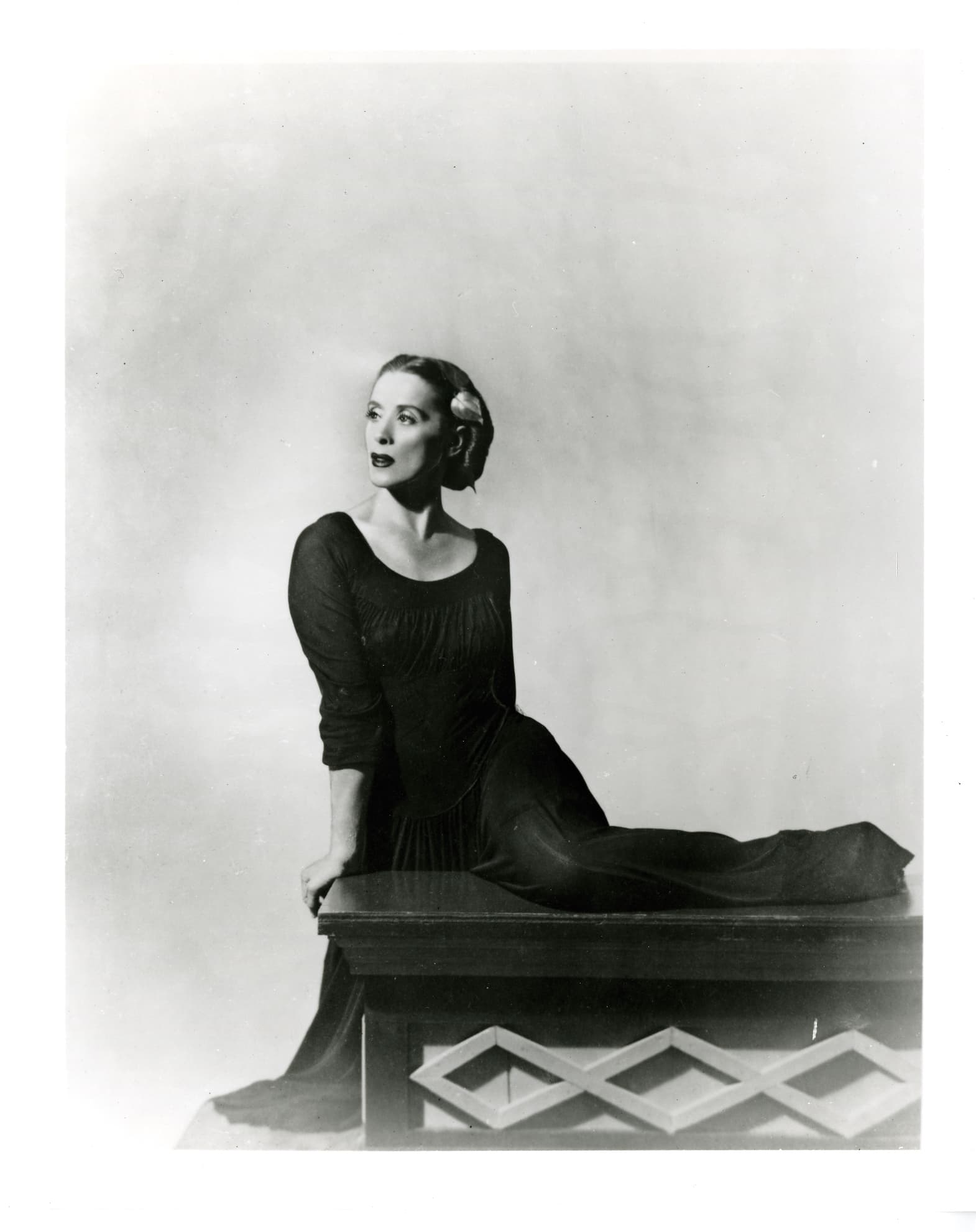
Portrait of Martha Graham. Photo: Arnold Eagle.
Word count: 1707
Paragraphs: 23
Entering the vast Martha Graham Company studio space quietly, I slide into my customary seat on a church pew beneath arching windows, Manhattan vistas glistening in full array. I am so much more comfortable in this cavernous Westbeth sanctuary than in the formality of the concert hall. The dancers, warming up, stretch, torque, and twist, each in their own way. Inward gazes alternate with breath-pauses. Even after more than fifteen years’ observing and writing about the Graham corpus, I remain enthralled.
Martha Graham (1894–1991) was born in Allegheny, Pennsylvania, outside Pittsburgh, and raised in Santa Barbara, California. Trained in ballet fundamentals, expressionist and folk dance, and music visualization at Ruth St. Denis and Ted Shawn’s School of Dancing and Related Arts in Los Angeles, she spent peripatetic years crisscrossing the US on the vaudeville circuit. An inaugural modern dance teacher at the Eastman School of Dance and Dramatic Action in Rochester, New York, she then put down roots in New York City’s Greenwich Village, where she founded her own school. Her all-female company gave their first performance on April 18, 1926. The first man to join Graham’s ensemble a little over a decade later, Erick Hawkins, became her tumultuous partner, onstage and off.
“[Martha] Graham’s work builds on a pulse through the body,” wrote one of her stars of the 1930s, Martha Hill, “a tension and release which is her dramatization of the breath impulse.”1 Graham’s movement vocabulary, nurtured in the body’s visceral core, stresses groundedness, angular counterbalances, quickening transitions, and primal leaps in extremis. “Contraction and release” is the lifeforce of Graham’s vast oeuvre, from intimate solos to epic ensembles.
To begin this essay on the one hundredth anniversary of the Martha Graham Dance Company, I sat down for a talk with Janet Eilber, artistic director since 2005, in a modest second floor office hemmed in by props, costumes, folding chairs, bankers’ boxes, and filing cabinets at the Westbeth Apartments on Bethune Street that she shares, shoulder to shoulder, with President and Executive Director LaRue Allen. I asked Eilber if, at this commemorative moment in her lifetime dedicated to perpetuating the Graham gospel, there was anything she wanted to emphasize about the company’s mission under her leadership.

Lloyd Knight and Anne Souder in Martha Graham’s Night Journey. Photo: Luis Luque.
After an introspective pause, Eilber dove in: “Martha Graham’s legacy lives in our dancers’ bodies committed to a kinesthetic conversation with our audiences.” She elaborated, “My curatorial responsibility is to look at a performance as the audience sees it, inviting them to take in, through their very pores, the force and power of Martha Graham’s exacting, sacred art.” To enrich this “conversation” from the dancers’ side, Eilber continued, they follow Graham’s imperative “to reveal themselves, naturalistically and with profound understanding.”
As choreographer and teacher, Martha Graham’s earliest gift to her dancers and students, beginning in the 1920s, remains more evocative than proscriptive, calling upon them to draw forth intimate inner truths through movement. I would encounter this legacy theme often in my interviews with today’s dance artists: the inheritance of Graham’s foundational technique dependent upon their joining, “body to body,” as Eilber put it, with generations of predecessors—“more than four hundred dancers”—over the span of a century.
When our dialogue was concluded, I took the elevator to the eleventh floor studio to sit in on a rehearsal of Graham’s Night Journey, to be performed on April 10 and 12, during the season at New York City Center. This 1947 masterwork diverts Sophocles’s tragedy away from King Oedipus and into the mind and soul of Jocasta, his tormented mother and wife.
Now I’m in intimate proximity to the action, noticing the dancers’ poised anticipation in the wings, barefoot stomping, inhalations and expulsions, eye-contact, leap-trajectories, and damp sweatshirts and leggings tossed aside. Run-throughs, called-out notes, and adjustments—the whole frenetic drama is on display a scant few feet away from me, the silent spectator, pencil in hand, notebook balanced upon knee.
This afternoon, Rehearsal Director and company alumnus Ben Schultz is subtly coaching Lloyd Knight (Oedipus: haughty, chest outward, gaze locked toward the distance), Xin Ying (for the first time in her fifteen years with the company taking on the role of the manic and seductive, bewitched and maternal Jocasta), Ethan Palma (Tiresias: the blind seer, shrouded by a massive cloak, his staff thudding like a dire metronome), Marzia Memoli (Chorus Leader: darting hither and thither, followed by the six “Daughters of the Night”). Composer William Schuman’s shrill strings, pulsating horns, and foreboding woodwinds trail the dancers weaving among sculptor Isamu Noguchi’s antique pedestals and massive “Bed of Memory,” where Oedipus and Jocasta, fated to entangle, enact their mortifying primal ritual.
In my study that evening, recalling Martha Graham’s encyclopedic research habits, I pulled the original The Oedipus Plays from my bookshelf. In the final pages of the playscript, I rediscovered the Messenger’s report to the stunned Chorus of Jocasta’s offstage suicide by hanging. His hallucinatory language burst with action: “She’d broken in through the gates, / dashing past us, frantic, whipped to fury, / ripping her hair out with both hands— / straight to her room she rushed, flinging herself / across the bridal-bed, doors slamming behind her—”
Martha Graham interpreted Sophocles’s lines as choreographic signals, situating Queen Jocasta at center stage, shedding her gown, revealing bare shoulders, collapsing with the fatal rope around her neck, “reliv[ing] her destiny”—rather than relegated to suffering and dying in the wings. Jocasta takes her place in Night Journey like the other empowered women Graham embodied in her long career throughout 181 dances: the Virgin in Primitive Mysteries, the One in Red in Letter to the World, the Empress in Every Soul is a Circus, the Bride in Appalachian Spring, One Who Seeks in Dark Meadow, One Like Medea in Cave of the Heart.

Martha Graham Dance Company in Night Journey. Photo: Luis Luque.
Beyond her stripped-down style outside the ballet box, Martha Graham’s legacy brims with indelible characters, female and male. And so, it was time for me to talk to some of the company dancers responsible for bringing these personalities to life in the here and now.
Twirling through her movements, alone in the studio an hour before the rest of the company is set to arrive—just as Martha Graham loved to do—veteran Xin Ying tells me these “channeling” warmups always bring forth her “addiction” to the Graham repertory: “You cannot do this kind of challenging work anywhere else … the passion for it inspires me endlessly.” Ying feels a long “legacy of responsibility” not only to “what one person [Graham] did, but to every dancer after her.”
Lloyd Knight, in his twenty-first year with the company, invokes Graham’s insistence upon “truth in movement” as his mission to keep that ideal alive. “When I am on stage,” Knight says, “I bring the audience along on my ride through the work as a character in the world… and it’s much more than ‘steps,’” he adds, “Janet always tells us ‘you have to talk to yourself while performing,’ I am who I’ve been cast to portray, and I’m open to taking chances at every moment of the journey.”
In the poetic realm of Anne Souder’s imagination, when she dances in the “legacy company” of Martha Graham, she is “stepping into the unceasing waves of an ocean, stepping into a character bigger than me.” The magically approaching and receding surf “shapes my present, where it is incumbent upon me to uphold our tradition.” Pivoting to the future, Souter envisions herself becoming “a forward echo, another wave” for successive generations.
Coming to understand Martha Graham’s “physicality and drama” galvanized Leslie Andrea Williams as a Juilliard student. After eleven years with the company, she speaks with faith in “the knowledge passed down to me…that the technique forms the emotions.” Williams has come to love the Graham technique for its “strength and speed in the legs, quick travelling across the floor, and expansive shifts of weight.”
Blakeley White-McGuire joined the company in 2002 as a principal dancer. Now she serves as a rehearsal director, inhabiting the legacy—which she calls “the bloodline”—from another perspective, “looking toward the dancers, activating them, instead of being among them.” Coached by her mentor, the late, legendary Linda Hodes, McGuire feels that the teaching wheel has come full circle: “I am in the studio every day with young people who are called to the sense of adventure that comes with being a dancer truly in the world,” McGuire tells me, “armed with the courage to respond to Graham’s rigorous canon.”

Portrait of Martha Graham. Photo: Arnold Eagle.
From her student days at the Graham School in the late 1980s, through many years performing with the company, to the directorship for two decades of its training-ground—Graham 2—Virginie Mécène remains driven by Martha Graham’s “journey of seeking.” The repertory gave Mécène, as a dancer, “the freedom to pursue self-inquiry.” She has deepened that quest as a choreographer with a tactile sense of history, “re-imagining and staging ‘lost’ Graham solos,” from the 1920s and ’30s, including Revolt, Immigrant, Desir, and Ekstasis.
This spring, the Martha Graham School likewise celebrates its first century. Ashley Brown, the director, brings her synthesis of dance, science, and technology training to develop the School’s “motion modeling improvement project” thanks to a major grant from Schmidt Sciences. Predicated upon Graham dancers’ contemporary bodies, layering archival images and footage into what Brown calls a “lineage map,” the ambitious goal is to capture and preserve for posterity a nuanced, multidimensional digital record of the classic Graham technique. “Accompanying her genius as a dance artist, Martha Graham was a devoted teacher. Our school is committed to her pedagogical legacy, today and always,” Brown declares.
So much more remains to be written and said about this great “institution of people.”
I will step aside and give Martha Graham, herself, the last words, in response to Janet Eilber’s “kinesthetic conversation.”
“By communication [it] is not meant to tell a story or to project an idea,” Graham wrote in her essay, The Modern Dance (1938),2 “but to communicate experience by means of action. This is the reason for the appearance of modern dance. The departure of the dance from the classical and romantic delineations was not an end in itself, but a means to an end…The reality of the dance is its truth to our inner life.”
- “Exponent of Modern Dance Comes to College to Give Recital,” Bennington (Vermont) Banner, March 9, 1933.
- “The Modern Dance,” Dancing Times, December, 1938: 270–72.
Neil Baldwin is an Editor-at-Large for the Brooklyn Rail.