A Soul-Filling Simulation
(LA)HORDE brings Brooklyn audiences an existential doomscroll at its best.
Word count: 901
Paragraphs: 10
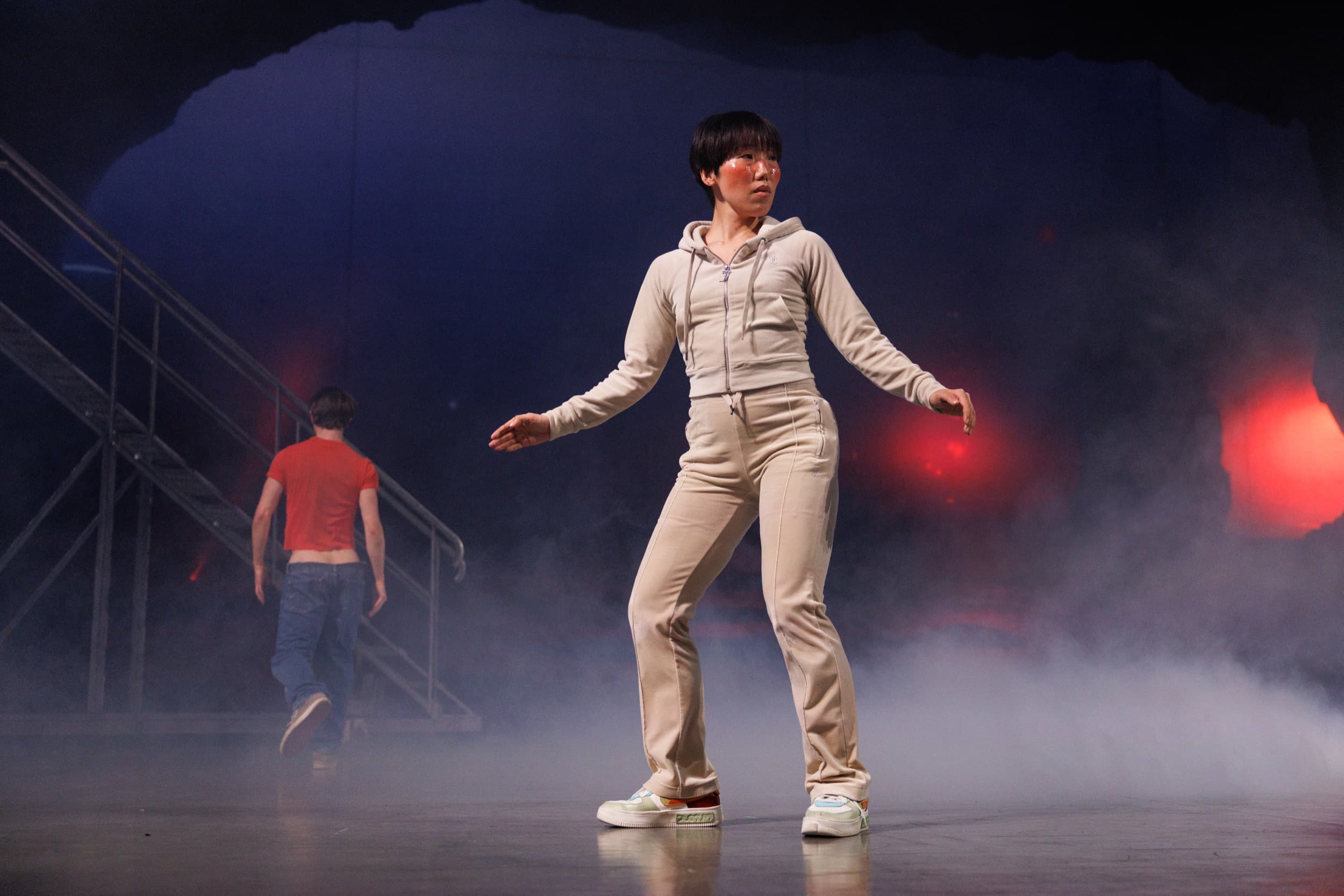
(LA)HORDE’s Age of Content, Brooklyn Academy of Music, 2026. Photo: Maria Baranova.
Age of Content
Brooklyn Academy of Music
February 20–22, 2026
Brooklyn
The blizzard of ’26 had just begun, but BAM’s Howard Gilman Opera House was still packed with a snow-soaked audience excited to see the closing performance of (LA)HORDE’s Age of Content, part of the Dance Reflections by Van Cleef & Arpels Festival that took over the city from February to March.
From the buzz around me, I could tell most of us had a sense of what to expect. (LA)HORDE, the French multidisciplinary collective formed in 2013 by artists Marine Brutti, Jonathan Debrouwer, and Arthur Harel, began directing the Ballet national de Marseille in 2019. When the company was founded in 1972 by Paris Opera Ballet–trained Roland Petit, they debuted the avant-garde Pink Floyd Ballet (the band played live!). Though technically a classical ballet company, it has included contemporary dance in its repertoire since the beginning. When (LA)HORDE inherited the company, it gained an even greater reputation for edgy, multidisciplinary works. So, we knew the next seventy-five minutes would be bold, provocative, visually striking, and examine internet culture. But how? I, for one, could not have guessed what was to come.
The piece begins with a dimly lit empty stage and the sound of rain. Julien Peissel’s set design has an industrial warehouse feel: a metal platform and stairs at the left, a stack of boxes beneath it. A dancer in a red T-shirt steps onto the platform and watches as a full-size car frame drives out from the back of the stage, headlights blazing, surrounded in a theatrical fog. The man seems to be controlling it, elbows bent on the railing and fingers tapping as the car moves forward, backward, turns. Then the side of the stage drops open with a boom and a woman runs out. She is wearing a light green fitted jumpsuit, hood up, a stocking over her face with the empty legs dangling down at the sides like pigtails. She mounts the car and poses seductively. A dog barks in the distance, someone breathes heavily. She lays upside down on the hood and spreads her legs. The car bumps its hydraulics and tosses her off. She lifts her fists and the fight is on. It tries to ram her, but she leaps on top of it and takes a triumphant stance. They are in, it seems, an unhealthy relationship.
Two more dancers join and the soundscape changes to choral music and thunder. More enter, all in matching green jumpsuits and stocking masks, all ready to fight, and the club beat drops. They punch at the sky and throw each other around like feral feline ninjas.
Then they’re all moving backward, disappearing along with the car behind the tan back curtain. The music follows, growing muffled and distant.
Bang. A tile in the ceiling drops open and something falls out—a cloth mannequin?—causing audible gasps in the audience. A dancer in a white sparkly jumpsuit crawls from behind the boxes—now causing laughter—moving like a robot on the moon. We have clearly swiped to another world: a world that looks a lot like a video game, where characters move with exaggerated precision in a perfect imitation of Sims. The curtain opens to reveal a hot-red backdrop (designed by Frederik Heyman) and another man in a red shirt steps out. The others return in eccentric street clothes (by Salomé Poloudenny) and the combat continues, but different this time. It’s less clean. There are more finger guns, simulated shootings, and laughter (hands held up to faces, heads thrown back, bouncing). Dancers grab each other by the mouths, fingers hooked inside cheeks, and puppet each other around. It’s—purposefully, I believe—hard to watch. Age of Content comments on online culture, after all, and that includes our growing desensitization to violent images.
The next time the piece swipes, it’s to a scene more explicitly sexual. Still cartoonish, still flamboyant, but not veiled. Couples climb atop each other and writhe. They bounce each other like basketballs and hump the floor. It all has a masturbatory tone—consensual but not mutual—everyone using each other for their own purposes. (And isn’t that internet culture in a nutshell?)
The final swipe is to a bright, warmly lit land (Eric Wurtz’s lighting design is superb) where joy, or its artifice, abounds and only smiles are allowed. Some of the previous over-the-top choreography continues, but in this new light, and set to Philip Glass’s hypnotic music, it now looks innocent. Yes, they are still pounding crybabys on the floor and pretending to shoot each other, but they are also executing jazzy spins and slides. They shimmy, they bang-bang-bang, they hump, they pas de bourrée. It goes on and on and on, the plastered grins never fading because it’s all great! It’s all okay! Finally, in a Broadway-ish moment, the dancers all form a line at the back of the stage, run at the audience, jump and scream, and then collapse. And… scene.
After, as the audience around me leapt to a standing ovation, I felt exhausted. Confused. Delighted. Still processing. I felt a lot like how I feel after a solid session of doomscrolling. But to have this sensation simulated in a live 3-D performance by a group of incredibly talented and diverse dancers, in a roomful of art-loving people, was the opposite of soul-sucking. It was hopeful.
For other perspectives on Age of Content, see Gerardo Bandera’s article also in the Dance section, and Stephen Zimmerer’s article in the Architecture section.
Caedra Scott-Flaherty is a writer based in New York. She is also a former dancer and choreographer and loves all things terpsichorean.