Robert Gober: Plein Air
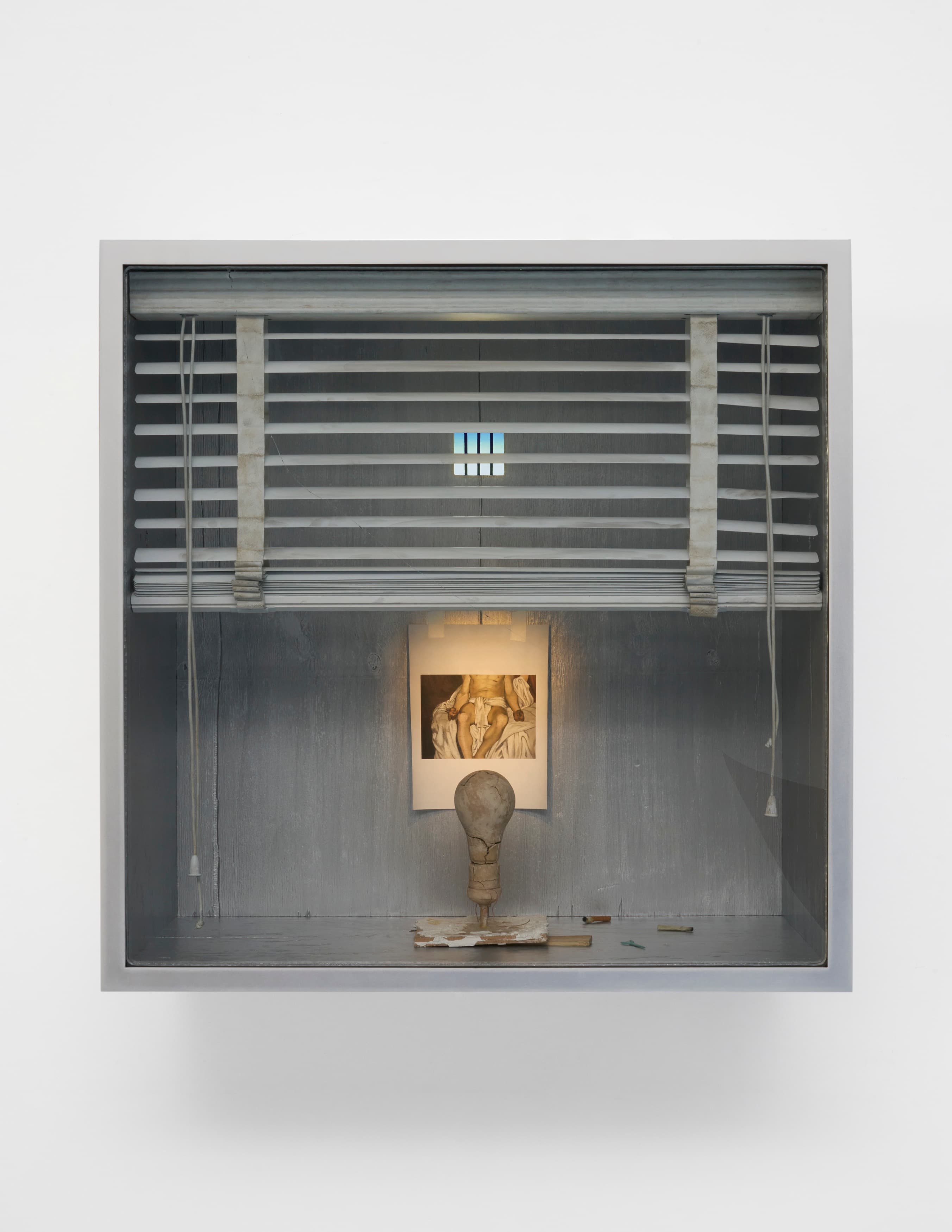
Robert Gober, Untitled, 1990–2025. Aluminum, wood, clay, plaster, copper, epoxy putty, handmade paper, pewter, brass, glass, acrylic and oil paint, pastel, LED lights, and string. 38 × 38 × 23 ⅜ inches. © Robert Gober. Courtesy Matthew Marks Gallery.
Word count: 887
Paragraphs: 8
Matthew Marks Gallery
February 12–April 18, 2026
New York
It’s often said that art is an invitation, but there are different sorts. Some warn that there will be a bouncer at the door, so it’s good to have a connection on the inside, someone in the know. Some come with a dress code. Others insist that anyone is welcome and there is something for everyone. But Robert Gober’s work has always arrived with a very particular invitation, it seems to me, a bit like Franz Kafka’s message to his hapless hero Josef K in The Trial: “This court wants nothing from you. It accepts you when you come, and it dismisses you when you go.” What you make of it all is largely up to you.
Yet like Josef K, we encounter repetitive motifs, signs, and symbolic allusions that can provoke a frenzy of interpretation: shoes interrupted by walls; small cut-out windows, barred like a prison cell and backlit; patterned wallpaper. I’ve always preferred the most prosaic and obvious of Gober’s constructions, for example a closet he constructed for his retrospective at the Museum of Modern Art or a partial doorway at the Prada Foundation. Probably because we are about the same age, from somewhat similar white and middle-class backgrounds, such gestures are profoundly evocative. The closet seemed lifted from a house of a certain vintage, in need of refinishing, the way closets can be because they are neglected. It made me nervous to be in such houses when I was young. They weren’t up to snuff. Then my family moved into one, and my father set about expunging the signs of economic vulnerability implicit in peeling paint and a sagging porch.

Installation view: Robert Gober: Plein Air, Matthew Marks Gallery, New York, 2026. © Robert Gober. Courtesy the artist and Matthew Marks Gallery.
For me, Gober’s art works best when the associations it provokes are intimate and uncomfortable but not obviously so. The closet, for example, was empty. This serves as a counterweight to what sometimes seems to me a facile surrealism, or, on the other hand, a hermetic self-reference. The current exhibition promises both. It consists of five wall-mounted boxes, fronted with glass and containing carefully arranged objects. In addition, there is a single floor sculpture of a child’s crib, sides folded in on themselves to form a crisscross. The very fact of containers—square—into which we must peer as if onto dramatic scenes, betrays immediately a voyeuristic world of psychological projection and traumatic encounter, no less than with Joseph Cornell’s boxes or Luis Camnitzer’s political installations. The preciousness of containment can be a little off-putting and also strangely sinister
But something more important is going on. The more time you spend in front of these boxes, the more obvious it becomes that everything is fabricated, down to the most minute detail. That was true of Gober’s previous exhibition at Matthew Marks, “Shut up.” “No, You Shut Up.” But that exhibition focused on more accessible imagery—mostly constructed windows—that made it easier to ignore the details. Not this time. Cigarette butts, rolls of tape, patterned wallpaper, light bulbs, shoes, even venetian blinds (upside down)—none are “natural” or appropriated as pre-existing objects. A studio team built them, just as they painted the several versions of famous paintings that show up in miniature, including Edouard Manet’s The Dead Christ with Angels, and just as they reproduced by hand a photograph of a young Franklin Delano Roosevelt. Copies of copies. Everything once or twice removed from its origin or model. And all contained in hermetic compartments. Made of aluminum, the boxes are not simply closed but sealed, and what they contain seems not just stage-managed but frozen and airless, a series of vacuums. “Plein air” indeed! The sense of atmospheric stasis affects even the light inside the boxes. In two cases backlit barred windows seem to suggest a time of day, an “outside” behind and beyond the box. But there is no outside, no time of day, no natural, changeable source to any light. Peering into another box reveals two miniature side doors with light leaking in around them. But, again, there is no behind, and no one there. Time feels not just suspended but cancelled.

Robert Gober, Untitled, 2022–26. Aluminum, wood, copper, epoxy putty, brass, cast pewter, glass, acrylic and oil paint, pastel, LED lights. 38 ⅛ × 38 × 23 ⅜ inches. © Robert Gober. Courtesy Matthew Marks Gallery.
These mounted vitrines are like traps, pulling us into and keeping us out of small worlds where nothing is as it seems, worlds arranged according to their own laws with no reference to an outside reality that might qualify their inexplicable oddness. That’s why the one vitrine whose glass front is cracked feels so shocking. The realms have suddenly come into contact via that fissure (also carefully managed by Gober’s team), and time can enter to corrupt what is essentially a mental event. But the converse is also true: the unreality of purely imagined situations can also escape into our world, invading our memories and populating our dreams.
I make no attempt to parse the individual arrangements themselves. What, for example, does an image of the young Roosevelt have to do with an anchor hanging from a chain? Something about Catholic spirituality, gay identity, or vacationing on a boat in Maine? Not being able to follow Gober’s logic of association we are left to imagine our own. That’s not a problem; it’s how the work lives. It is the invitation. After all, some people’s confusion is worth more than other people’s clarity.
Lyle Rexer is the author of many books, including How to Look at Outsider Art (2005), The Edge of Vision: The Rise of Abstraction in Photography (2009) and The Critical Eye: 15 Pictures to Understand Photography (2019). The Book of Crow, his first work of fiction, parts of which first appeared in the Brooklyn Rail, has recently been published by Spuyten Duyvil Press.