Hawai‘i: a kingdom crossing oceans
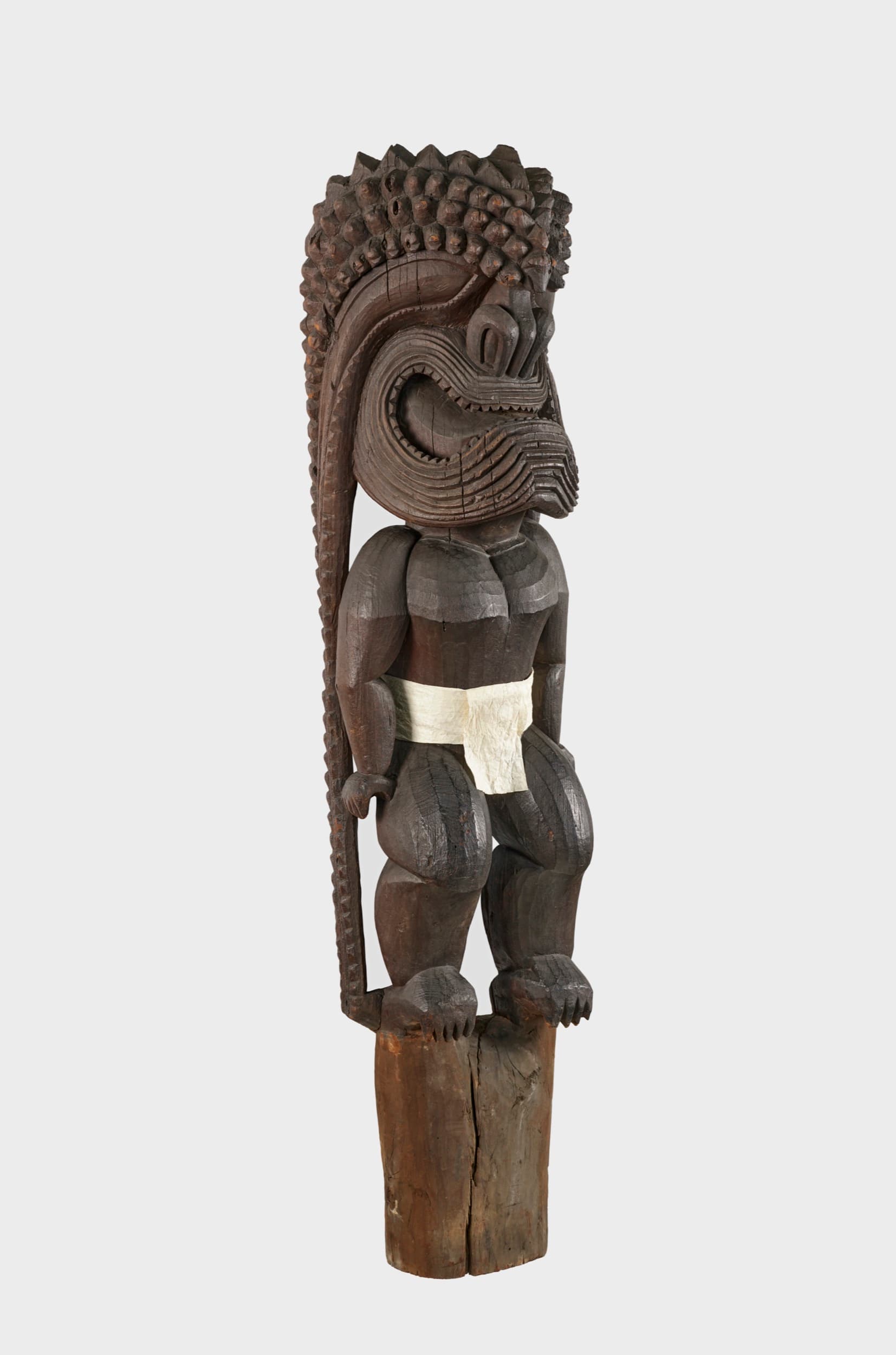
Kiʻi (image) of the god Kū, 1790–1819. Breadfruit tree wood, 102 ¾ × 27 ⅕ × 21 ⅗ inches. © The Trustees of the British Museum.
Word count: 1148
Paragraphs: 8
The British Museum
January 15–May 25, 2026
London
Our impressions of Hawai‘i have often been so overtaken by stereotypes—by the simulacra of tiki culture or The White Lotus, as appealing as they are—that its history and native visual culture are regularly obscured. How many students of American or Pacific region history know that Honolulu boasts the 1882 ‘Iolani Palace, the seat of Hawai‘ian kings and queens? And how many fans of Moana realize that the Bishop Museum houses Maui’s own magical fishhook, the Manaiakalani, as part of its collections? Hawai‘i’s complex relationships with the United States, which supported an 1893 coup and then occupied the nation as a territory before naming it a state in 1959, and Great Britain, which acknowledged Hawai‘i’s status as a sovereign nation (the first Indigenously controlled nation to be so recognized by the major European powers) in 1843 even while calling its archipelago the Sandwich Islands, have complicated perceptions for more than 200 years.
The British Museum cares for a nearly unexampled collection of Hawai‘ian objects, some of which entered the museum not long after its founding in 1753. Many items were likely collected by crewmembers during Captain James Cook’s third Pacific expedition (1776–80; he was killed in Hawai‘i in 1779) and Captain George Vancouver’s 1791–95 voyage, or by nineteenth-century missionaries and given later to the institution. For some, no one knows their stories, rediscovered as they were in the storerooms of the museum without identifying information. Still others were diplomatic gifts from Kamehameha I, the founder of the unified kingdom of Hawai‘i, and his son, Kamehameha II, also known as Liholiho, or their advisers or representatives: presents from kings to kings—George III and IV—who reciprocated in kind. This lack of clarity has made it difficult to display the objects properly, which is an enormous loss, as Hawai‘i boasts one of the world’s great sculptural traditions. The museum’s current exhibition, Hawai‘i: a kingdom crossing oceans, curated by Alice Christophe, permits a glimpse of the astounding visual environment that Hawai‘ians would have occupied at the turn of the nineteenth century.

Installation view: Hawai‘i: a kingdom crossing oceans, The British Museum, London, UK, 2026. © The Trustees of the British Museum. Photo: MKH.
A kingdom crossing oceans begins with a towering wooden image representing Kū, the god of governance and war, standing outside the gallery doors. I visited the show shortly after it opened in January, and Kū was wearing a traditional loincloth—which acknowledges the dry season during which the god predominates—made by the contemporary artisan Verna Takashima (2017) and celebrated with fresh leis and a salt-filled coconut bowl at his feet (at the start of the rainy season, during which Kū yields to the harvest god Lono, Kū’s arms are bound in barkcloth). This massive, about eight-and-a-half-feet tall, depiction of Kū is magnificent, with his slightly bent legs and clenched hands held taut—all potential energy—and the beads of his braided hair and striations of his grimacing mouth reflected in the repeated ripples of the chisel that formed him. This statue’s history is characteristic of the Hawai‘ian objects in the British Museum’s collection: its original location is in question, though scholars think it came from the Island of Hawai‘i (known colloquially as the “Big Island”), and the circumstances of its gifting, which happened during the rule of Liholiho and may have even been initiated by him, are unclear, as it may have been “decommissioned” due to changing religious customs and Christianization of the islands. Such religious upheaval resulted in a Hawai‘ian iconoclasm; there remain only three monumental statues of Kū (the others are held in the Bishop Museum and the Peabody Essex Museum), tumbled together with the kingdom’s political fortunes. Other larger-than-life Hawai‘ian sculptural figures have been found buried, perhaps deliberately or perhaps forgotten.
One of the remarkable things about the Hawai‘ian sculptural tradition is how effortlessly its power transcends scale, easily surviving miniaturization. I first noticed this in a whalebone pendant installed at the Metropolitan Museum in 2019; carved in a posture of leaping, the miniscule figure would have seemed forcibly to propel itself off its wearer’s chest like a superhero. At the British Museum, I felt it in a smaller representation of Kū, half the size of its larger twin yet still intimidating, with muscular thighs as thick as my arms; in mounted cups borne by people baring bone or boar-tusk teeth; and in doubled serving bowls bridged by a figure that clings to them by hands and feet, as though swimming between them. Its white dog-fur hair, dressed with a red feather, streams behind, reinforcing the aquatic impression. Pearl-shell roundels dot its limbs, as if pockmarked or tattooed with eyes. Similar pearl-shell discs reappear later in the show, strung together and circled by feathers in a human-scaled sash of unknown purpose.1 The tiny sculpture’s own intent eyes are made from the same shell and are opened wide, while its delicately modeled lips purse in concentration.

Installation view: Hawai‘i: a kingdom crossing oceans, The British Museum, London, UK, 2026. © The Trustees of the British Museum. Photo: MKH.
A kingdom crossing oceans also affords its visitors the opportunity to view royal featherwork in the form of capes, helmets, leis, and the modeled heads of feathered gods, as well as lengths of barkcloth painted with pigment. The cloths’ abstract designs suggest wave patterns, overlapping leaves, the shade of palm fronds, and furrows; one luminous textile was painted and printed in a patchwork of designs, including repeating, lightning bolt zigzags and black-and-white chevrons that zoom back and forth across their span.
Constructed from thousands or even millions of tropical bird feathers, the plumage objects provide the brightest colors in the show. The feathered god heads frown and leer; I can imagine them being used in war, but I could also believe them as tricksters, depending on the person they honor. Their mouths are lined in rows of dog or shark teeth, and one of them poignantly wears a full head of ancestral hair. This genealogy links them to the feathered capes, gorgeous red, yellow, and black garments woven with circles, diamonds, and triangles, rich with the mana (the life-force) of their possessors. Many of these capes are royal regalia and many of them were gifts, though whether given in hospitality, trade, coercion, or tactically, we cannot know. What is known is that the mana of the owner inhered in the cape and was transferred when gifted; this made these exchanges incredibly potent and moved the importance of the object beyond mere worth. Catalogue essays grapple with the difficulty of honoring the decisions behind the gifts while experiencing the “loss and longing” for the ancestors they manifest; they soberly recognize, too, that objects such as Kū may have survived precisely because they left Hawai‘i. Hawai‘i: a kingdom crossing oceans offers these gifts to us; I hope that the British Museum will continue to honor them and find ways to make these significant objects accessible. But for now, I’ll close with the song of Liliʻuokalani, the last sovereign queen of the kingdom of Hawai‘i: “Until we meet again.”
Amanda Gluibizzi is an art editor at the Rail. An art historian, she is the Co-Director of the New Foundation for Art History and the author of Art and Design in 1960s New York (2021, paperback 2025).