Naples: Black Holes
Word count: 3038
Paragraphs: 24
1. In the Belly
A city, any city, is the sum of its representations. If I say the word Naples, no discussion of its municipal budgets, housing scarcity, and overtourism can displace the folklore, urban legends, lies, scabrous historical half-truths, and fictions that gather in the word. Nor do “Gomorrah” and the camorristi of the Sails housing project, with a contract out on the author Roberto Saviano, who did little more than assemble damning documents about the mob already in the public record, nullify the upscale interiors and up-the-hill views of the bay in Elena Ferrante’s novels. And Anish Kapoor’s spectacular new Monte Sant’Angelo subway station doesn’t assure that trains will be running in both directions when you need them to. At a time when every third Neapolitan word seems to generate a Netflix series, I wanted to visit Naples for the opportunity to sift through the images and stories, see how they lived in the streets around me. And if another excuse, pretext, or omen were needed, it came in the form of yet another set of representations, a small pamphlet of street photographs taken just a year ago by Charles Traub. In The Belly of Naples, there is no belly, instead a place ceaselessly transforming itself through images, those its people makes and those it invites and has always invited others—outsiders, stranieri—to make.
So, I would follow Traub’s example but without a camera. I wasn’t sure whether I had been to Naples. I have a memory, possibly invented, of having set foot in the city briefly on the way somewhere else, decades ago. If I knew Naples at all it was because I knew what it wasn’t, all the Italy I had known through nearly five decades. It was not, for example, the enthusiasm and egotism of first visiting Florence, with a copy of Berenson and a conviction I understood The Renaissance and knew very well why the Ghirlandaios and Fra Angelicos were far superior to the grandiose Tintorettos of Venice, not to mention the mannered, even decadent, Caravaggios. Not Rome, with its Papal politics and imperial grandiosity. There were no volcanoes in Trentino and only memories of poverty, what with the northern province, flush with EU money and decades of special dispensation, now only too happy to separate from the shiftless, corrupt, lazy, superstitious, crime-ridden south. Solo i fessi stanno laggiu, (“only fools stay down there”) captures the attitude. Later on, certainly not Tuscany or Umbria, thick with retired ad execs buying small wineries and ex-money managers turned art patrons running creative retreats. Bertolucci and Tarkovsky locations. As for Neapolitan thinkers, I knew only two, literary critic Benedetto Croce and the heretic philosopher Giordano Bruno, burnt at the stake. Titanic figures, yes, but belonging to the universe, not a city.
Naples as a record of aversion or ignorance, then, a kind of black hole at the center of my Italy. And yet. Experiences pointed the direction. I carried like an old coin in my pocket the memory of walking along the south rampart of the Castello di Brolio in Chianti with the sister-in-law of the Baron Ricasoli. She chose to ignore my transparently fraudulent pose as a wine writer for The New York Times. Looking out over the hills she said, “It’s beautiful here, yes. But down there, it’s mystical.” Years later I was in the Milan studio of the sculptor Pietro Consagra, born in Sicily. I made some reference to the Baroque architecture of Puglia and Lecce in particular. He stopped me. “Overdone and derivative,” he said, “compared to Naples, which is the origin.” Then he explained to me the architecture of darkness in Caravaggio’s paintings, especially the Seven Works of Charity, also in Naples. Eventually it came to the point where I had seen all the places without volcanoes, and almost all the paintings except for that one.
I went to Naples, and Naples took me in.
2. Ladders and Labyrinths
The representations of the city play tricks with time as they accumulate and alter each other. They are like walking the old city without a phone, as the streets seem to cross and recross each other, in defiance of up and down, north and south, even when you can see the water. Like the heat and cool of the day, light and shadow are extreme. The sun cuts the narrow alleys into disorienting patterns. Caravaggio lived in Naples, very much off and on, for less than two years, a temporary visitor like the poet Giacomo Leopardi two centuries later, but both did great work here at the end of their lives. Naples took them in. Caravaggio was on the run from a murder in Rome and hoped to get special permission from the Pope to return. His Seven Works of Charity (1606-7), commissioned by a recently formed group of wealthy and pious do-gooders, captured his sense of the complicated human density of a Naples street, of say Via dei Tribunali, where the painting would eventually be installed, in the church of Pio Monte della Misericordia, and remain. Its tumbling perspective and physically felt emotion on a grand scale was the most ambitions thing the artist had done. No accident, to my eye, that the exile, thinking of home, might have included a woman resembling his Fillide Melandroni, a sex worker in Rome he often used as a model. She matter-of-factly offers her breast to a starving man. The angels that embrace each other above it all might be any of the street kids, scugnizzi, he would have studied and probably sought out. The same street kids, in a later incarnation, would be transformed by films and magazines into legend as heroes and martyrs of the anti-Nazi uprising known as The Four Days.
Almost four centuries after the painting entered the church, it was captured re-entering in another representation that seems to me to recapitulate the painting’s local truth. In 1991 photographer Stefano Renna shot a documentary series of a group of workmen lugging the massive painting, recently restored, down the street and into the church, where they attempt a very precarious rehanging on a couple of spindly step ladders. One photo shows the painting leaning up against an alley wall as its handler idly watches the street. Another shows the thing lying on the floor while the crew figures out what to do next. No security is visible, no cultural custodians from Rome in tight suits. The guys doing the work could be the same people hired by the Camorra to steal it. Walter Benjamin saw Naples as frozen in its past, but he also observed, “Everything joyful is mobile: music, toys, ice cream, circulate in the streets.” To which we add: masterpieces too.
Leopardi wrote his final, and some say his best, poem in Naples, “The Setting of the Moon” (1837), a profoundly bleak work, but he also kept a list of what he ate during his last two years, adding to a different sort of myth about Naples. Probably the most outrageous culinary episode, given notorious currency by novelist Curzio Malaparte, involved the serving up of a rare cephalopod from the Naples Aquarium at a wartime dinner of US military officers and Naples officials when most of the city was on the brink of starvation. My own contribution, mirroring that of numberless visiting majority, would be more enticing. It is a photograph of two pizzas I ordered at Lombardi 1892, an institution of classic reputation on the border between the neighborhoods of Centro Storico and Rione Sanitá.
3. The Impatient Dead
For artists, filmmakers, and writers like Leopardi—or for that matter the many novelists of Italian noir – Naples’ primary figure is not the pizza but the skull, a symbol not merely of death’s presence but the constant communication of the dead, “tongued with fire beyond the language of the living,” in T. S. Eliot’s famous phrase. A cult of skulls, fostered in the city’s ossuaries but especially in Rione Sanitá, obsesses the contemporary poet Marius Kociejowski, whose vast ramble through folkloric Naples, The Serpent Coiled in Naples (2022), gives back to the city the deeply appreciative attention it deserves. His book is filled with stories of the impatient dead and their reciprocal relations with the living, primarily through beliefs surrounding anime pezzentelle, purgatorial souls represented, if not embodied, by their skulls. If you believe in purgatory, it makes perfect sense: the souls waiting in purgatory could use a little propitiation and in return may have some wisdom to impart. Their interventions range from delivering lucky lottery numbers to more excessive intrusions. Kociejowski relates a story he was told about the Irpinia earthquake of 1980, which dislodged a child’s skeleton from the wall of a former convent in Naples. It seems that in earlier times the priests had a propensity for violating the young nuns, and the unwanted offspring were sometimes dispatched and then immured. Murder will out.
Until relatively recently, the Catholic Church tolerated the cult, as in other places it has tolerated beliefs and practices older and often more durable than Christianity. No longer, and in the face of global tourism that packs the narrow streets of the Spanish Quarter even in the off season, what can such stories convey? In front of the church of Santa Maria delle Anime del Purgatorio are three bronze skulls (there used to be four but one was stolen). They are polished to a gleaming smoothness by the touch of passersby. So, too, the nose of the nearby sculpture of Pulcinella, the symbolic trickster of Neapolitan puppet theater. It used to be that the skulls were talismans of luck and remembrance. Now they are woven into the stereotypical experience of Naples—old weird Naples, exotic Naples, reactionary primitive Naples, that one great city in Italy that the Renaissance never touched. I stuck my fingers in the eye sockets of one skull, like a bowling ball. I didn’t ask for a lucky number or for a child for my son and daughter-in-law. And yet, my unspoken wish appears to have been granted.
Death in Naples is not the intolerable interruption of a life that should last—why not?—forever. It is a fait accompli declared at birth, not an opposite but a twin. Plague, cholera, and typhoid ravaged the densely packed city numerous times from the Middle Ages until well into the 20th century. Since the 1700s, Naples has also suffered earthquakes, volcanic eruptions, and, most catastrophic of all, Allied bombing in World War 2. Losses have tallied more than a million souls, and Vesuvius remains active. Herman Melville spent a week in Naples in 1857, long enough to call the Via Toledo “Broadway” in admiration of its vitality, but also to describe the mindset of living under a possible death sentence:
‘Let us eat, drink, and be merry, for tomorrow we die.’ Such seems the lesson learned by the Neapolitan from the scenery – The beauty of the place in connection with its perilousness—Skaters on ice.
Skaters on ice. Gianfranco Rosi, whose documentary on Naples, Below the Clouds, takes place on the other side of Vesuvius, recently spoke about the feeling of a merely possible future, potreb’ essere (“it could be”) that accompanies an underlying climate of anxiety. This sense of the extremes of life would have suited Caravaggio down to the ground and is most likely what he saw all around him. It was somewhat more than a decade prior to his arrival when the most celebrated crime in Naples’ history took place, a crime that united true extremes of sublimity and horror. The prince and composer Carlo Gesualdo (1566-1613), whose chromaticism shocked his contemporaries but would inspire musicians in the 20th century, murdered his wife and her lover in the palace of San Severo. He mutilated the bodies in a particularly suggestive way and left them on display. He was never arrested, charged or prosecuted. The palace is only a few blocks from the chapel housing the Seven Works of Mercy.
4. Thresholds
The longer view sees Naples as a threshold between realms. This is how the poet Virgil saw the region more than 2,000 years ago, for he identified nearby Lake Avernus—sulfurous, mephitic, created by eruptions—as the entrance to the underworld. Probably most volcanoes have also been seen as entrances to the underworld, in which case the geography of Hades is far larger than classical authors thought. Its doorways are scattered all down the Mediterranean to Mount Aetna, in Sicily. Vesuvius was quiet when I was in Naples, but I stopped at the island of Stromboli, on whose volcano Roberto Rossellini perched Ingrid Bergman in the eponymous film. Its flames light up the night like a giant warning beacon. Beach signage cautions that in case of eruptions, tremors, and tsunamis, a claxon will sound warning everyone to move to higher ground (not into the water!). But where is higher ground except up the volcano, closer to its burning core?
What lies beneath your feet is infinitely old and powerful. You have a palpable sense of occupying only the thin stratum of the present. So much is underneath, and that goes for representations as well. I visited the suburban town of Pozzuoli, not far from Lake Avernus, to see three paintings by Artemesia Gentileschi (1593-1653), in the church of San Procolo, who was martyred in the town with San Gennaro, well known to New Yorkers for the festival celebrated in his name. I was surprised to walk into a beautifully reconstructed entrance to the nave flanked by classical columns. When the church was nearly destroyed by fire in 1964, it was revealed to have been built not just over a Roman temple but around and through it. In 2014 at the long-delayed reopening, that temple was reappropriated, but on equal visual terms with its Christian setting. It is a light-filled palimpsest of the erasures and discoveries, the occasions of worship and disaster that have marked the site. In the sacristy museum, contemporary artist Yvonne De Rosa had engaged a group of local incarcerated women in a photographic project to reinterpret the life and work of Gentileschi herself. The compression and communication of time periods in this place strikes me as one of the most vivid metaphors for Naples itself.
I went to see Yvonne De Rosa in her studio in Rione Sanitá, once one of the poorest neighborhoods in Naples and still a quiet backwater. An archivist of the city, she is intensely aware of the presence of the past, and her work engages its many legacies. In the church of the Nunziatella Military Academy, coincidentally just near where I was staying, she discovered an archive of photos and letters from young soldiers at the northern front, probably the Dolomites, during World War 1. It is a rugged landscape of snow and ice that must have seemed as foreign as the moon to boys who had never been out of the region, and more soldiers were lost there due to avalanches and slides than were killed by poison gas on the Western front. They took and mailed back photographs of the makeshift memorials that they erected for their slain comrades—folk sculpture recorded in vernacular photography of enormous poignancy. These became the basis for De Rosa’s book A Mia Madre (To My Mother, 2022). Looking over her work, I wanted to get a sense from her what the essence of Naples is. Where should I go, on what corner should I stand to begin to divine it amidst its many versions? The answer she gave me was a complete surprise. “Go to the Maradona Mural,” she said.
5. “Oh Mamma, you know why my heart beats”
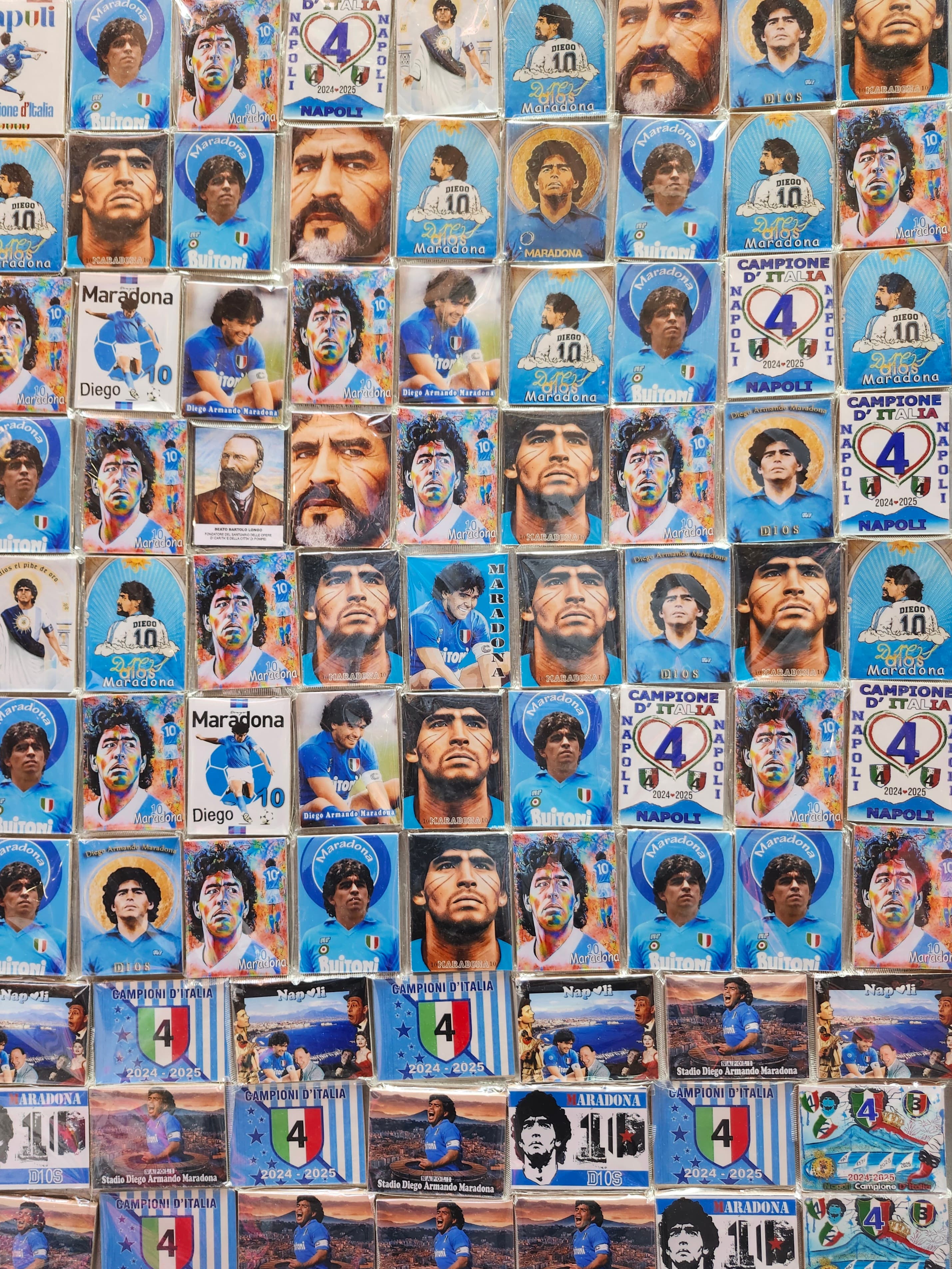
Everybody goes there. It’s kitsch, the pop culture deification of a soccer player who was neither born nor died in Naples, nor, for that matter, played his last game there. But for seven years, from 1984-91, Diego Maradona (1960-2020) helped deliver for S.S.C. Napoli two Serie A titles, making it the first southern Italian team to achieve such success. So revered was he that Neapolitans forgave him for scoring a goal for Argentina against Italy in the 1986 World Cup. A wonderful memorial adaptation of a Neapolitan street song goes: “Oh Mamma, you know why my heart beats./ I have seen Maradona. I have seen Maradona.” You can’t miss him, a 40-foot-tall mural in the Spanish Quarter, but that is really the tip of an iceberg. Forget the fridge magnets and the cheap jerseys, his image is everywhere on the street, an occasion for portrait artists to try their skill at scale and for others to engage iconographic traditions, transforming the working class, cocaine-taking footballer into a winged putto that might have been transferred from a church fresco.
This is less about popular religion than it is about aesthetic opportunity, the chance to interpret and modify a symbolic representation that everyone knows. Precisely what Caravaggio, even more of a bad boy than Maradona, was up to, and, for that matter, the chefs at Lombardi. It’s a pizza. It doesn’t have to be presented so artfully, a gustatory mandala, as elaborate as a cathedral’s rose window, and yet it always is. Pizza has been around since before Queen Margherita brought the people’s food into the palace in the 1780s and designed her own, in red, white, and green. Whether in a kitchen or an artist’s studio, every gesture self-consciously revises a myth—whether or not it originated in history—represents and modifies it, sometimes as homage, sometimes as parody, sometimes as faith, sometimes all at the same time.
In a ride across town, my cab driver first insisted that Neapolitans were the cleanest people in the world and that the bidet was invented there. “Other places are not as clean as they look,” he said. Then he quoted crime statistics to demonstrate the city’s erroneously bad reputation. Milan, Bologna, Rome, even Florence, were all more dangerous. (I had read the same stats online.) “Everything I am telling you is realtá,” he added. As I left the cab, I suggested to him that this sounded like an attempt to establish a new Naples mythology. He nodded at me and said, “Sometimes myth and reality turn out to be the same thing.”
Lyle Rexer is the author of many books, including How to Look at Outsider Art (2005), The Edge of Vision: The Rise of Abstraction in Photography (2009) and The Critical Eye: 15 Pictures to Understand Photography (2019). The Book of Crow, his first work of fiction, parts of which first appeared in the Brooklyn Rail, has recently been published by Spuyten Duyvil Press.