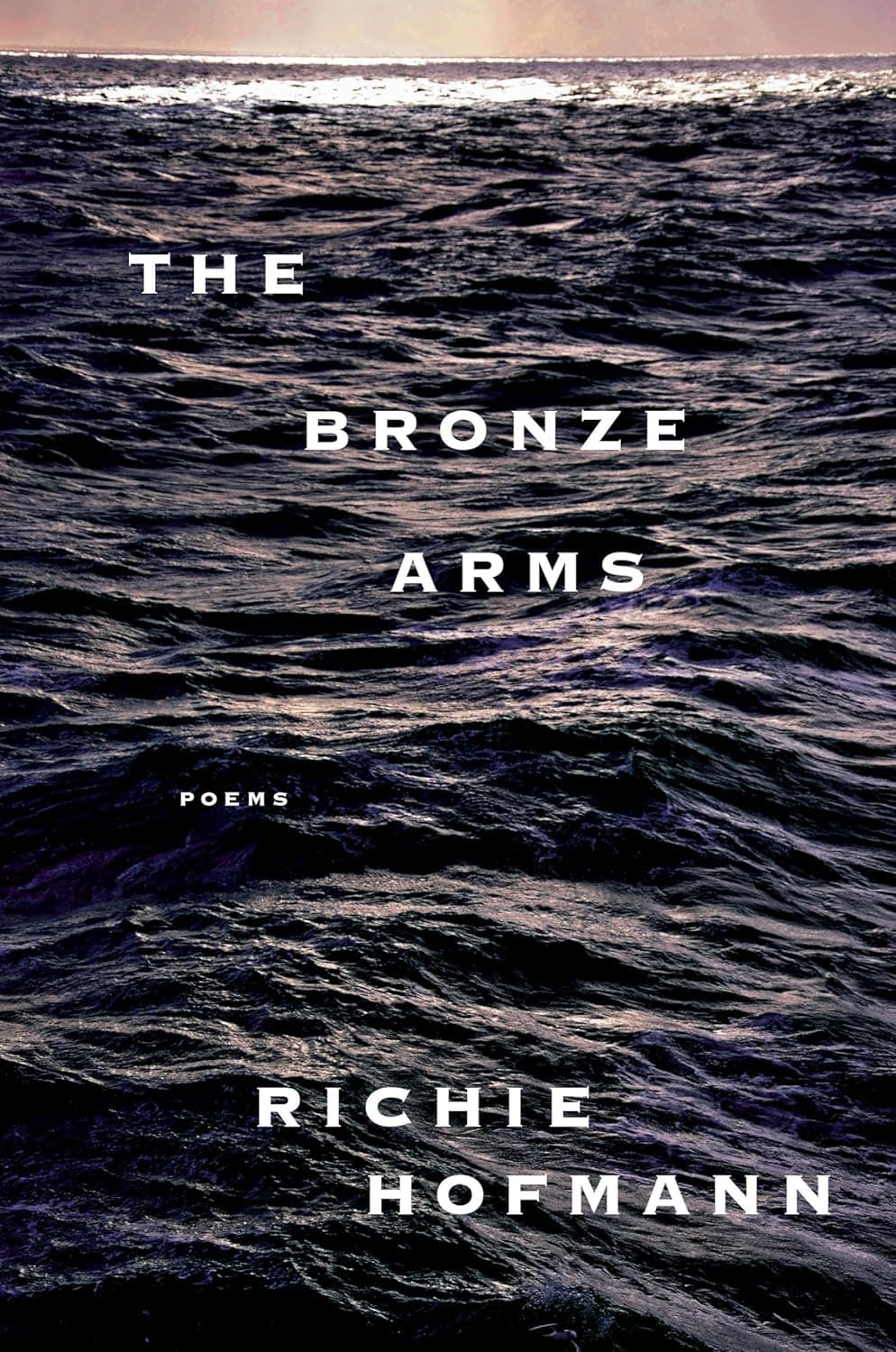
Richie Hofmann’s The Bronze Arms
Word count: 1008
Paragraphs: 9
The Bronze Arms
Knopf, 2026
In one of the many aphorisms that makes up Oscar Wilde’s “Preface” to The Picture of Dorian Gray, the author writes, “All art is at once surface and symbol.” Richie Hofmann’s exquisite volume of eroto-aesthetic poems, The Bronze Arms is concerned less with symbol than it is with surface and its often literal penetration. I call the volume eroto-aesthetic because of its insistence that beauty—whatever else it might do—can never be evacuated of its erotic content. Beauty rarely seems to be or bring pleasure, or even joy, in Hofmann’s work; it might be pain’s antidote or pain’s apotheosis: the speaker “suffer[s] from beauty”—and to be sure we all have had our stomach turned by an attraction than repels us or, in the object’s absence, undoes us. Later in the volume, Hofmann tells us “so much pain rushes through / my love of beautiful things.” And mortality is over and again linked to beauty: “I can’t help lying there like a slain boy / if you bleed in the dust / if the blood turns to beauty.” But then, a twist, “if the beauty turns to nothing.” Hofmann’s speakers are never quite certain beauty will save them from the void.
A central paradox inherent in Hofmann’s work is that the surface might be just as, or even more, beautiful when subject to the defilements and delights—delightful defilements, defiling delights—of the body. In “Breed Me,” Hofmann enjambs the lines “You forgave”—a general statement—and “my love of surfaces”—a love that is perhaps the central characteristic of the volume as a whole. An aesthetic attachment to the surface might be that which prevents one from going deeper—philosophically, sexually—but the poet assures us of various forms of penetrative depth: “the way you hurt me (fingers, teeth)” and the “other men tried to put death into my mouth.” Most significantly, the poet tells us “I had a pain inside me / and I needed you to deepen it.”
Hofmann turns to an artist whose surfaces are his legacy, Titian, and his fleshy “Poesie,” a series of seven mythological paintings, executed for the King of Spain (only six were delivered). Of the Venetian Renaissance and its painters, Willem de Kooning said, “Flesh was the reason why oil painting was invented” and then, “the more painting developed, in that time, the more it started shaking with excitement. And very soon they saw that they needed thousands and thousands of brush-strokes for that—as you can see for yourself in Venetian painting.” The flesh, in trembling brush strokes, in Hofmann’s “Lust Archive” is reduced to its reproductive use: “Philip II used them / To get hard for his ugly wife.” Hofmann gives us a comparatively perfunctory erotic description of the bodies of the goddesses who populate the paintings—perfunctory like Philip II making love to his wife—before turning to (homo)erotic life: “I was writhing, sucking.” His final comparison of ejaculate to the painted object ties the homoerotic and art historical together: “A couple drops / Still dripped / Like a portrait’s diamonds.” In the context of Titian’s “Poesie,” one thinks not of any specific piece of seminal jewelry but of Jupiter as a cloud raining his version of a golden shower over Danaë, straight but not narrow, as the old pride parade buttons used to say.
A continued theme of Hofmann’s volume is the loss of youth and its concomitant beauty. In a poem that draws directly from Hofmann’s childhood, he is nearly drowned: “My parents hold my small body … The sea smells like men’s bodies / I didn’t die / But for one moment / I was someone who would never be old.” A pietà over a child, I’ve written on this subject as regards my own stillborn daughter, and I am momentarily angry. What right has Hofmann to celebrate what would be his parents’ tragedy, let alone celebrate it in the aestheticized terms of eternal youth, akin to Dorian Gray? (This is entirely the wrong way to read a poem. This might be the only way to read a poem). But then the next poem, “Arms,” changes my mind: “It would have been a catastrophe for my father / but it wouldn’t have changed a thing in the world. / I was a boy who drowned, the old women would say, / Drawn from the water / By his father’s arms. / The tide came in. / You wouldn’t have known there was ever a beach.” Here, the boy becomes myth, and myth requires tragedy—deep, personal tragedy, but small in its reach—for its very structure. I was reminded of a piece of juvenilia by Elizabeth Bishop, “To a Tree,” which ends:
For me, who stand behind its framework stout,
Full of my tiny tragedies and grotesque grieves,
To lean against the window and peer out,
Admiring infinites’mal leaves.
The speaker of Hofmann’s poem understands that for the world, his loss is experienced as the sum of “tiny tragedies” and “grotesque grieves,” even if something more—something massive—for his father. What is worth the price of immortality? And who pays?
Bishop and her characteristic privacy lead me to a fundamental question about Hofmann’s volume, one that, as is in the case of Bishop, is lent particular importance by Hofmann’s queerness. Is this confessional poetry? Can one write erotic poetry in the first person and create anything other than confessional poetry? One of the great accomplishments of the volume is that Hofmann manages to do so—to be explicit, even explicit about acts and fantasies—while demonstrating restraint about the intricacies of something we might call the soul. He does so by displacing himself in ancient myths and aesthetic objects. “Richie Hofmann” remains ever elusive, a museum about to close for the day and turn its lights off before its objects come to life. His work is sincere, but sincerity is not revelation. It is in its explicitness and evasiveness in a quest for a beauty whose power is to heal and harm that the profound effectiveness of The Bronze Arms lies.
Natalie Prizel is a writer and scholar based in New York City. Most recently, she was Andrew Mellon Senior Fellow in European Paintings at the Metropolitan Museum of Art. She has taught at various institutions, including Bard College and Princeton University. Her book, Victorian Ethical Optics: Innocent Eyes and Aberrant Bodies was published by Oxford University Press in 2024.