Giada Scodellaro’s Ruins, Child
Word count: 888
Paragraphs: 8
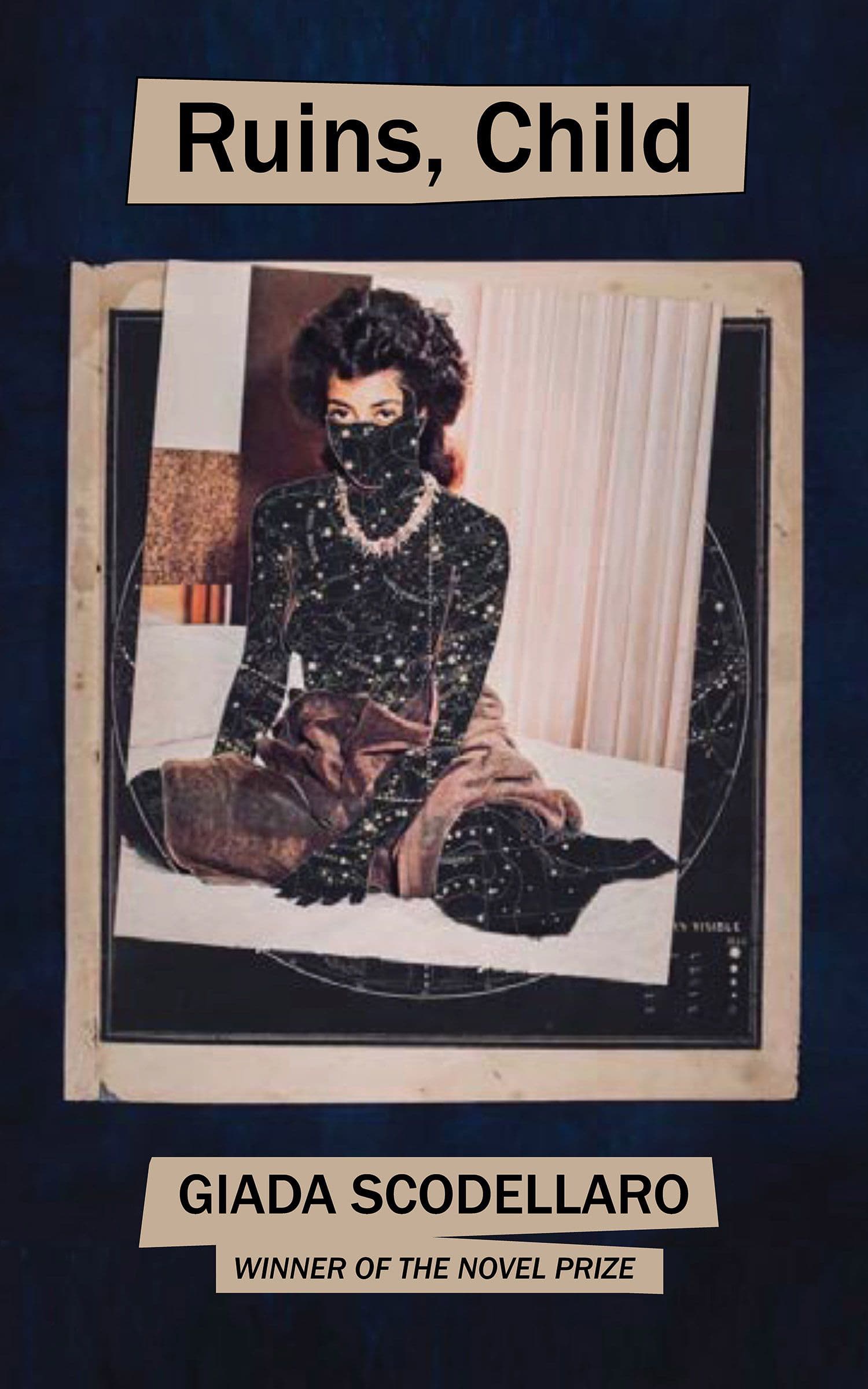
Ruins, Child
New Directions, 2026
Giada Scodellaro’s story starts with the gaze, awkward and self-conscious, panning the subjects and their contours. First the legs, then their fingernails, then their bare feet. Always at a distance, the gaze hones its focus with equal amounts of judgment and curiosity, though nothing is ever concluded. The lens keeps adjusting, incessantly grasping for the next detail. A mustard green, a streetlight, keloids. Candied yams, a woman’s scalp. The gaze never hungers for facets of beauty. This version of the universe is abundant with them. Naturally, the questions arise: Whose gaze is this? Whose point of view are the readers following? This line of inquiry seems to be the core fascination of Scodellaro’s second book and debut novel—Ruins, Child. By juxtaposing ever-shifting perspectives and their resulting images, Scodellaro creates a collage of cinematic still lives, attempting the challenge of adapting them for the written word.
At the center of the novel is a group of Black women who live in a deteriorating apartment building situated in a declining urban environment. Though New York is not explicitly mentioned, the city’s claustrophobic and grimy conditions suggest that this place is inspired by the density and airlessness of New York City. In fact, certain streets in the Bronx are referenced: Gun Hill, 219th Street, Eastchester Road. This setting is far from glamorous or idyllic. Homes are crumbling. Churches and schools are burning down. And in the distance, climate change looms. Like many stories of the ghetto, the local government does nothing to protect the community or help it recover, forcing the people to patch up their domestic spaces with glue, plastic coverings, and other household materials. Of course they know these remediation efforts are too meager to mend the oncoming chaos of civic neglect and climate disaster. The women continue on with life anyway. “Picture this: Vonetta! washing the hallway floors, Sanaa Lathan climbing on the couch to take a nap, Mona wiping down the counters, Jackie cutting the vegetables into cubes. Pearl dusting the piano.… The woman is not slow in her movements, she is methodical.” We watch them exist around the ruin and tend to each other.
The readers though are not the only audience following these characters. Throughout the story, these women are captured by a camera crew while simultaneously being watched by their neighbors who view them on TV. These assorted perspectives create a web of meta dynamics: the recurring first-person plural narrator which represents the television audience; the camera crew who controls what the at-home audience sees; the women who monitor each other and sometimes even join the collective screening; and us, the readers, functioning almost like the eyes of God as we watch these dynamics play out on the page. We watch them being watched and we watch them watching themselves—usually with love and sometimes with scorn. Part of the gaze’s purpose lies in documenting how people, specifically women, often police each other’s bodies.
“Fast-thing, Fast is the name the neighbors use when her leg sticks out of place.” The narrator proclaims. “Or worse, a damned whore. That thick ass leg is out of place for a woman! An old woman at that. The musculature is out of place for how the body should be presented.” The gaze is not always gracious, especially when it deems a woman to be out of line. The women watch themselves to understand the expectations of society at large via the judgments of their direct community. Framed by these expectations, the women's personal gaze constantly recalibrates as conflicting slants take shape. We watch them being watched and we watch them watching themselves.
Here lies Scodellaro’s authorial vision. She is not invested in linear plot lines nor does she have any interest in character arcs or resolutions. In the moments when a straightforward narrative seems to be forming, there is an immediate break and shift. One character becomes a chorus of six; the narration switches from the first person to the third; a section of prose is followed by a section of verse. The conventions of the traditional novel don’t exist here. Scodellaro rejects them to pursue a formulation akin to the patterns of free jazz. The pacing is erratic, and the dialogue is at times nonlinear and rich in repetition.
It would be naive to claim Scodellaro’s style is improvisational. Clearly, her sentences are the result of a meticulous sensitivity to minute details. Yet, much like the best improv musicians, there is an unpredictability overflowing from sentence to sentence. As the novel progresses and the fragments accumulate, the pattern behind it doesn’t necessarily clarify but it does create a logic of its own. This finely-crafted web of overlapping viewpoints forms a multilayered portrait of the Black woman figure and her life—and the effect is undeniably original. The collage of scenes holds an array of arresting detail that is striking, humorous, and surrealist in nature. Scodellaro breaks the novel form to experiment with its limits, but at times this experimental approach can feel laborious and overwrought. There is much to observe, much to consider and after taking many such long looks, without much for the reader to ground oneself in, all these beautiful images coalesce into a blur. Though, for Scodellaro, these blurring sequences seem to be the intended effect.
Loré Yessuff is a writer based in New York City. Her poetry and prose have been featured in Voicemail Poems, the New York Times, Vox, American Chordata, and other publications. She writes a casual newsletter about meaning, culture, and modern life: poembutter.substack.com.