Ann Rower’s Lee & Elaine
Word count: 1011
Paragraphs: 10
Lee & Elaine
Semiotext(e), 2026
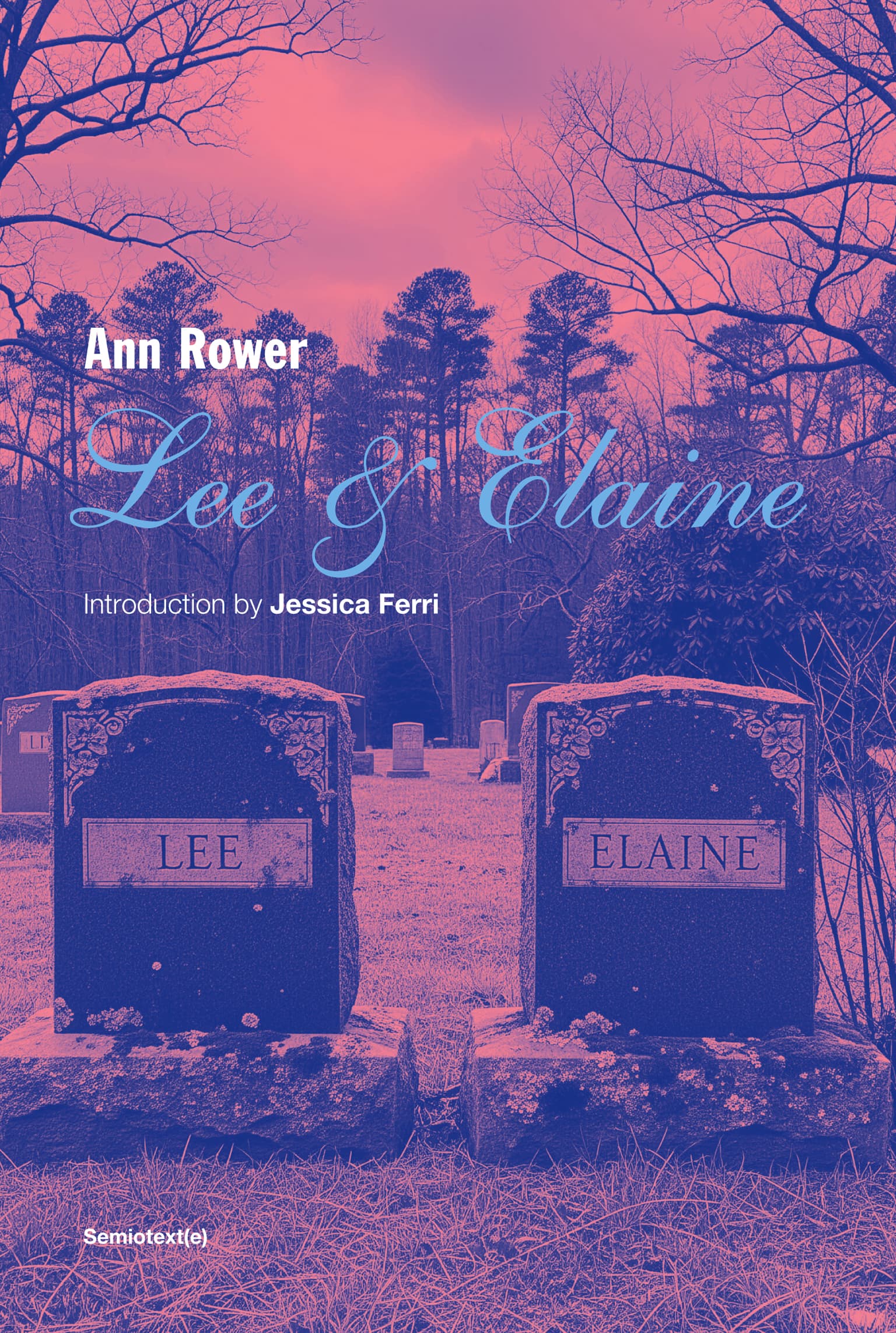
Thank God we are living through the Ann Rower renaissance. In 2024, Semiotext(e) republished her collection of short stories If You’re a Girl to much-deserved fanfare. The book intersperses the original material from 1990 with intimate scenes of her life as an octogenarian, and the cult classic rocketed her back to the forefront of the New York scene. This February, Semiotext(e) reissued Lee & Elaine, one of her two novels, originally published in 2002.
In the book, the narrator gives herself a residency in the Hamptons during the off-season and becomes obsessed with the dead who inhabit Green River Cemetery, particularly Lee Krasner and Elaine de Kooning. In this self-imposed solitude, trying to finish a different book than the one we’re reading, she begins an affair with a female student and struggles to leave a decades long relationship with her male partner. As these life circumstances become increasingly distressing, the narrator obsesses over Lee and Elaine, imagining the two come back to life as lesbians.
Despite the contemporary tone Rower achieves, this couldn’t have been written today. For one thing, Krasner and de Kooning are far more well-known now than when Rower wrote the novel. A slew of books has come out rightfully restoring these women to their place in history including Ninth Street Women by Mary Gabriel in 2018 and The Loft Generation by Edith Schloss in 2021. In the last few months, New York has had many shows by female painters of this era including Joan Mitchell’s To define a feeling: Joan Mitchell, 1960–1965 at David Zwirner gallery in 2025, and Helen Frankenthaler’s 2025–26 MoMA retrospective, A Grand Sweep. Likely the most extensive exhibit will be Krasner and Pollock: Past Continuous, set to open at the Metropolitan Museum of Art in the fall of 2026, and put the couple into conversation as to how each influenced the other’s work.
Of course, correcting the omission of women from the canon is important. Still, I found myself thinking that these galleries are cashing in on the trend of identity politics that made women artists hip and cool. Rower’s book is refreshing for the way in which she cares little about markets or facts. She researches these women with a frenzied energy yet also feels like an outsider to these academic pursuits. Her book isn’t interested in recuperating these women as idealized figures who toiled in obscurity. Rather, she makes them even more marginal by imagining them resurrected as lesbians. She understands the difficulties they faced and as opposed to trying to make them scions of an exploitative art world, turns them into separatists.
Rower is deadpan, hilarious, and this book is an absolute romp (see the episode in which her lover, Iris, ties her to the four-poster bed just in time for a realtor to show up with clients to view the house and the knots are too tight to undo). She wants Lee and Elaine to be friends, or even better lovers, so desperately she becomes almost completely delusional. Her method of research primarily involves gossip. As she lives in East Hampton, she begins meeting everyone who knew the two women and they all tell her, more or less, that the two were almost certainly not close. This willful delusion might grow from the other plotline in the novel: the narrator’s difficult relationship with a younger woman. It’s almost as if she, too, is coming back from the dead as a lesbian and she wants some company. What better company than these two brilliant painters?
I found myself wondering whether some of this desire to imagine the two as friends was possible precisely because of a lack of information. Today, we read artists’ Wikipedia pages in minutes and come away with their milieu and influences. When Lee & Elaine was written, Rower printed out directions to find the cemetery. In Rower’s novel, de Kooning’s headstone goes missing and there is no Reddit board to check for its whereabouts. I’m not trying to turn this review into a lamentation for the pre-internet age. It is simply an interesting artifact for what is possible when we do not know. At the end of the day, we never can know all the absolute facts of the past, but this book gives me the sneaking suspicion that our information clogged era has led us to a false sense of proximity.
The spread of misinformation is trending upwards, and the generation of content by AI is sure to further muck up the truth. But maybe rather, or in addition to, the liberal handwringing, we might see this as an opportunity for our artwork to do something other than politely reconstruct the past. We can hold two things at the same time as Rower does here. All of her interviews, the hard work and research that went into this novel, suggest that the two women were likely not friends and maybe even at odds. In fact, near the end of the novel, the passage she’s cited throughout, about the two women having been spotted together on Eighth Street, was misremembered and Jason Hook, the respectable critic, theorist, historian, and expert lays into her shouting, “‘Lee and Elaine friends! That’s just such ridiculous bullshit. You’re a fool. Get out of here. You’re wasting my time.’”
This setback is short lived. Soon after we see the narrator lunching with her friend, Sophia: “‘Well, I have reason to doubt all the premises of my book. But maybe I can turn it into a funny scene. How foolish he made me feel and how foolish it is, when you try to write about history, knowing nothing, going on instinct—’ ‘—from a personal point of view,’” finishes Sophia. This is Lee & Elaine’s wonderfully playful yet profound offering: the past, from a personal point of view. I found myself wondering how we can cultivate this sense of intimacy with the historical when we know, or think we know, so much? How can we cultivate realms of unknowing so we might imagine again?
C. Francis Fisher is a poet and translator. Her first book of translations, In the Glittering Maw: Selected Poems of Joyce Mansour, appeared with World Poetry Books in 2024. She has been supported by fellowships from Yaddo and the Bread Loaf Writers Conference. Her work has appeared in the Yale Review, the Adroit Journal, and the Los Angeles Review of Books among others.