Yasumasa Morimura & Charles Atlas: Anamneses
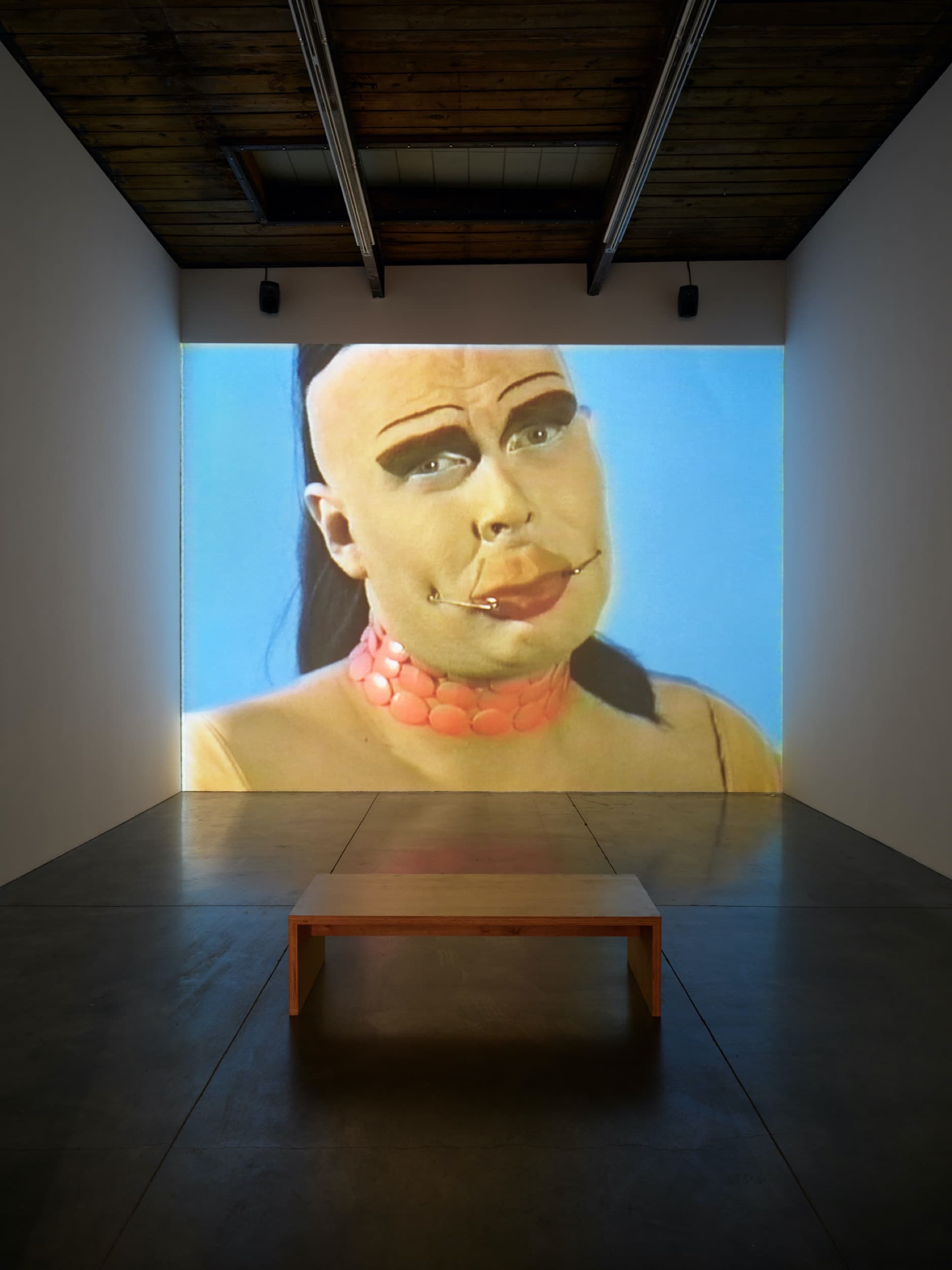
Installation view: Yasumasa Morimura and Charles Atlas: Anamneses, Luhring Augustine, New York, 2026. © the artists. Courtesy the artists and Luhring Augustine, New York. Photo: Farzad Owrang.
Word count: 1068
Paragraphs: 9
Luhring Augustine
January 30–March 28, 2026
New York
Here’s the thing about spectatorship: at the end of the day, it’s about power. More acutely, it’s a display of authority. In the charged dynamic between seeing and being seen—between who controls the look and who is reduced to spectacle—viewers have historically held the power. And what of spectatorship’s parasitical twin, voyeurism? What are the stakes when bodies are on display? For artists Yasumasa Morimura and Charles Atlas, that’s the question, and a joint exhibition featuring works by both artists answers it unambiguously: our freedom.
Morimura is perhaps best known for his photographic tableaux restaging paintings from the Western art historical canon, with himself cast in the leading role. Among works included in the current show, Une Moderne Olympia 2018 (2018) is a riff on Édouard Manet and Paul Cézanne’s works of a similar composition and name—Morimura plays the part of the reclining nude. Daughter of Art History (Princess A) (1990) channels Diego Velázquez’s Infanta Margarita Theresa in a White and Silver Dress (1656)—a child-size Morimura deadpanning in full courtly attire. Great lengths are taken by Morimura to recreate not only a painting’s respective mise-en-scène (period costumes, elaborate props, theatrical sets) but also the style of its painter (brushstroke, texture, palette) with Morimura going so far as to paint his own body and clothes in the same manner. Attentive viewers will observe Morimura doing his best impression of Cézanne’s quick, directional hand. Adding to the theatricality of it all, Morimura applies a glossy varnish mimicking brushstrokes to the surface of his photographic prints.

Installation view: Yasumasa Morimura and Charles Atlas: Anamneses, Luhring Augustine, New York, 2026. © the artists. Courtesy the artists and Luhring Augustine, New York. Photo: Farzad Owrang.
The effect, however, is deliberately ersatz; this is not an impression, it’s high camp. In Morimura’s images, the purposefulness of the not-quite-passing aesthetic recalls the knowing wink of drag’s half-illusion. Morimura doesn’t want to fool the viewer, he wants us in on the gag. As if to underscore the point, the exhibition opens with Doublonnage (Marcel) (1988)—Morimura’s reenactment of Man Ray’s portrait of Rrose Sélavy from about 1920–21, the drag alter-ego of Marcel Duchamp. Doublonnage is a tricky word, a French term favored by bureaucrats meaning redundancy, duplication. In the case of Doublonnage (Marcel), the overlapping of identities—Morimura-as-Man Ray’s image-of-Duchamp-as-Rrose Sélavy—is heightened by Morimura’s choice of makeup echoing the white powdered face and red lips of a geisha, a reference to his Japanese heritage, and a second set of hands—the subject out of frame—held by Morimura.
The “duplication” at play in Doublonnage (Marcel), but more broadly in all of his works exhibited, transforms passive visibility into active intervention. Morimura doesn’t just recreate these images: he occupies them, stares back from within them, and in doing so, shatters the one-way gaze that defined them. The viewed becomes the viewer, the spectacle claims spectatorship. Through the complicity of camp—that knowing wink—Morimura denies the furtive authority of the voyeur. You can’t secretly watch a performance if you know it’s being performed for you.

Yasumasa Morimura, Daughter of Art History (Princess A), 1990. Ilfochrome print mounted on acrylic, 82 ¾ × 63 inches. © Yasumasa Morimura; Courtesy the artist, Luhring Augustine, New York, and Yoshiko Isshiki Office, Tokyo.
Atlas, like Morimura, prominently features queer bodies in his ongoing body of work; the queer body, after all, has long been the subject of regulation, pathology, and fetish. Both artists refuse the passivity expected of the spectacle, claiming agency for the viewed over the voyeuristic viewer. Yet, whereas Morimura’s photographs preserve the relationship between observer and observed—Morimura occupying the latter position to subvert it from within—Atlas’s films fragment the unifying spectatorial gaze into multiple, partial perspectives. To achieve this, Atlas combines formal techniques—non-linear editing, rapid-fire intercuts, archival self-sampling—with storylines featuring queer artists and personas of the 1980s and ’90s.
The titular Anamneses is something of a greatest hits. As the title suggests—it is an archaic term meaning recollection and reminiscence but also freighted with clinical overtones of a patient’s recorded medical history—Anamneses is a thirty-minute anthology comprised of eight shorter films, featuring a who’s who of the Pyramid Club: Leigh Bowery, Hapi Phace, and Kabuki Starshine, among them. Included in Anamneses is Teach–X (1998/2026), featuring the twisted brilliance of Bowery. The pairing of Bowery’s exaggerated drag—prosthetic lips fastened by cheek piercing safety-pins, makeup verging on the absurd—with Atlas’s stroboscopic edits and frenetic close-ups, give Teach–X a propulsive, almost assaultive tenor. Meanwhile, Kabuki Starshine (Rehearsal) (1998/2026), captures a performance by the eponymous makeup artist and former club kid, set to an ambient electronic soundtrack composed by musician Anohni. Starshine—painted head-to-toe like some erotic alien with skin in hues of white, cobalt, and acid yellow—poses, one moment staring directly into Atlas’s camera, the next moving through a series of languid gestures. In counterpoint to Bowery’s grotesque visage, Starshine’s is sensual: the glossy painted lips, those come-hither lashes. Where Atlas’s edits give Bowery a manic sensibility, with Starshine his camera lingers on the performer’s steady, entrancing gaze. Wildly different in cinematic register—frenetic fragmentation for Bowery, sustained contemplation for Starshine—seen together, Atlas’s films underscore an aesthetic of gleeful mutability in defiance of a fixed spectatorial authority. In our current political climate, this couldn’t be more urgent.

Charles Atlas (in collaboration with Anohni), Kabuki Starshine (Rehearsal), 1998/2026. Single-channel video with sound, 4 min., 15 sec. © Charles Atlas. Courtesy the artist and Luhring Augustine, New York.
With talk of AI platforms mining user data for financial enrichment, immigration authorities targeting Instagram accounts belonging to protestors, and the pressure of maintaining a public presence on social platforms, the age of spectatorship has become something else altogether: an era of surveillance. It’s a trajectory that’s not unexpected. The distinction between voyeurism and surveillance has always been thin. Both operate through the same authoritarian structure: the unilateral claim to observe, know, and control without reciprocity. Voyeurism removes the personal to produce an object of fantasy—Cézanne’s A Modern Olympia as available woman, Velázquez’s Infanta as dynastic commodity. Surveillance extends this logic, removing personhood entirely to produce the impersonal object—the data point, the risk profile, the pattern to be predicted. As of late, there’s an argument being advanced in theoretical circles that, with the rise of social media in particular, we’ve traded state surveillance for what has been termed “participatory surveillance,” where users form “coercive communities” bound by the compulsory visibility that platforms demand. We network our own fetishization, surveil ourselves and each other, all while maintaining the fiction of choice. Against this totality, the works of Morimura and Atlas gain urgency. Their refusal of passive objectification—whether through camp’s weaponized performance or through fragmentation of the commanding gaze—models resistance to surveillance’s presumption that all bodies can be rendered legible, categorizable, and controllable. The freedom these artists enact is the freedom to remain opaque, excessive, irreducible—to be seen without being mastered, to see without domination.
Joseph Akel is a New York-based freelance writer and editor. His non-fiction writing and criticism have appeared in the New York Times, the Paris Review, Frieze, and Vanity Fair, among others. Additionally, he has penned several artist monographs, most recently for artist Doug Aitken. Akel is currently working on his first novel. He holds a master’s degree in Art History from Oxford University.