William T. Williams: Word of Eye
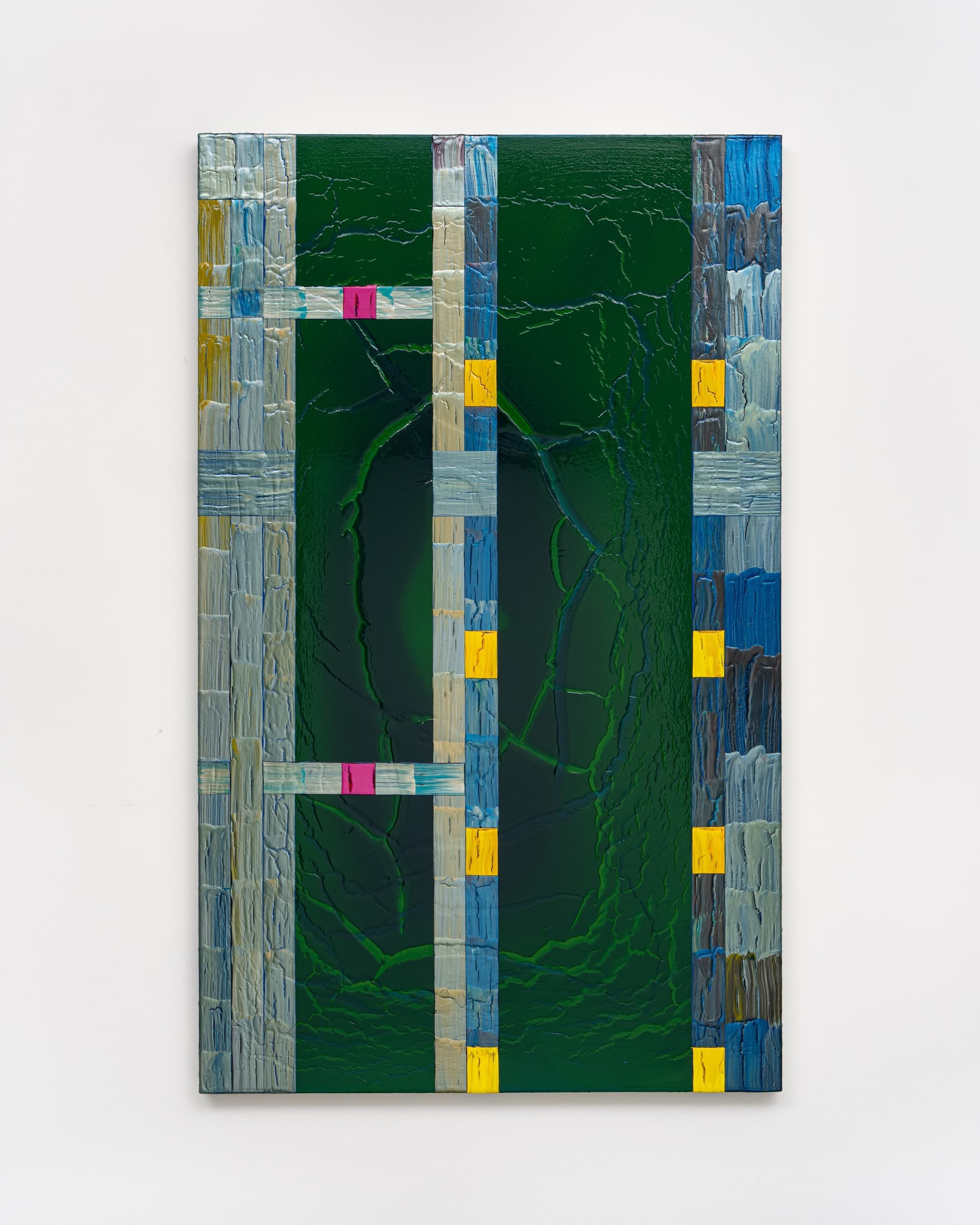
William T. Williams, Word of Ear, 2024. Acrylic on canvas, 60 × 36 ⅛ inches. © William T. Williams. Courtesy Michael Rosenfeld Gallery LLC, New York, NY.
Word count: 713
Paragraphs: 7
Michael Rosenfeld Gallery
February 7–April 4, 2026
New York
The most emphatic quality common to the eleven recent paintings by William T. Williams on view in Word of Eye, his fourth exhibition at Michael Rosenfeld Gallery, is the cracked, mottled, and glossy acrylic surface characteristic of his art since the early 1990s. What is new to these pictures is his use of close-valued dark hues and color-shifting interference paints, both of which draw the viewer closer to the visually complex paintings and invite further scrutiny. The two largest pictures in the show measure five by three feet, while all of the remaining works are just shy of these dimensions, about three inches smaller in both height and width. The shared vertical format and near identical size of the works directs one’s attention to their subtleties of color and facture.
The pictures can be roughly divided between “cool” and “hot,” with those paintings in the former category being much darker and revealing themselves more slowly. Though each work features bars of boldly contrasting color as well as secondary hues revealed by their cracked surfaces, the most subtle color chords appear upon the broadest surface planes of seemingly monochrome paintings like Word of Mouth (2024), which is comprised of deep blues and greens and rich purples. The full tonal range within each painting can be difficult to see through their glossy, reflective surfaces, a condition further exacerbated by Williams’s use of interference pigments, which shift between metallic silver and shimmering color when viewed from different angles. Together, these elements produce a surface that feels active and unstable.

William T. Williams, Diva, 2024. Acrylic on canvas, 57 × 33 inches. © William T. Williams. Courtesy Michael Rosenfeld Gallery LLC, New York, NY.
A geometric artist in the late 1960s, Williams was among those like Sam Gilliam and Larry Poons whose work became increasingly painterly in subsequent years. Looking over Williams’s trajectory, one sees how he gradually expanded the range of compositional strategies, textures, and techniques in his work, keeping some elements, discarding others, but always developing organically. Though his paintings have been ruggedly textured for several decades, geometry still prevails. He structures the canvases in Word of Eye with scaffoldings of bars and bands that, despite their abrupt changes in color and texture, nevertheless appear not so much upon the surface but rather built into it, like solid blocks locked into position. This sense of construction or assemblage does not preclude the weaving of these elements into a network of planes and intersections reminiscent of Piet Mondrian, but Williams’s color is more electric than the primary colors of De Stijl. The contrast of neon hues like hot pink and bright yellow against lambent metallic tones in Voice Over (2025) recall instead the dramatic color temperatures in the classic late paintings of Hans Hofmann.

Installation view: William T. Williams: Word of Eye, Michael Rosenfeld Gallery, New York, 2026. Courtesy Michael Rosenfeld Gallery.
Music has figured prominently in Williams’s art, whether as a visual allusion, as in his “Blue Line Series” where fluidly drawn, curving arabesques recall musical clefs and the scroll of a stringed instrument, or in the titles of paintings like Local Voice (2024) and Diva (2024). For Word of Eye, Williams has compiled a playlist of jazz tunes that plays softly in the gallery space. The late 1950s/early 1960s jazz standards by Cannonball Adderley and John Coltrane reflect the predominantly cool palette and syncopated brushwork of pictures Blue Risk and Up the Road (both 2024). But the blisteringly hot, molten surfaces of Diva and Sand Spurs (2024) bring to mind the more unrelenting sound of Coltrane’s free jazz period and the ferocious tenor tone of his late career collaborator Pharoah Sanders. With its charred and smoldering surface, Diva is the show’s most intense painting, as the fissures on its cosmic surface reveal even more searing colors. The vivid subterranean glow of these high-keyed red tones appears to light the painting from beneath with a slow, persistent burn.
Like the jazz music filling the gallery, Williams’s paintings deal effectively with structure and improvisation. Their geometry provides a steady, structural framework for Williams’s painterly improvisation, with the cracked surfaces and shifting colors introducing moments of visual tension and disruption. Seen together, the works in Word of Eye demonstrate how Williams continues to refine the pictorial language he has been developing for decades, one in which roiling textures provide a space for pulsing light, shifting planes, and rhythmic color.
Alex Grimley is an independent art historian specializing in postwar and contemporary art, particularly Color Field painting. His writing addresses intersections of visual art, criticism, and experimental music.