William Kent: Trust the Peeple!
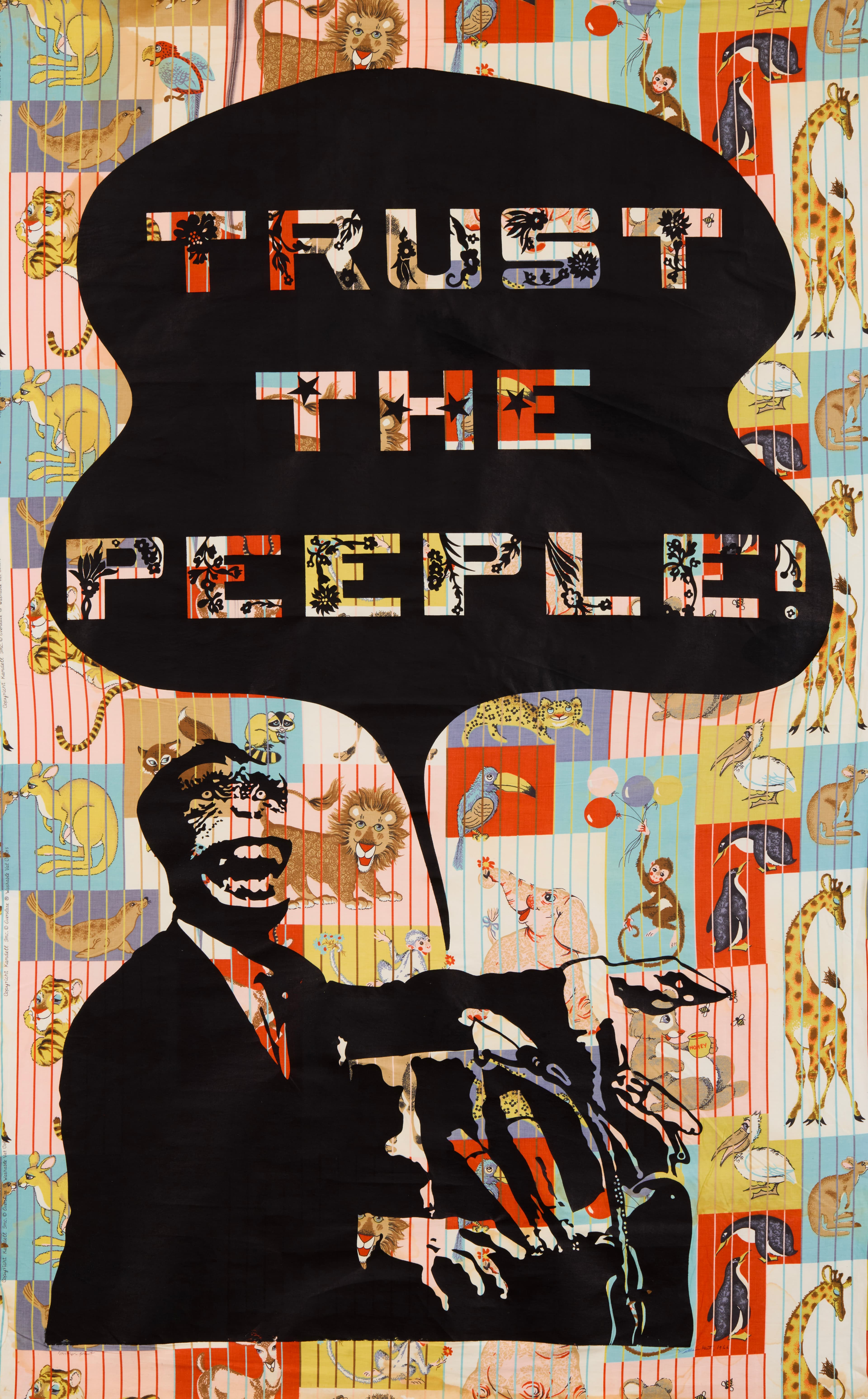
William Kent, Trust the Peeple!, 1966. Unique slate-cut print: ink on patterned fabric 70 ½ × 45 inches. Courtesy Ricco/Maresca.
Word count: 1208
Paragraphs: 7
Ricco/Maresca Gallery
January 15–March 7, 2026
New York
William Kent: Trust the Peeple! at Ricco/Maresca consists of seventeen unique slate-cut posters limned with graphic imagery and political cries. Each print is based on a slate blackboard plate impression, the self-taught artist having gleaned these blackboards after they were discarded from a local school. Though rather brittle due to their meager width, Kent (1919–2012) was able to use them to produce clean-lined, prismatic banners on patterned fabrics. Although Kent has been featured in numerous exhibitions over the years—including multiple group shows (e.g., the Rose Art Museum’s 2025 Surrealism(s) – Then & Now and the New Haven–based Ely Center of Contemporary Art’s 2024 exhibition Avant Colony: Unearthing the Westbrook Gallery)—and a number of his works, including his political prints, belong to important museum collections, Kent has hitherto not been subjected to sufficient biographical and scholarly study. Indeed, this is the first solo exhibition dedicated to the musician cum self-taught visual artist and curator in years—though one must qualify the latter label, as Kent was summarily dismissed from his first and only curatorial post following a 1965 scandal during which he was deemed a "pornographer" due to his inclusion of his own bawdy appropriations of erotic Greek vase paintings, then deposed from the John Slade Ely House Art Center, where he had worked for five years. It is rare that one finds Kent, who worked as a sculptor and printmaker in Durham, Connecticut, mentioned in extant writing about the 1960s. One exception is Lucy Lippard’s contribution to the 1967 anthology Pop Art, in which she reproduced Kent’s Nation in Good Shape (1964), remarking that “Kent has dealt with popular images for years now, but unlike the Pop artists', his motifs are strongly satirical, especially in this slate print series.” However, this is the sole reference to the artist who was apparently a temperamental recluse.
The works, which dovetail anti-war rhetoric and appropriation with Pop art’s verbal-visual formatting, were executed in the period between 1964 and 1967. Kent is understood to, like several artists from this era, have opposed the cool, ironic political remove of Pop art proper. Rather than hewing toward mark-making, figuration, or the underground Bowery scene—as fellow downtown detractors such as Dan Basen, Nicholas Sperakis, and Peter Dean, who similarly decried Pop art, did—the cantankerous Kent worked in geographical and factional isolation. During the 1960s, he also distinguished himself by making pronouncedly political work, in many ways anticipating the uptake of artistic activism of the subsequent decade produced by collectives such as General Idea, Group Material, Guerrilla Girls, Gran Fury, Adbusters, and Political Art Documentation/Distribution (PAD/D).
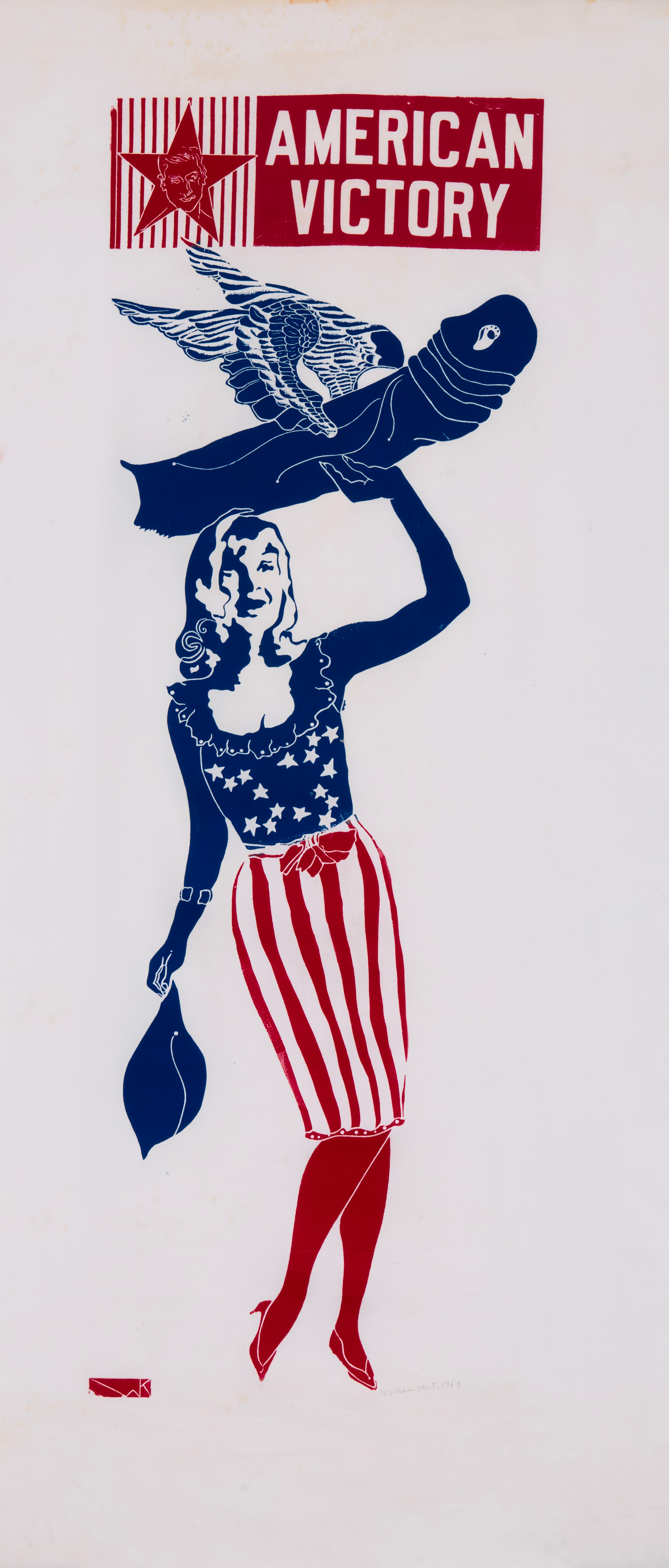
William Kent, American Victory, 1964. Unique slate-cut print: ink on fabric, 55 × 20 inches. Courtesy Ricco/Maresca.
Facets of Kent’s patterned fabric and slate-cut prints undoubtedly reflect the broader ethos of the 1960s New Left and Students for a Democratic Society (SDS); Kent’s politics, it should be said, are manifestly anti-war. This grounds the entirety of his practice, including in his seemingly whimsical imagery and phraseology. In American Victory (1964), a patriotically donned woman commands a cannon-shaped winged phallus; the seemingly equivocal expression in Do Your Duty (1967) recalls the wartime messaging (“Come on, boys! Do your duty by enlisting now!”) used by the U.S. Army during the First World War and by the British Admiralty during the Second World War, respectively. In each work, Kent signifies instruments or expressions of war. Given Kent’s penchant for also appropriating ecumenical and American cultural indices, ranging from Gilbert Stuart’s 1796 portrait of George Washington to colonial New England headstones, one might very well take his anti-war messaging to enjoy continued and ever-timely significance. Nevertheless, the bulk of the appropriated source material is, it should be appreciated, anchored in the culture of the 1960s Civil Rights struggle and anti-war movement, countenancing portraits of Lyndon B. Johnson, Robert F. Kennedy, John F. Kennedy, Emanuel Celler, and Harry S. Truman alongside phrases associated with figures like the Enola Gay B-29 bomber pilot, Colonel Paul Tibbets, whose uncontrite remarks concerning his role in the atom bombing of Hiroshima are blazoned beside Truman in one of Kent’s most important “Gravestone Series” posters.

William Kent, JFK (Valentine), 1967. Unique slate-cut print: ink on patterned fabric 56 × 40 inches. Courtesy Ricco/Maresca.
Several similar posters arrange quadrate phrases, comic strips, and limned politicians in headstones.. Rather than outright announcing pointed opposition to the military-industrial complex’s bulwarks, Kent’s associative arraying of historical referents is, at its best, of a more ambiguous stripe. In Truman (1966), the eponymous thirty-third president palms a fanning fistful of signing pens whose ends gleam like lit dynamite. The source image is likely a July 1949 photograph of President Truman sitting at his Oval Office desk, holding a number of pens employed for signing S. 1359, an act that had extended the Civil Service Retirement Act. Truman is hardly a celebratory poster lauding the president’s social justice accomplishments. His sunken, benighted visage is set in harrowing contrast to his wide grin, endowing Truman with a somewhat ghastly mien. The signing scene is met with a border-frame of decorative cherry-red ballistic missiles. Above this square pattern is a second, tondo portrait of a staider Truman; below, in capitalized stencil lettering, reads the aforementioned Tibbets phrase cum aphorism, “I NEVER LOST A NIGHT’S SLEEP.” Colonel Tibbets’s full remark, which Kent has shortened, was: “I regretted it was necessary, but to me it was necessary to do it. I tell everybody I never lost a night’s sleep over it.” This commentary had precipitated significant moral and historical scholarly opposition concerning the putative necessity of the use of the atom bomb, which resulted in the immediate deaths of 80,000 Japanese (most of whom were civilians)—a figure that doubled due to radiation and related injuries (to say nothing of the Nagasaki atomic bombing). By appending it to Truman’s silhouette, Kent is apparently relegating Truman to the machinations of the war machine—connoting his backing of the French anti-communist war effort to defeat the Việt Minh. In dispensing with what might, at first gloss, be received as laudatory signifiers (i.e., imagery associated with expanding American civil service and the social safety net), Kent productively renders his posters interpretable. In so doing, they function as political aesthetic objects rather than aesthetic political objects.
There are, however, some more literalist posters—ones where the political purview licenses the aesthetic-constructive format, functioning as more of a call to action than an interpretable artwork. This is not to claim that art history does not have room for such work, but purposiveness inherently stands in an inverse relationship to interpretability. JFK (Stars) (1967) is near-hagiographic. Despite JFK’s ambivalent, if not wavering, containment-management strategy towards the Cold War, it cannot be said that he adamantly opposed the Bay of Pigs Invasion. This is to say nothing of his complicity in the Operation Mongoose destabilization project, escalation of the Vietnam War, and backing of various armed factions to fight the Lao People's Liberation Army. One wishes that Kent’s treatment of JFK enjoyed the same register of scrupulousness and depth as his treatment of Truman. From a purely artistic register, Kent’s posters are at their best when they utilize polysemy and anti-war (rather than adulatory) messaging, compromising neither pole. Thankfully, a significant number of the works in this exhibition do this fruitfully. One hopes that this exhibition will galvanize scholars and curators to further research Kent’s work and life.
Ekin Erkan is a writer, curator, and researcher whose writing has appeared in the Journal of Value Inquiry, the International Journal of Philosophical Studies, and Hyperallergic, among others.