Stanley Whitney Henri Matisse
Word count: 1364
Paragraphs: 12

Installation view: Stanley Whitney Henri Matisse, Craig Starr Gallery, New York, 2025–26. Courtesy Craig Starr Gallery, New York. Photo: Dan Bradica.
Craig Starr Gallery
October 23, 2025–March 14, 2026
New York
As the unpunctuated title propounds, Craig Starr Gallery’s Stanley Whitney Henri Matisse pairs the titular artists in a broadly fluid hanging. In the show, there are seven oil on linen and two gouache on paper works by Whitney and three Matisses, two of which are oil on canvas still lifes and one of which is a version of the artist’s 1949 cut-out, The Dancer (La danseuse). The lack of punctuational differentiation suggests that Whitney’s work might cede to Matisse’s, and vice versa. Indeed, there are some points of significant contiguity between the two artists—chiefly, in their palettes. This is pronounced in the deliberately colorist pairings, like Whitney’s Stay Song 26 (2018), whose central rectangle elements suspend a light azure and broken indigo block abutted by a charcoal-black demarcation, with Matisse’s Gourds (Les coloquintes) (1915–16), in which the leftmost bulbous, glaucous gourd is flattened against an ink-black quadrilateral tile. However, as the exhibition progresses, we find Matisse’s work increasingly dissolving the line as a marker of distinction while Whitney blazons it.
In subject matter, too, there is a significant gulf between the two artists. In executing the latter work, Matisse was particularly interested in the transposition of surface forms against a contracted background plane, where the depicted objects would, to quote the artist, “participate in the same intimacy,” but without coming into contact. One espies a more attenuated formalism in Vase with Flowers and a Plate of Oysters (Vase de fleurs et le plat d'huitres) (1940). Whitney’s gridded surfaces are also apportioned from one another, but the jointing line is an active part of the paintings that brings each seemingly separate chromatic unit into a shared visual semblance.

Henri Matisse, Vase with Flowers and a Plate of Oysters [Vase de fleurs et le plat d'huitres], 1940. Oil on canvas, 20 × 24 inches. Courtesy Craig Starr Gallery, New York. Photo: Pierre Le Hors.
Whitney is something of a formalist, but a moderate one at that. His rectilinear, blocked-out rows, arranged three or four cells long, were initially precipitated by an interest in producing chromatic and spatial harmonies that appeared to be in motion. This partially clarifies the mark-making that recurs throughout Whitney’s work and his frequently lapsed edges and collapsed borders. It is not quite correct to deem Whitney a geometrical abstractionist; his quavering shapes teeter on the edges of structural loosening. The drips and drops leaking from the squares’ bottom and top edges also intimate the presence of a brush-swept glide rather than any exacting, ideal shape. Thus, while the exhibition catalogue essay by John Elderfield adverts to Donald Judd’s sculptures and Piet Mondrian’s Broadway Boogie Woogie (1942–43)—noting that, like Whitney, the latter artist similarly drew upon hard bop jazz’s syncopation—Whitney’s work is far less contained.
There is, however, something to be said about the influence of music on Whitney. In analyses of how abstract paintings betray the influence of jazz music, the precise structural homology between a musical element and the work’s painterly elements often remains underspecified. Where the transfiguration from sound to perceptual elements is stated, we are frequently provided with broadly abstract references to the relationship between improvisation and painterly “rhythm.” Such analyses can traffic in unhelpfully opaque metaphors. Indeed, a pictorial figurative element or palette can just as easily bespeak a chord as it can a particular segment of the rhythm.
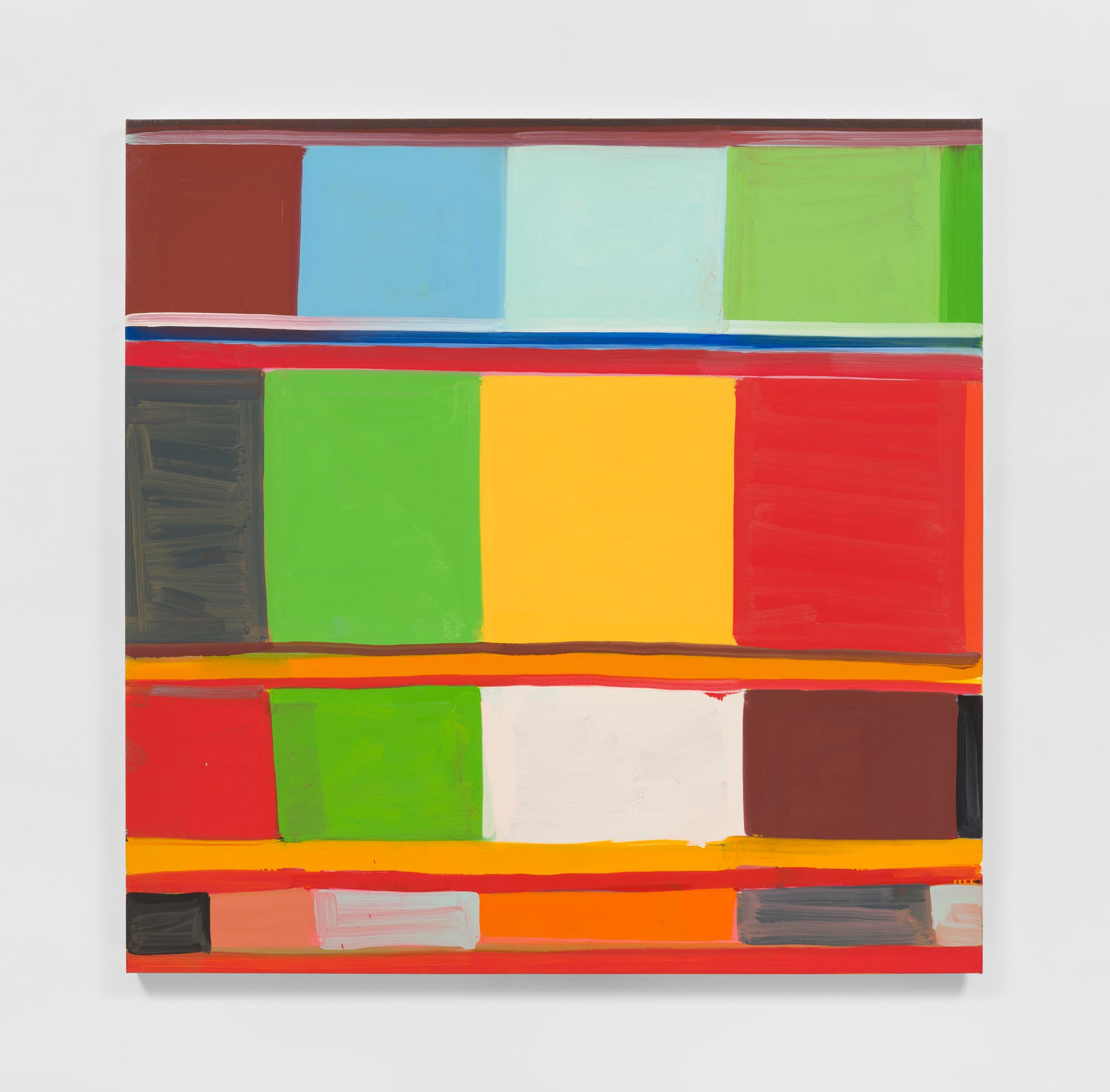
Stanley Whitney, Dream Keeper, 2007. Oil on linen, 54 × 54 inches. Courtesy Craig Starr Gallery, New York. Photo: Pierre Le Hors.
This is not to claim that this line of analysis is mistaken. For instance, the title of Whitney’s Stay Song 26 indicates the importance of musical influence and to forego this transfiguration would impoverish one’s understanding of his practice. But what is it in the work’s quilted patterning that conveys some facet of jazz music? Whitney’s set of influences includes Charlie Parker, Miles Davis, and Ornette Coleman. Elderfield remarks that it was their more “experimental jazz” compositions that served as “Whitney’s soundtrack.” If, then, we briefly consider one of Davis’s more avant-garde albums, like the 1970 Bitches Brew, we might propose that the isomorphism consists in his permutational looping and Whitney’s askew cubic planes—specifically, in their shared difference-in-repetition. Also recall Whitney’s aforementioned bleeding horizontal lines, which range from saccharine orange to fleshy pink. These bounds separate his cells into rows, preventing us from interpreting Whitney’s arrangements as columns. Here we find another point of confluence between Whitney’s blocks—which, however much they slope and slant, appear as sets of squares—and (jazz) sheet music measures. The reference to the measure is most evident in Whitney’s untitled gouache on paper (2019), where swatches of lime, coral, and tangerine are edged by the paper’s white negative space. The measure, as aurally perceived in performed (jazz) music, can strike one as outstretched or distended, as evinced in Whitney’s host of wending, dripping squares. The more pronounced the separation is, the more successfully his works express difference-in-repetition. The strongest of Whitney’s paintings, Dream Keeper (2007), makes difference conspicuous by varying the height and width of his square cells.
It should also be noted that Whitney’s throbbing line is also inspired by the irregularity of natural objects. In The Turn to Provisionality in Contemporary Art (2023), Raphael Rubinstein writes that:
During a studio visit in the 1990s, Whitney described to me how the gently sloping horizontal lines in his paintings took a cue from the way in which African carved-wood objects incorporated natural features of the wood rather than regularizing them.
In both Whitney’s purposing avant-garde jazz music and natural wooden grain patterns, a preconceived motif (be it aural or visual) serves as his guiding plexus. It is fitting, then, that in his October 2008 interview with John Yau, Whitney remarked that drawings have always been “very important to me,” adding that “they were key to figuring out the space. Even now with the paintings, no matter how structured they are, the lucid stuff really belongs to drawing.” Despite their literal absence, such drawings, I would argue, are also part of Whitney’s paintings.
It is known that Matisse, a thoroughgoing Rubenist, decried Jean-Auguste-Dominique Ingres’s conception of drawing as “the probity of art.” But what is Whitney’s horizontal line or measure if not a line? For the line is, at its core, an order of priority that serves as a requisite condition for subsequent subject matter. For Ingres and the Poussinists, disegno [drawing/design] renders the image as coextensive with a field that nevertheless constrains it. As Yve-Alain Bois suggests in his classical study, Painting as Model, an adherent of the Poussinist line need not proffer literal drawings and studies but must entreat the canvas to a “compositional a priori.” Elderfield, too, underscores this point. Reflecting on Matisse’s work, he writes:
We know that the stacked building blocks of his paintings were partly inspired by the façades of Roman buildings. However, it seems important to say that he did not construct his paintings from bottom to top, like building a wall, but oppositely, working down from top to bottom. This affords the sense that the rectangles of color do not carry weight but hang in pictorial space.
In both The Dancer and his still lifes, however, Matisse’s rectangles “hang” in the background; they do not function as units of pictorial containment. Although Whitney’s measures-cum-delineated rows go through colorist and spatial permutations, he recycles a subtending structure that is filled in. Where his brush occasionally bleeds and slips beyond the edges, it does not negate the presence of the container. On the other hand, the Matisse works on view purpose the studied objects into ever flat repositories of color. At their best, the limned objects facilitate slight tonal variance by working in contiguity with the background palette. In Vase with Flowers and a Plate of Oysters, for instance, a salmon-colored glass pitcher is posited in Matisse’s red studio. Its rusted-pink surface shimmers into the flurried ruby walls.
Returning, then, to the exhibition’s title, one might propose that the lack of disambiguation is something of a wittingly dialectical act. However much the latter may have influenced the former, there is a genuine opposition at play between Whitney and Matisse’s respective use (and abuse) of spatial containment. It is all the more interesting, then, that the exhibition, in abrogating the dividing line (both in the show’s titling and its mixed hanging), has nevertheless clarified the enduring frontier of line versus color.
Ekin Erkan is a writer, curator, and researcher whose writing has appeared in the Journal of Value Inquiry, the International Journal of Philosophical Studies, and Hyperallergic, among others.