TheaterFebruary 2026In Conversation
MICHELLE URANOWITZ with Patrick Denney
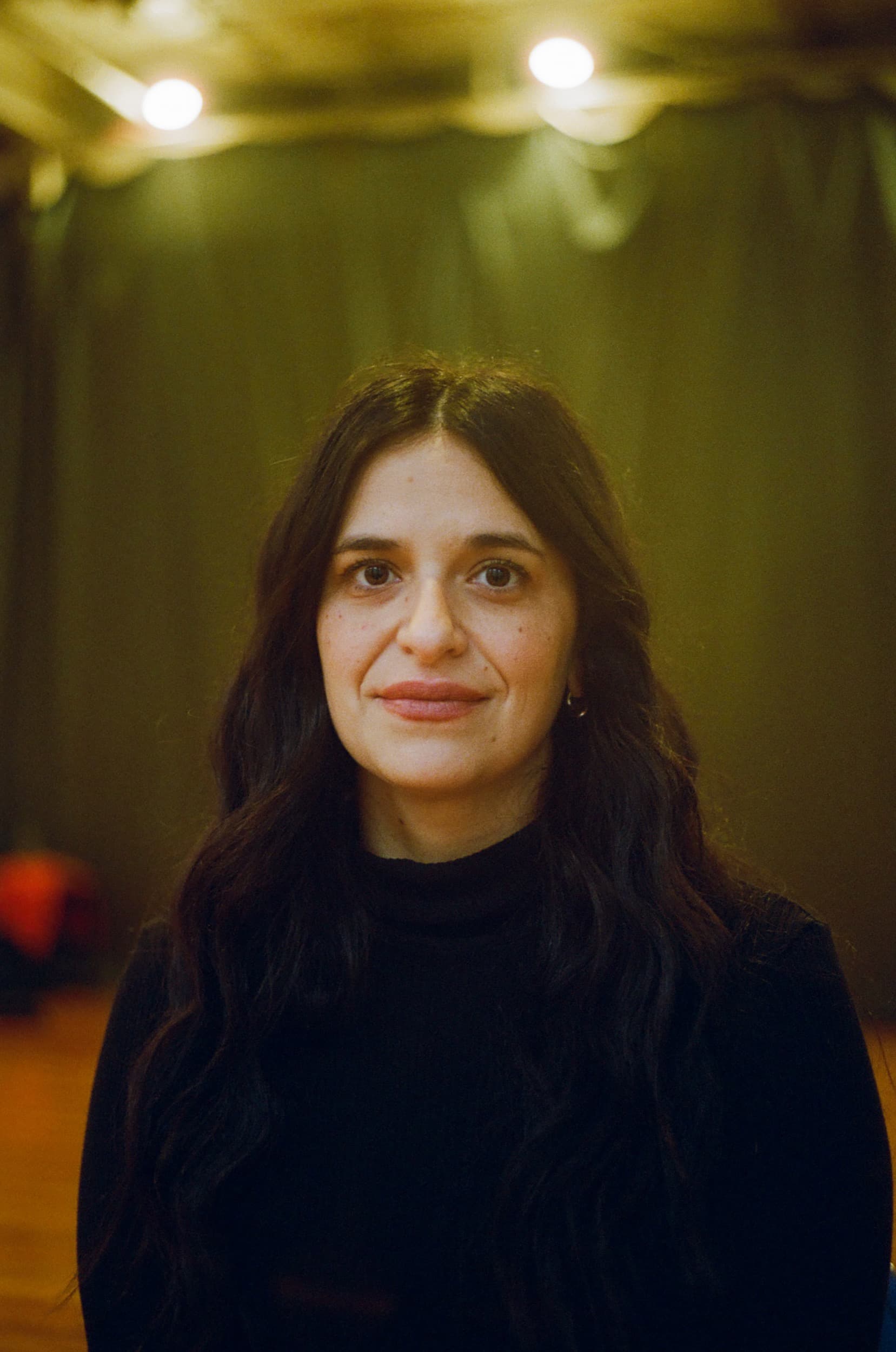
Michelle Uranowitz. Photo: Brennan Goldstein.
Word count: 1058
Paragraphs: 19
In a well-worn SoHo loft, the dancer and filmmaker Michelle Uranowitz has spent the last year-and-change building something special. Through her consistent yet casual movement classes, Uranowitz and her students (myself included) have formed a community to practice a little-known technique called Allan Wayne Work.
Named for its originator—a former principal dancer with the Metropolitan Opera Ballet—the work is grounded in a series of repetitive exercises that encourage both physical and psychic release in the body. The work has been shepherded into the present by a trio of committed teachers: Paul Langland, Brendan McCall, and Brenna Palughi. However, a new generation of practitioners, including Uranowitz and her mentor Julia Crockett, is taking the technique into uncharted territory. Creating an environment for artists of every stripe—but particularly actors—to nurture a physically-informed sense of self-exploration and risk-taking, her practice asks, what if you went a little bit deeper? Below is a condensed and edited version of our conversation.

Left to Right: Allison Zahigian, Gaela Solo, James Park, Michelle Uranowitz. Photo: Brennan Goldstein.
Patrick Denney (Rail): Do you remember your first exposure to Allan Wayne Work?
Michelle Uranowitz: I studied with Paul Langland. His whole thing was Allan Wayne Work and contact improv. What I learned from him was that I could feel strong, and I could feel messy at the same time. I love feeling strong and messy. Then I took some classes with Brenna Palughi at Triskelion Arts. It was a technical way of letting go, like a simple release, which I liked. And then the pandemic happened.
So, I started studying with Julia Crockett on Zoom. I remember feeling like this is the way I can do this when everything is shut down. You can just do it standing in your living room. The work that I had been teaching was all about contact. It’s like the tenet of acting—making contact, taking in—and this was the first time that I was learning something that was about contacting my muscles and my fascia. That’s a very different way of making contact I hadn’t experienced before.
Rail: We’re already dancing around it a little bit, but what are some of the principles at the heart of this work?
Uranowitz: I always go back to what Brenna taught me, which was this idea of water eroding a rock. We work with these repetitive movements as a way of exhausting our muscles. Showing up super exhausted is oftentimes the best class you’ll have because you are without filter, you’re without inhibition. You’re riding something so hard you can’t help but let go. I think that repetitive motion is the most helpful in finding a deeper kind of release. Julia always says it’s about getting to the bone of things. It’s about getting beneath the skin, beneath the fascia, beneath the muscle, and all the way down to the edge, and finding out what’s there. It’s a technique that really gets to the bone.
Rail: And the bone can be a scary place.
Uranowitz: The bone can be a really scary place. Bones can break. They’re hard and fragile, you know? I think that’s the thing that I experience in Allan Wayne Work. You can always go farther than you think you can, and then some. I think there’s something really amazing that happens when you find the edge of yourself and find the brink of something. It’s that surrender, and surrender can feel really good.
Rail: I think there’s no better example of this in Allan Wayne than the scalpel roll. Talk a bit about the scalpels and how they represent these principles?
Uranowitz: The things that I love and always return to in class are the scalpel rolls, the shoulder rolls, and the cervical spine rolls. I love the idea that it requires dead weight. So when you’re moving, you want to put as much weight on the muscle as possible, to make it work as hard as possible. With the scalpel rolls, we’re exercising the hips, so we’re working with the deadweight of the legs. When we’re exercising the shoulders, we’re working with the deadweight of our arms. Those are things we’re always using. So, to think of them as deadweight, it means that you’re accessing what’s beneath the everyday. There has been shit that’s been just sitting there and building. It’s forcing us to let go of all the parts around it so that we can listen to where it begins, you know?
Rail: I do.

Left to Right: Michelle Uranowitz, Allison Zahigian, Gaela Solo, Tali Papouchado (in the mirror), James Park. Photo: Brennan Goldstein.
Uranowitz: Not only is there stuff stored in there from yesterday, it’s there from ten years ago. We’re constantly having to clean out the septic tank so that everything can run properly, so that you also aren’t exhausting yourself. I think sometimes you have to have a place where you can do that, so that outside you can find more ease and openness and permission to actually do less, you know?
Rail: That balance between do less and do more, it’s something I always come back to in this work. If you’re in your head, just move a little bit faster.
Uranowitz: You may be in your head, and that’s all right. Let go of trying to get out of your head. Just be in your head and see what happens. We spend so much of our days resisting, rightly so. The world is a fucking scary place. So, I think this class is all about noticing what you are resisting, and maybe not even doing anything about it all, but just becoming aware of it. Better yet, like, what is it like to let go? Julia, she was like, “Imagine your hands are on a branch. What would happen if you let go?” I think that’s a really ripe place to exist. In the falling, in the letting go. Giving up can be a way of getting it.
I like to think about class as a place where rejects can go. Feeling rejected is important to me. Feeling at odds with what you’re doing is important to me. I want to create spaces where people feel comfortable being at odds with things in the world and themselves.
Rail: In a supported way.
Uranowitz: In a way that’s safe. In a way that can be dangerous for them, knowing that they’ll be okay and other people around them won’t be hurt either. I think danger is good. Risk is good.
Patrick Denney could always be writing more about live performance—and menswear. Examples of previous efforts can be found on Staff Picks, Culturebot, and his Substack, Party Hat Press.