TheaterFebruary 2026In Conversation
HERE’S CO-DIRECTORS with Joey Sims
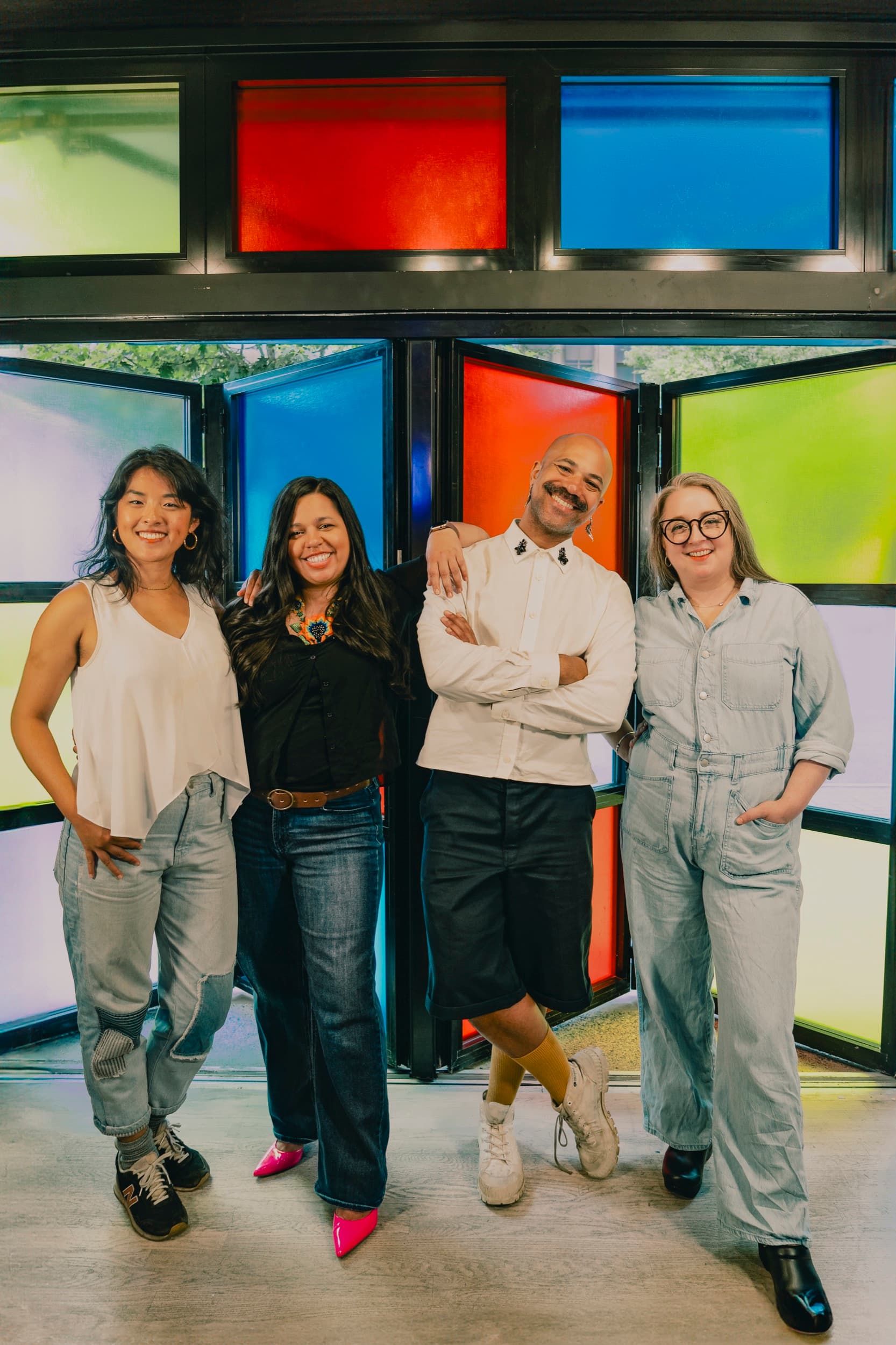
Lanxing Fu, Annalisa Dias, Jesse Alick, and Lauren Miller. Photo: Zayira Ray.
Word count: 1855
Paragraphs: 48
The future of risky multidisciplinary work is HERE. But for the theater’s new leadership, that future is far from a foregone conclusion.
Led for three decades by Kristin Marting (who founded the theater in 1993 alongside Tim Maner, Barbara Busackino, and Randy Rollison), HERE Arts Center has long been an essential off-off-Broadway hub of dance, puppetry, opera, and hybrid work, hosting V’s The Vagina Monologues, James Scruggs’s Disposable Men, and Young Jean Lee’s Songs of the Dragons Flying to Heaven, among countless weird and wild works.
Ask the theater’s new co-directors—who collectively took the reins in July 2024—to recall one show that captures the spirit of HERE, and you’ll get a range of answers as wonderfully eclectic as this quartet of creative minds.
Dramaturg, producer, and playwright Jesse Cameron Alick named The Lily’s Revenge by Taylor Mac, a five-hour extravaganza that took every nook and cranny of HERE’s two-theater SoHo home in 2009. Lauren Miller, a director and arts advocate with over a decade of fundraising experience, thought immediately of The Reception, a dance-theater piece staged by Sebastián Calderón Bentin and Sean Donovan in 2017. Lanxing Fu, a board member of the eco-theater troupe Future River, recalled Gelsey Bell’s mɔːnɪŋ (pronounced as morning/mourning), a millenia-spanning chamber opera imagining a world without humans (part of PROTOTYPE Festival in 2023). And while transdisciplinary artist Annalisa Dias came to HERE from Washington, DC and Baltimore, she always associated the theater with its boundary-pushing puppetry work, dreamt up in its Dream Music Puppetry Program (led by the singular Basil Twist).
The co-directors spoke with the Rail about collaborative decision making, budget woes, reassessing the HERE Artist Residency Program (HARP), and what it means to “make a splash.”

Machine Dazzle in Puppet Parlor 2025. Photo: Richard Termine.
Joey Sims (Rail): How did this shared leadership model first come into being?
Jesse Cameron Alick: HERE played matchmaker. The board decided they wanted a shared leadership model, and went out searching. And I applaud the board for realizing that for a theater that’s going to be interdisciplinary, you need more than one set of tastes to serve that identity.
Lanxing Fu: There was a post-offer, pre-acceptance phase where we were on the phone with each other quite a few times being like, “So… what’s your vision?”
Alick: I don’t think that any of us were naive to the challenges HERE was going to face. It was a moment where we all looked at each other and went “Are we doing this?” And I wouldn’t have done it without all of y’all.
Fu: Oh yeah, no. Insane job to have alone. You can quote me on that.
Lauren Miller: We all recognized that we were going to learn and discover how to do this together. And it’s really powerful to be at an organization where we’re trusted with that journey.
Rail: You weren’t selected to manage respective departments—to each have your own “lane,” so to speak—but rather to operate as a collective. In practice, has it been feasible to share responsibility in that way across every aspect of the organization?
Annalisa Dias: The intention is that everyone holds responsibility for everything. We are still in the process of figuring out how to operationalize that in an efficient way. But if we were all in our own “lanes,” we wouldn’t be having the big conversations we’re having now.
Miller: It’s not like you start fresh with everything. This season is the first one that we collectively curated. And still, we are both bringing in new relationships and following through on existing commitments to HARP artists. So the first year was us being like, “Now we carry this ball,” and this year we got to plan more. It takes three years to even get settled.
Alick: To pick up that metaphor, which I love to do—first year: carry the ball. Second year: what is the ball? Third year: shift the game completely. Both formally, in terms of the HARP research project, but also informally, in terms of: what happens if we play with this model?
Rail: On HARP specifically, you’re referencing the decision to temporarily pause applications and review that residency program. Why was that pause necessary?
Alick: The program was established in 1999, and the field has changed quite a lot. So we’re looking to analyze who HARP is serving and how we can serve them better. To figure that out, we’ve just completed interviews with about forty different HARP alumni.
Miller: I don’t believe we have any intention of the program going away, for the record. What we’re trying to do is have a deeply informed review process, so that when we evolve the program, it’s not just springing forth from our four brains but from the whole HERE community.
Rail: What kind of feedback have you been hearing from past and present HARP artists?
Fu: At the time of HARP’s inception, it was easier in the ecosystem for generative artists to “launch” their career with a single piece. That is now less true, because of the challenges we’re all collectively facing. There’s just a huge lack of sustainability and stability. The four of us are from that performing arts ecosystem, and we know, very viscerally, that it’s not working. It’s not working for artists, it’s not working for institutions. So, what is supportive now?
Rail: It seems that for this incoming generation of non-profit theatrical leaders, the inherited financial situation is rarely pretty. What was the financial health of HERE Arts Center when you guys came in?
[The four all laugh nervously.]
What realities did you immediately face, and how did you respond to them?
Fu: We were not facing a very rosy financial situation. HERE’s existence today and beyond is, like so many other theater organizations, not a foregone conclusion.
Miller: For HARP, there was a situation where the level of resources required to sustain the program in its current form had diminished. HARP depended on both institutional support from HERE and cobbling together various artist residencies and grants directed towards individuals and commissions. So, if you have a guarantee from MAP Fund, or the New England Foundation for the Arts (NEFA), and if you can point to a touring model, maybe you can amass the resources to do really ambitious work.
Rail: And MAP and NEFA are two programs that no longer provide as many or any grants for theatrical work.
Miller: With that part of the sector going away, it has been difficult. We also came into a situation where programs like the Shuttered Venue Operators Grant (SVOG) that HERE was able to benefit from—and many theaters weren’t—had been expended for us. There was support to get HERE through the moment of transition, but not a lot of cushion for actually enacting that transition. So we had to be very clever in looking at the budget.
Rail: What’s the long-term solution?
Miller: We’re in the quiet phase of a three-year campaign to raise ten million dollars in contributed income for change capital, along with some renovations to the space, so that we don’t have to depend on year-to-year philanthropy—given the limitations of how current philanthropy works. Hopefully, if the campaign is successful, we will be able to move with the same kind of inventiveness that you see on our stage.
Rail: You also shifted the model of HERE Hosts, formerly known as the SubletSeries, to bring in more self-producing companies and assist on those outside shows more closely.
Dias: We all know that the co-production is how many theaters are saving themselves. And HERE is a place where we can do a lot of different kinds of collaborative producing. Hopefully this collectivism that we experience as a shared leadership also finds its way into all the ways that we make things, too.
Alick: Now with HERE Hosts, even if there’s an exchange of money that looks like rent, we’re so much more deeply involved. We help produce ancillary activities, we help with marketing, we give them producing advice, and we document their work.
Rail: Some audience members might only know of HERE as the host venue for Colt Coeur, or EPIC Players, or other outside companies. Were you approaching that as a problem to fix?
Fu: If you’re walking through the doors of HERE for something you’re excited about, that’s an opportunity for us to form a relationship with you.
Alick: And lots of relationships are continuing. EPIC Players just did BUM BUM (or, this farce has Autism) in December. Experiments in Opera (EiO) and Colt Coeur are both in this season. National Queer Theater is new to us as of last season, but is continuing on this season. So it’s keeping the relationships and adding new ones, and deepening everything.

Eisa Davis in The Essentialisn’t. Photo: Daniel J. Vasquez.
Rail: You are taking a deliberate and considered approach as you reconsider all aspects of HERE, but I wonder if you’ve felt pressure along the way to announce yourselves in some way; to do some big, splashy show that tells the world, “this is who we are.”
Dias: I think we are telling the world! Maybe we’re not loud enough? We opened this season with Eisa Davis in The Essentialisn’t, and what a fucking amazing show that was. In terms of “splashy,” I mean, she literally opened that show by dunking herself into a tank of water. And that continues into the whole season. James Scruggs’s OFF THE RECORD: Acts of Restorative Justice is a play, but also an act of restorative justice. Everything we have put into this season is, to some extent, an announcement of: “Look at what we’re doing!”
Fu: Part of the “splash” is also what artists can expect from working at HERE. Every single team this season has left being like, “Wow, I have never been treated so well by a theater.”
Dias: Literally.
Fu: It’s a place you want to be, where you’ll be treated well, and loved. That’s huge to me.
Alick: We don’t have pressure at HERE to be like, “Sorry guys, we have to do this rock star musical so we can pay the bills.” Sorry to call out people—
Miller: [Laughs] Gee, Jesse, I wonder where you’re talking about—
Alick: In this day and age, any theater. But we don’t have that kind of pressure, so we can actually double down on our artistic relationships, and not break hearts. So this idea of a “splash,” God… I mean, I hear what you’re saying—
Rail: That word is going to haunt me—
Alick: No no, but I would definitely suggest that our impact is over time.
Miller: It will take a little bit longer to introduce ourselves and make that story legible, because it is so big. To really get context for all the things that HERE does, it does require you to become that repeat attender, because just one piece doesn’t sum up the totality of what we do.
Dias: Look, I wouldn’t wish artistic leadership in 2025 on anybody, because it’s so hard. And, I stand behind everything that we’re doing. Full stop. Which I’ve never, not once, been able to say at any other artistic organization I’ve worked at.
On January 27, HERE announced that Lauren Miller would be departing the organization to focus on political organizing. This interview occurred prior to that job switch.
Joey Sims has written at Vulture, Theatrely, American Theatre, Into, TheaterMania, Time Out, TDF Stages, Queerty, IGN and many more. Joey is an alumnus of the Eugene O’Neill Theater Center’s Critics Institute. He runs a theater substack called Transitions.