Hunters and Collectors
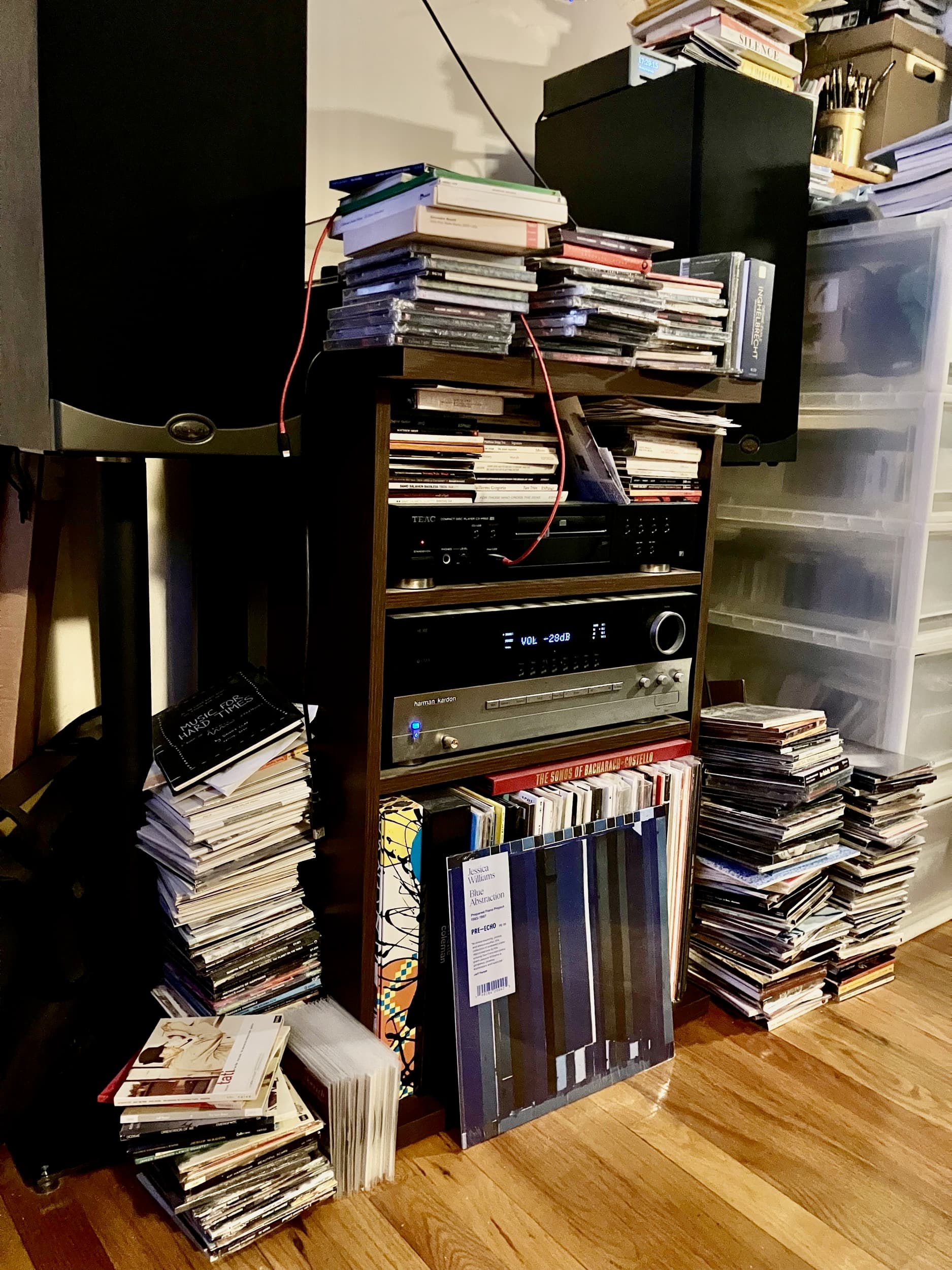
A stereo system surrounded by current listening. Photo: George Grella.
Word count: 1025
Paragraphs: 10
Spotify launched in the fall of 2008, has been available to American consumers since 2011, and seems like it’s always been around. That’s because it’s not an innovation so much as a fine-tuning and consolidation of the distribution of recorded music since the nineteenth century. We’ve had recorded music for over a century, and broadcast radio came soon after. One of the largest and most important cultural revolutions of the twentieth century was that if you wanted to hear music, you no longer had to go to a performance, play an instrument in your own home, or even go to a record store and buy something—you could just flip a switch and twist a couple knobs. Music was always flowing through the airwaves, you just had to tune in.
Spotify and the other streaming services are extensions of the radio experience. The end-user is the DJ, making a playlist or starting a personal “station” off of a single track or artist and letting the algorithm do the rest. There’s no innovation there, it’s fundamentally what commercial stations have been doing for decades by establishing a format and pre-programming digitally what goes out on the air (when a corporation owns multiple stations, this comes from the main office). Playlists are what people in my generation used to sequence onto cassettes in the Zeno-esque quest to put the best music in an order so perfect that it would not only never be tiresome to hear but might also attract mates through the power of our superior taste. Digitizing existing ideas and processes makes new platforms, not new ideas.
What is new, however, is the idea of who owns streaming music. Your subscription fee rents music that belongs to someone else, ostensibly the copyright holder, but in reality, as determined by where your money goes, whoever is the landlord. That business model is not so different from how the music business has operated since the beginning, which is the people who run the companies administratively take the biggest cut, the people who make the music these companies sell, or rent, the least. The consumer rents the experience and owns nothing.
Spotify is the focus of most attention to this because it was the first, and it’s the biggest (Digital Music News reported in August 2025 that as of May that year Spotify had 37 percent of the market, with around fifty-four million subscribers). That focus is valuable because Spotify is also the worst in terms of sound quality and the damage it does to society. It pays the least to musicians, meaning it steals the most value from artists. And if you pay for an account then you help pay Joe Rogan’s salary, you fund the 150,000 dollars the company donated to Donald Trump’s 2025 inauguration, and pay CEO Daniel Ek, who in turn is investing in an AI military startup. And if you have a free account, you get to listen to ICE recruitment ads. Enjoy!
This attention has led to several books, from the technical study Spotify Teardown by Maria Eriksson, Rasmus Fleischer, Anna Johansson, Pelle Snickars, and Patrick Vonderau (MIT Press, 2019); Eric Drott’s general Streaming Music, Streaming Capital (Duke University Press, 2024); the valorization of Ek in The Spotify Play by Sven Carlsson and Jonas Leijonhufvud (Diversion Books, 2021)—later turned into the Netflix series The Playlist—and Liz Pelly’s important 2025 book Mood Machine: The Rise of Spotify and the Cost of the Perfect Playlist (Atria/One Signal Publishers).
Pelly not only writes about how streaming works as a business, but what it means for music. Because the trick that streaming services play on people—and full disclosure, I use Tidal—is that while we care about the music, they really don’t. Yes, there is some curation and editorial guidance, and Apple Music, Tidal, and Qobuz are not terrible at this, but the fundamental business model and thus the design of these services is to have users who aren’t really paying attention. The algorithms that build stations, or suggest further listening, are designed to give more of the same, a purposeful aural numbing.
The further away the music is from the most common commercial denominator, the worse this is. Morgan Wallen was the top musical artist in 2025 per Billboard, and an “artist’s radio” on him in Tidal gives me Tyler Hubbard, Jelly Roll, Luke Combs, and several dozen other musically interchangeable, glossy, country artists. It’s as predictable as can be because it’s supposed to be. But every time I play through an opera album, what follows is Luciano Pavarotti singing “Che gelida manina” from La Bohème, no matter how inappropriate this is after, say, Lady Macbeth of Mtsensk. The algorithm recognizes the genre labels, but has no interest in mood, era, style, or anything else musical.
Streaming means hunting in an endless cycle of killing, consuming, and excreting. While the concept has room for valuing music and reducing the amount of sheer stuff, the practice is inseparable from human nature and capitalist economies. And not all stuff is created equal, there’s lots of it worth collecting. Collecting means valuing. Streaming isolates the end user through what the services decide they want; collecting means joining the company of others who are eager to help, from the Bandcamp Daily editorial pages (full disclosure: I contribute there as a freelance writer) to ClassicsToday.com’s chief David Hurwitz and his unexpectedly popular the Ultimate Classical Music Guide channel on YouTube. These are people who want to share their critical judgement with you so that you can discover music that doesn’t fit into any algorithm.
In between hunting and collecting is radio, which endures. Radio listening is unique, every record a shared experience. Radio connects. And if you use a streaming service, that means you can also connect to the many hundreds of radio stations that livestream through the web, or through apps like the wonderful Radio Garden where you can spin the globe, pick a dot on the map—Madagascar? The Gobi Desert?—and tune into live radio and a taste of the community around it. It’s not often you can buy things and build human connections, but only collect, my friends.
George Grella is the Rail's music editor. He is the author of Minimalist Music and Miles Davis' Bitches Brew (Bloomsbury).